Instruction meant to cultivate learners’ computational thinking skills has become increasingly available in recent years. But has the content become more accessible? This project explores one of the core issues with K-12 computational instruction today: while there may be ample, quality curriculum available, there is a significant deficit of technically-proficient educators to teach said curriculum. This project offers a framework for developing co-curricular, discovery-centered coursework in computational thinking—designed for students and educators with no prior computer science or programming experience, and facilitated by the Wolfram Language. This framework is paired with a set of online learning modules built directly from it, designed to supplement the AP Research course.
Background & Mission
Background & Mission
The New Digital Divide
The New Digital Divide
In the United States, we have been witnessing a significant rift in computational instruction—traditionally, computer science and programming coursework—that has prompted serious concerns of educational inequity. Discourse around this issue has mainly fallen into three main deficits: access to hardware, reliable internet connection, and proper educational software (Project Tomorrow, 2024). Computational instruction, at some level, requires computers. So, ensuring that students have access to internet-enabled devices is crucial. Fortunately, school districts like the New York City Department of Education are actively experimenting with large scale device intervention via the distribution of more than 300,000 internet-enabled Chromebooks to public K-12 students and working class families(New York City Office of The Mayor, 2025). Still, 53% of middle and high school students say slow or inconsistent internet connection is their greatest obstacle to using technology (Project Tomorrow, 2024). And at the point where students have access to both devices and network connection, they would still need access to grade-level coursework in computation.
Yet, an even larger, generational lag is holding back students’ emerging understanding of the computable world: there are simply not enough technically-proficient educators to meaningfully deliver this type of instruction. A 2025 report from the Computer Science Teacher Association (CSTA) underscores this point substantially: of the nearly three-thousand PK-12 Computer Science teachers polled from across the fifty states, only 42% are full-time CS teachers, 74% have only 0-1 CS colleagues at their school, and only 17% can participate in relevant professional development in their district (Twarek et al, 2025). Ultimately, the few teachers we do have that can offer computational instruction are isolated, underresourced, and spread thin.
If we had to educate our nation’s youth with only one or two history teachers per district, our children may never understand the social, economic, and political structures that govern our society today. If we had to educate our nation’s youth with only one or two English teachers per district, our children may never be able to fully access, understand, and communicate complex ideas. Like reading comprehension or cultural aptitude, we should expect better of ourselves as a society whose responsibility it is to educate our youth meaningfully and equitably, by prioritizing the acquisition of computational thinking skills in public K-12 education. With this, the computational educator is at the center of our new digital divide.
Yet, an even larger, generational lag is holding back students’ emerging understanding of the computable world: there are simply not enough technically-proficient educators to meaningfully deliver this type of instruction. A 2025 report from the Computer Science Teacher Association (CSTA) underscores this point substantially: of the nearly three-thousand PK-12 Computer Science teachers polled from across the fifty states, only 42% are full-time CS teachers, 74% have only 0-1 CS colleagues at their school, and only 17% can participate in relevant professional development in their district (Twarek et al, 2025). Ultimately, the few teachers we do have that can offer computational instruction are isolated, underresourced, and spread thin.
If we had to educate our nation’s youth with only one or two history teachers per district, our children may never understand the social, economic, and political structures that govern our society today. If we had to educate our nation’s youth with only one or two English teachers per district, our children may never be able to fully access, understand, and communicate complex ideas. Like reading comprehension or cultural aptitude, we should expect better of ourselves as a society whose responsibility it is to educate our youth meaningfully and equitably, by prioritizing the acquisition of computational thinking skills in public K-12 education. With this, the computational educator is at the center of our new digital divide.
The Challenge and Potential Solutions
The Challenge and Potential Solutions
The central challenge associated with the computational educator shortage is as follows: how can computational thinking skills be cultivated in learning environments where no party (student nor teacher) are technically proficient. Environments where students are more knowledgeable on a subject than the teacher in the room typically take the form of independent studies, or clubs. The opposite type of environment is standard, expected, and essential to education writ large. But seldom is the case where neither party is knowledgeable; even still, it is no more prevalent than in computer science and programming.
Potential solutions have ranged from greater investment in professional development in districts that can afford it, to asynchronous coursework that extracts the educator almost entirely. After a review of literature in the field of computational instruction, the following ideas warrant attention, based on their potential to inform more effective, feasible, and accessible solutions:
Potential solutions have ranged from greater investment in professional development in districts that can afford it, to asynchronous coursework that extracts the educator almost entirely. After a review of literature in the field of computational instruction, the following ideas warrant attention, based on their potential to inform more effective, feasible, and accessible solutions:
◼
Computer science curricula becomes more engaging when it is relevant: connecting the content to students’ current or recent coursework is a bridging-strategy that encourages co-curricular development.
◼
Ryder et al., (2020)
◼
Browser-based instruction can often circumvent technical difficulties, and lower the accessibility threshold.
◼
Wolf, D., Ebner, M. (2026)
◼
Expanding non-specialist teachers’ technical knowledge and abilities enhances their ability to support student learning; thereby increasing in-class engagement and knowledge retention.
◼
Wolf, D., Ebner, M. (2026)
◼
Computer science education should be viewed through the lens of experiential learning: although practiced widely in most other areas of the field (university-level especially), direct instruction should remain greatly limited in K-12 settings. Instead, curricula should be adapted so that students can interact with the technologies they are learning about, and “break things” along the way.
◼
Parker (2026)
After considering these most prominent factors, and others that have arisen in my own experience teaching, it seemed most apt to establish an curricular framework with the aforementioned qualities that affords non-technical educators both the freedom and guidance to bring computational thinking into their classrooms.
The Modular Computational Thinking Framework
The Modular Computational Thinking Framework
What is Computational Thinking
What is Computational Thinking
In his essay, How to Teach Computational Thinking, Stephen Wolfram describes computational thinking as being about “formulating things with enough clarity, and in a systematic enough way, that one can tell a computer how to do them.” In a way, it may be thought of as an act of translation which compels the speaker to structure their ideas in a way that may be universally understood. So as computation becomes increasingly more involved in science, culture, and our daily lives, so does the practical importance of computational thinking. Yet, even in a world without computers, the ability to communicate universally—past physical, cultural, social, linguistic and ideological barriers—would be no small commodity. Let us define a few key skills that will comprise computational thinking for the purposes of this framework:
◼
Breaking-down a problem into digestible parts
◼
Recognizing patterns
◼
Filtering out unnecessary information
◼
Prioritizing essential data
◼
Designing a set of steps or rules to approach a solution
Computational thinking consists of sets of skills we may use to approach complex problems in a concise, systematic, and reproducible way. These skills can be applied to make discoveries and do meaningful work in almost any discipline, with or without a computer. The Modular Computational Thinking Framework leverages this unique, defining quality for creating modules in a vast array of fields, for a diverse group of interests.
The Framework
The Framework
The Modular Computational Thinking Framework describes a process, guided by a set of foundational pillars, for developing instruction meant to cultivate computational thinking skills, specifically in contexts where neither learners nor educators bring prior technical expertise. Whether technically proficient, an educator, or simply willing to learn, anyone can use this framework to design instruction for this vital skill set, in whatever medium suits them.
Pillars of Modular Development
Pillars of Modular Development
The final product of the Modular Computational Thinking Framework is a module. A module is a brief, self-contained learning experience. The guidelines and considerations for developing a module through this framework are as follows:
◼
Choose an accessible, beginner-friendly format: If someone cannot access your module, it has no use to them. Wolfram notebooks accessible via the cloud are recommended.
◼
Keep it brief: A lesson should be paced to fit within roughly an hour of instruction. Always overestimate how long an activity will take to complete.
◼
Keep it self-contained: Modules should have only limited work to be done outside of the module itself. This includes prerequisite work outside of the primary document, and co-requisite content students would be expected to complete alongside or after completion of the actual module. Ideally, a student should be able to complete a module successfully without any external material.
◼
Have students break something: Productive struggle is an essential part of modern pedagogy. Students now are mostly aware of how technology looks when it works, not when it fails to. So providing perfectly visualized data and clean statistical results may not be as instructive as students being given the opportunity to manipulate a sample of code, receive an unexpected output, and solutionize with their peers or teacher on a better way forward.
◼
Prioritize discovery: For every module, in addition to practicing a computation skill(s), students and teachers alike should share in new discoveries. This can be facilitated in a number of ways, but at its core, a learner should be able to complete your module a few times, and be able to come to new conclusions or offer a different perspective with each iteration.
Process for Modular Development
Process for Modular Development
To develop a module, in accordance with pillars listed, follow the steps below in-order.
1
.Anchor Task: This framework takes a task-based approach, meaning every learning experience is grounded in a clear, actionable objective that is not inherently computational. These tasks are to be derived from established literature in any field, usually in the form of research questions. Once a task and primary document or artifact (research paper, article, exhibit, novel, visual media resource) have been identified, the developer can proceed to the next step.
2
.Computational Relevance: Are your anchor task and primary document related to computation in any way? Is data being collected, manipulated, analyzed, or visualized in any way that a computer could facilitate? Is there a concept of process that can be represented computationally? Once the connection between the anchor task/primary document and computation as a whole has been identified developers can begin to think about how to bridge the two.
3
.Computational Task: A computational task should be established to either extend or emulate the work of the anchor task. This will be the objective students will be expected to meet by the end of a module, with the anchoring material serving as the context or backdrop to said objective. This is where computational skills should be bridged, and communicated for instruction.
4
.Adaptation: A computational task may be too complex for students to work with directly. In this step, the developer will create clear, interactive code in Wolfram Language that students can recognize at least symbolically, if not comprehensively. As a rule-of-thumb: 100% of the code needing to be written should be written by the developer, but 5% should be extracted or hidden for students to engage with their own ideas and interests. For data analysis tasks, this will often take the form of having students be able to choose and input their own variables of interest from a dataset, along with what graphs or tests they would like to use in order to communicate their findings; still, the code for the graphs and tests should be nearly functional and executable from the start.
5
.Documentation: Although last, this step is crucial. One must remember that these modules are not simply made for students to learn from, but for educators to teach from. As such, every student module should have a teacher’s analog, which should include the following:
5
.1
.Lesson Overview
5
.2
.Standards-alignment
5
.3
.Learning targets
5
.4
.Required material
5
.5
.Criteria for success
Additional documentation should be developed (if not already covered in An Agile Guide to The Wolfram Language, which is the documentation file accompanying this framework) for functions, syntax, and background information that are important but not central to achieving the computational task. All supplemental information central to completion of a module should be included directly in the module.
By the end of this process, a single module should contain the following:
◼
A student-facing notebook containing the module’s contents
◼
A primary document/artifact
◼
A teacher-facing notebook with the same content but additional educational context
◼
An Agile Guide to The Wolfram Language
◼
Additional files or documentation as necessary
In the next section, we will examine a case study for how one could develop computational instruction by utilizing the Modular Computational Thinking Framework.
The AP Research Series
The AP Research Series
This framework comes equipped with three Computational Thinking (CT) modules, made using the process and pillars outlined in this essay, all co-curricular to the Advanced Placement, Research course for high school students.
Advanced Placement, Research
Advanced Placement, Research
AP Research is a year-long course created by the College Board which tasks students with investigating a topic of their choice by designing, planning, and implementing a study. The course culminates in the final assessment, which is a four to five-thousand word academic paper and a presentation with an oral defense. It is often taken after AP Seminar, a course with a similar design, and in a student’s junior or senior year of high school. Ideally, a student enrolled in AP Research would have taken an abundance of courses in varying disciplines like the natural sciences, humanities, and arts to be able to choose a research topic. While this may be the case, many students lack the statistical or computational experience in their K-12 education to complete a crucial component of the AP Research final assessment: data analysis. Students must not only study their topic, but reach results that are empirically based, and employ data that can be clearly communicated to a diverse audience.
Computational Thinking Modules strike at the heart of this issue, as they may often rely on research studies to ground instruction. In a typical AP Research class, these research studies would often be taught and examined regardless. CT Modules in the AP Research series comfortably position themselves between necessary exposure to academic literature, and supplemental skill-building in data analysis that students will have to be familiar with as they progress through the course. As the framework intends, educators who are subject-area specialists are enabled to teach the primary content of the course, while simultaneously supporting their students computationally, in ways they may not have been able to otherwise.
Computational Thinking Modules strike at the heart of this issue, as they may often rely on research studies to ground instruction. In a typical AP Research class, these research studies would often be taught and examined regardless. CT Modules in the AP Research series comfortably position themselves between necessary exposure to academic literature, and supplemental skill-building in data analysis that students will have to be familiar with as they progress through the course. As the framework intends, educators who are subject-area specialists are enabled to teach the primary content of the course, while simultaneously supporting their students computationally, in ways they may not have been able to otherwise.
The Computational Thinking Modules
The Computational Thinking Modules
Below is a brief showcase of the modules accompanying this framework.
Palmer Penguins (Biology)
Palmer Penguins (Biology)
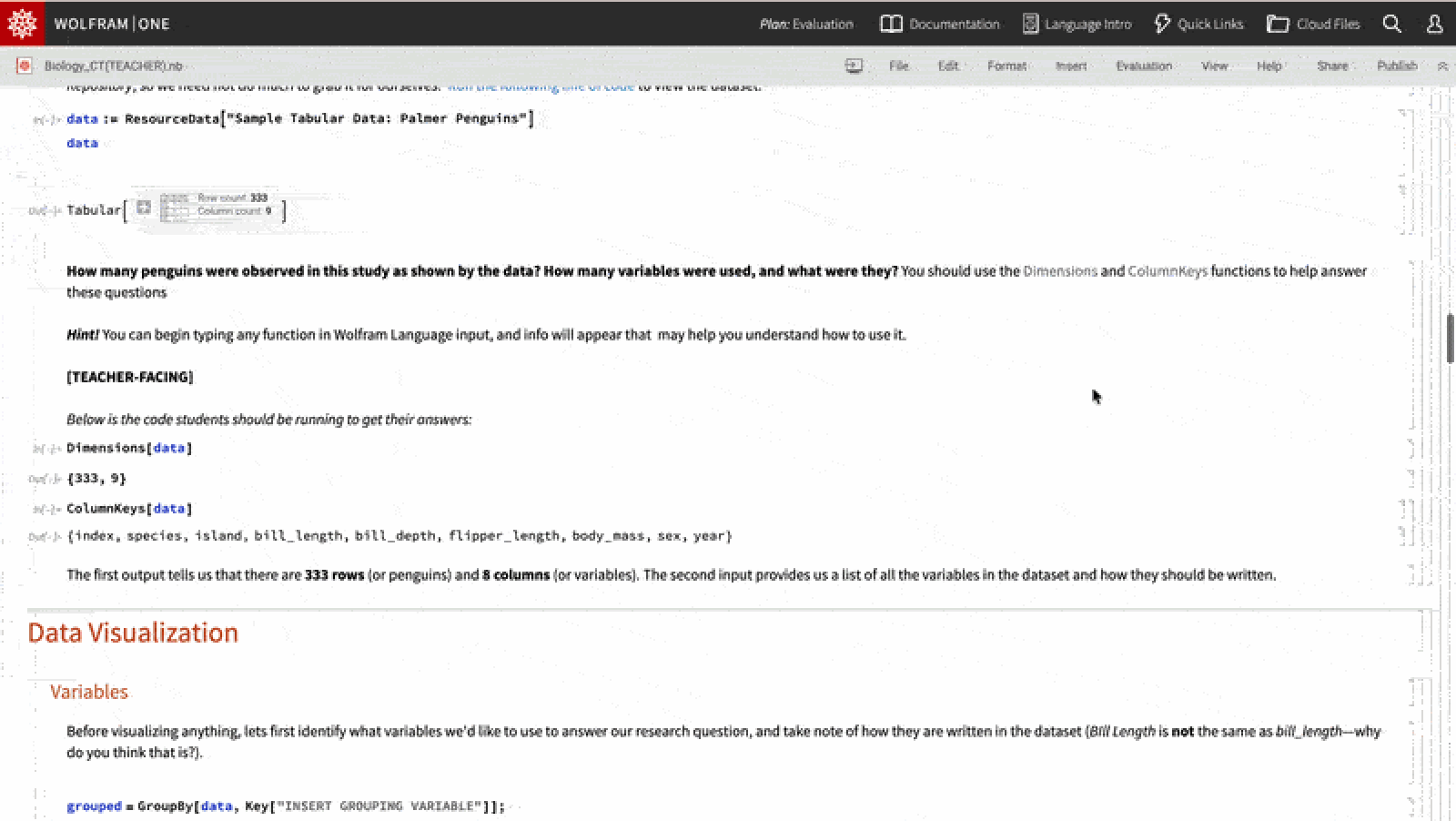
Students learn to apply computational thinking to biological data using the Palmer Penguins dataset. Aligned with the AP Research QUEST Framework, students practice generating aligned research questions, evaluating data types, analyzing data distributions, and interpreting empirical results through statistical modeling.
Emily and Lakisha (Social Science)
Emily and Lakisha (Social Science)
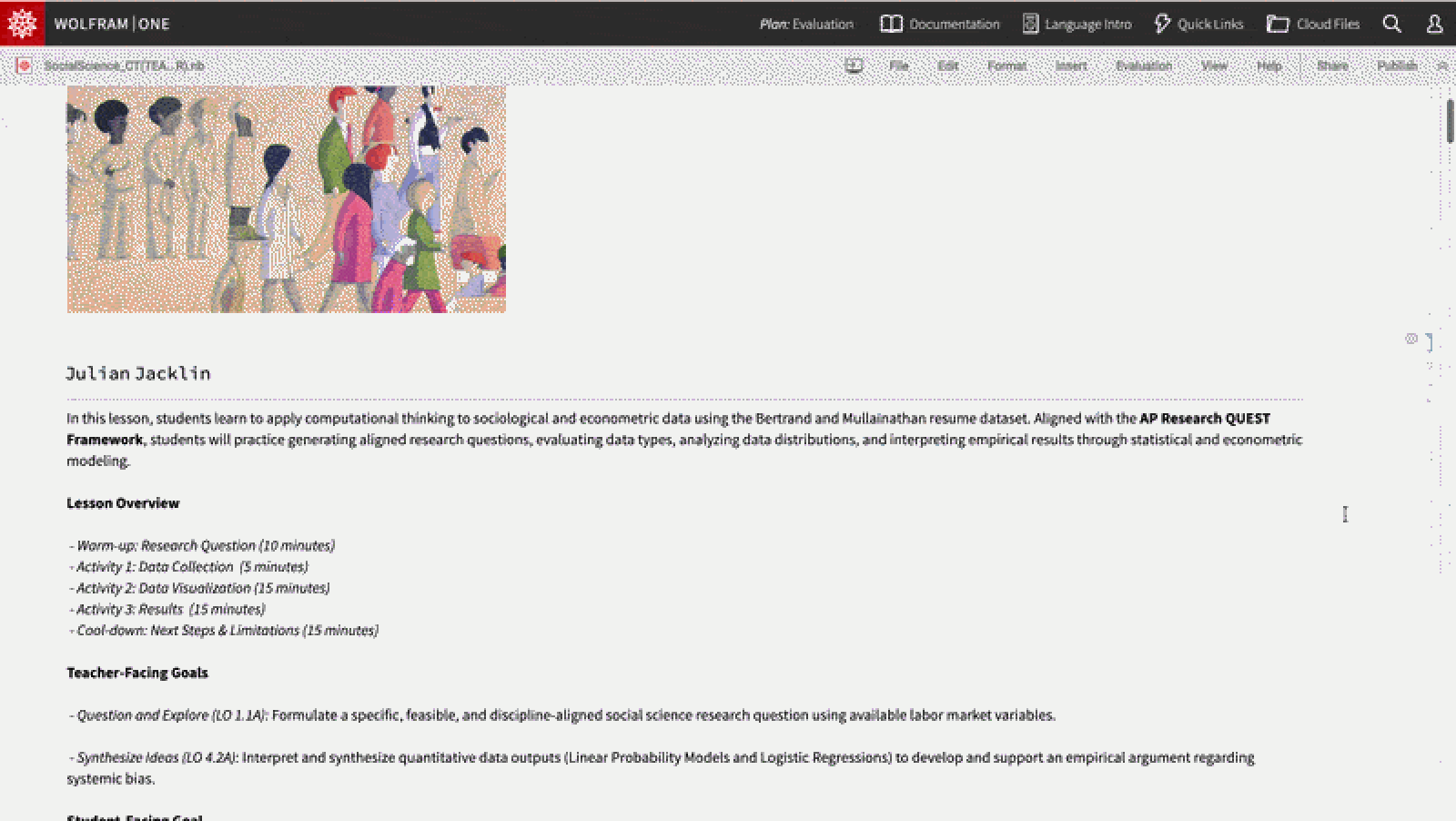
In this module, students learn to apply computational thinking to sociological and econometric data using the Bertrand and Mullainathan resume dataset. Aligned with the AP Research QUEST Framework, students will practice generating aligned research questions, evaluating data types, analyzing data distributions, and interpreting empirical results through statistical and econometric modeling.
Loudness in The Novel (Arts)
Loudness in The Novel (Arts)
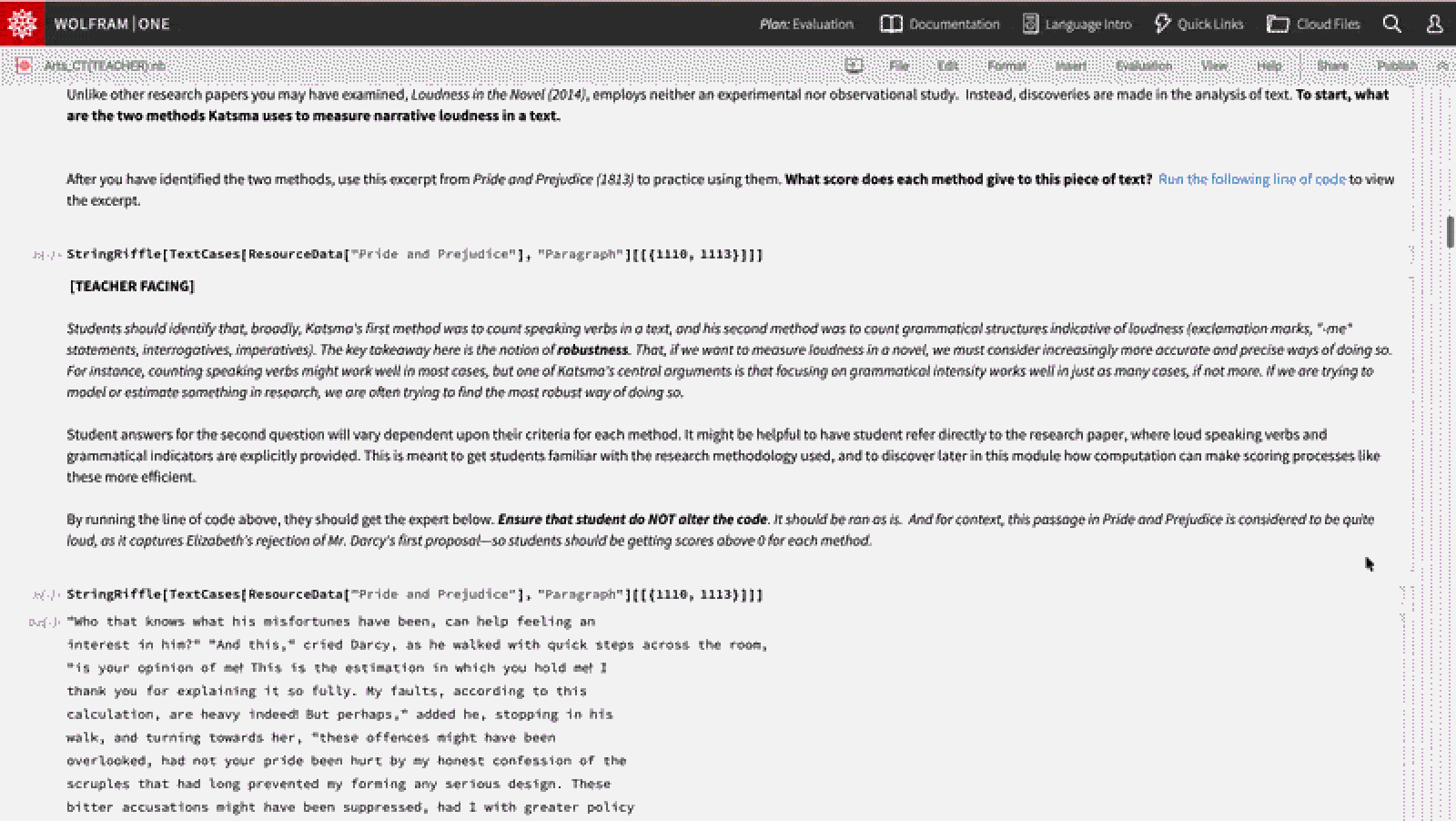
Students learn to apply computational thinking to digital humanities and literary data using computational literature pipelines. Aligned with the AP Research QUEST Framework, students will practice generating aligned research questions, evaluating data types, analyzing data distributions, and interpreting empirical results through text mining and narrative architecture modeling.
An Agile Guide to The Wolfram Language
An Agile Guide to The Wolfram Language
While not a standalone module, An Agile Guide to The Wolfram Language serves as the primary reference document for the Computational Thinking Modules, particularly those created for the AP Research series.
Further Development
Further Development
How Can I Develop My Own Modules?
How Can I Develop My Own Modules?
Is there a branch of science, humanities, or art that genuinely interests you? Is this something you wish you would have been introduced to in school? Does it relate to subjects already taught at the primary or secondary level? If not, does it exist at the undergraduate level, and can it be adapted? These are some of the questions that helped inspire the current series of CT modules. This framework offers a unique opportunity for educators and non-educators alike to not only expand but enrich opportunities for learning in nearly any field imaginable—all conveyed through a computational thinking mindset, and the Wolfram Language ecosystem. One could begin developing their own modules using the Modular Computational Thinking framework, by
◼
Considering topics that fit into a larger narrative. People—especially young people—love stories.
◼
Recounting a time you made a discovery or had a revelation in some discipline, no matter how small.
◼
Using the Wolfram Data Repository to search for datasets, documents, and other artifacts that could be part of a larger discussion (The Biology CT module, Palmer Penguins, was developed this way).
Still there are several ways to extend this project besides simply developing more modules in different areas. The creation of expert-led videos, integration of high-level code widgets (similar to Wolfram demonstrations), and contribution to a central module repository are all promising paths forward.
Concluding Remarks
Concluding Remarks
The Modular Computation Thinking Framework is an attempt to center not only computational instruction in K-12 education, but empower the computational educator to deliver knowledge and experiences that serve the whole student. The three modules previewed offer a blueprint for how this can be done in a feasible, effective, and accessible way.
Resources
Resources
Student Modules:
Teacher Modules:
Acknowledgments
Acknowledgments
I would like to thank my expert advisors, Amanda Palley, Brian Sulkow, and Zachary D’Amico for their pedagogical insights and wisdom. I would also like to thank the professional staff at All City Leadership Academy in Bushwick, Brooklyn, who helped secure sponsoring for this project from the New York Department of Education. These individuals include Principal Daphne Rivera, Asst. Principal Jessica Tancreto, Asst. Principal Michael Quiñones, Ruth Cordero, and Asst. Principal Tony O’Connor. And for their advise and mentorship, I would like to acknowledge Stephen Wolfram and Phileas Dazeley-Gaist, as well as my peers in the educational innovation track, David Sola Gil and Ukasha Hamza. Thank you to the entire Summer Wolfram Research Institute community for this experience and opportunity.
AI Disclosure
AI Disclosure
The following generative AI tools were used in this project: Claude Sonnet 5, Gemini 3.5 Flash. They were used for preliminary literature search and debugging code. All code and written content was reviewed, understood and approved by the author.
CITE THIS NOTEBOOK
CITE THIS NOTEBOOK
Modularizing K-12 Instruction in Computational Thinking
by Julian Jacklin
Wolfram Community, STAFF PICKS, July 16, 2026
https://community.wolfram.com/groups/-/m/t/3762192
by Julian Jacklin
Wolfram Community, STAFF PICKS, July 16, 2026
https://community.wolfram.com/groups/-/m/t/3762192