Quasicrystals live at the intersection of math and matter. In materials science they are solids with long-range order and no repeating unit cell, verified by sharp diffraction with “forbidden” symmetries like fivefold and icosahedral. In mathematics they are examples of aperiodic order, modeled by nonrepeating tilings that still follow precise rules.
The blueprint arrived first. Roger Penrose’s 1974 tilings showed how a pattern can be perfectly ordered yet never repeat. N. G. de Bruijn soon explained them with a higher-dimensional “cut-and-project” method, giving a toolkit later used for real atomic structures.
The laboratory shock came on 8 April 1982. Dan Shechtman recorded an electron-diffraction pattern from rapidly cooled aluminum-manganese that showed icosahedral order. The result appeared in 1984 and kicked off immediate global tests. In 2011 Shechtman received the Nobel Prize in Chemistry for the discovery.
Acceptance took work. Linus Pauling, a two-time Nobel laureate in Chemistry and Peace, argued that the patterns came from twinned periodic crystals, not a new kind of order, and he pressed the case in public. Years of careful synthesis, single-crystal studies, and theory resolved the debate. In 1991–1992 the International Union of Crystallography updated the definition of “crystal” to include aperiodic structures with discrete diffraction.
A practical turning point arrived in 1987, when A.-P. Tsai’s group reported a thermodynamically stable icosahedral phase in Al-Cu-Fe. Stable bulk samples enabled precise structure solutions, phason studies, and reliable property measurements.
Nature then weighed in. Between 2009 and 2011 researchers identified the first natural quasicrystal, icosahedrite, in fragments from the Khatyrka meteorite. In 2021 an icosahedral quasicrystal was found in red trinitite from the Trinity nuclear test, showing that shock conditions can also produce quasicrystals on Earth.
Famous names span this story. Shechtman’s observation anchors the field. Penrose’s tilings remain the canonical geometry, although his 2020 Nobel recognized black hole work, not tilings. Pauling’s high-profile skepticism shaped the early debate and forced stronger evidence.
Why it matters today. Quasicrystals can be hard, corrosion-resistant, and low in friction and thermal conductivity. They are explored for wear-resistant and non-stick coatings, tribological surfaces, thermoelectric and hydrogen-storage materials, and wave-guiding photonic and phononic devices.
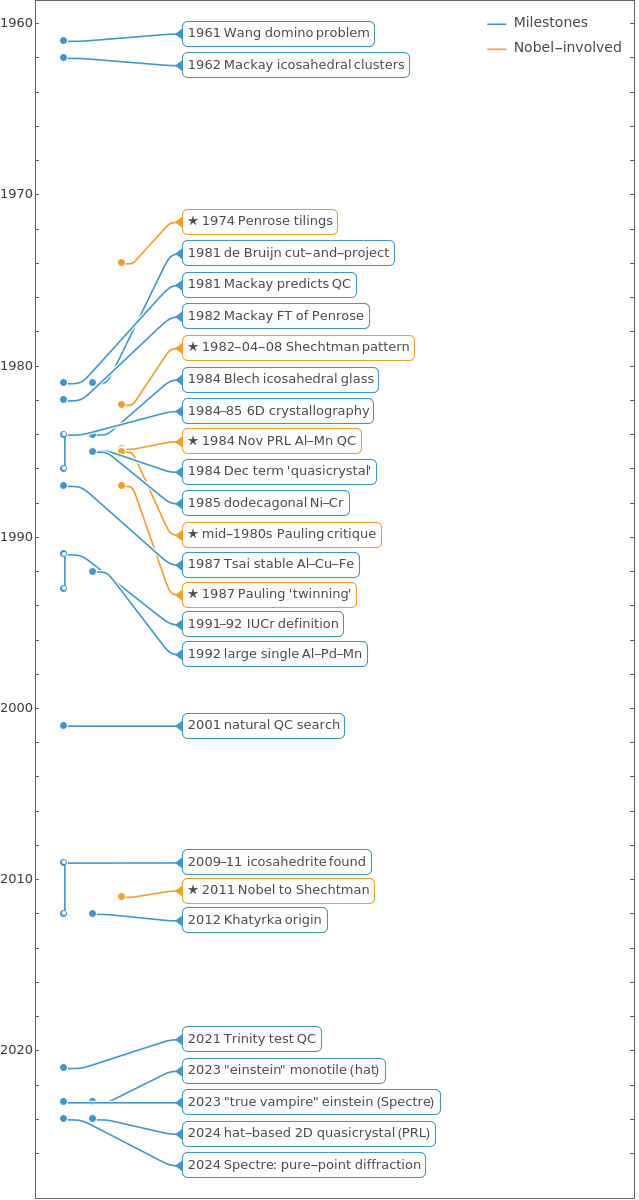
A detailed timeline helps connect the pieces. It shows how abstract tilings became atomic blueprints, how a surprising diffraction pattern became accepted physics, how nature and extreme conditions confirm formation pathways, and how modern applications build on those milestones.
The blueprint arrived first. Roger Penrose’s 1974 tilings showed how a pattern can be perfectly ordered yet never repeat. N. G. de Bruijn soon explained them with a higher-dimensional “cut-and-project” method, giving a toolkit later used for real atomic structures.
The laboratory shock came on 8 April 1982. Dan Shechtman recorded an electron-diffraction pattern from rapidly cooled aluminum-manganese that showed icosahedral order. The result appeared in 1984 and kicked off immediate global tests. In 2011 Shechtman received the Nobel Prize in Chemistry for the discovery.
Acceptance took work. Linus Pauling, a two-time Nobel laureate in Chemistry and Peace, argued that the patterns came from twinned periodic crystals, not a new kind of order, and he pressed the case in public. Years of careful synthesis, single-crystal studies, and theory resolved the debate. In 1991–1992 the International Union of Crystallography updated the definition of “crystal” to include aperiodic structures with discrete diffraction.
A practical turning point arrived in 1987, when A.-P. Tsai’s group reported a thermodynamically stable icosahedral phase in Al-Cu-Fe. Stable bulk samples enabled precise structure solutions, phason studies, and reliable property measurements.
Nature then weighed in. Between 2009 and 2011 researchers identified the first natural quasicrystal, icosahedrite, in fragments from the Khatyrka meteorite. In 2021 an icosahedral quasicrystal was found in red trinitite from the Trinity nuclear test, showing that shock conditions can also produce quasicrystals on Earth.
Famous names span this story. Shechtman’s observation anchors the field. Penrose’s tilings remain the canonical geometry, although his 2020 Nobel recognized black hole work, not tilings. Pauling’s high-profile skepticism shaped the early debate and forced stronger evidence.
Why it matters today. Quasicrystals can be hard, corrosion-resistant, and low in friction and thermal conductivity. They are explored for wear-resistant and non-stick coatings, tribological surfaces, thermoelectric and hydrogen-storage materials, and wave-guiding photonic and phononic devices.
A detailed timeline helps connect the pieces. It shows how abstract tilings became atomic blueprints, how a surprising diffraction pattern became accepted physics, how nature and extreme conditions confirm formation pathways, and how modern applications build on those milestones.
1
.c. 1197–1453 — Early Islamic works of art and architecture (e.g., Gunbad‑i Kabud tomb tower, Al‑Attarine Madrasa, and the Darb‑e Imam shrine) exhibit quasiperiodic girih tilings; at Darb‑e Imam (Isfahan, 1453) a girih‑tile subdivision rule yields perfect quasi‑crystalline decagonal patterns. (Science (Lu & Steinhardt, 2007))
2
.1961: Hao Wang formulates the domino problem using Wang tiles (squares with colored edges that must match), conjecturing that any finite set tiling the plane does so periodically; this proves undecidable and inspires the search for aperiodic tile sets, foundational to quasiperiodic structures. (Wikipedia)
3
.1962 — A. L. Mackay models dense icosahedral shell clusters, foreshadowing icosahedral order used later to interpret quasicrystal structures. (Wiley Online Library)
4
.1974 — Penrose discovers nonperiodic tilings with exact fivefold rotational order that later provide blueprints for quasicrystal order. (Department of Mathematics)
5
.1981 — N. G. de Bruijn shows Penrose tilings arise by “cut-and-project” from 5D lattices, establishing the higher-dimensional description used for quasicrystals. (Wikipedia)
6
.1981: Alan Mackay predicts quasicrystals via studies of fivefold symmetry, advancing theoretical recognition of quasiperiodic structures in materials. (ScienceDirect)
7
.8 Apr 1982 — Dan Shechtman observes icosahedral electron-diffraction from rapidly solidified Al-Mn; his lab notebook captures the date and ten-fold pattern note. (AIP) Correction (for B4): 1982: Dan Shechtman observes tenfold electron diffraction patterns in rapidly solidified Al-Mn alloys at the National Bureau of Standards (NBS; later NIST) on 8 April 1982. (Reason: agency name and date.) (NIST)
8
.1982: Mackay demonstrates that Penrose tilings produce sharp, fivefold-symmetric diffraction peaks via Fourier transforms, bridging theory to potential experimental observation. (ScienceDirect)
9
.Nov 1984 — Shechtman, Blech, Gratias, Cahn publish the first paper on an icosahedral metallic phase with long-range order but no translational periodicity (Al-Mn). (Physical Review) Correction (for B8): 1984: Shechtman, Blech, Gratias, Cahn publish their findings in Physical Review Letters 53, 1951–1953 (12 Nov 1984). (Reason: actual PRL date.) (Physical Review)
10
.Dec 1984 — Levine & Steinhardt formalize “quasicrystals,” classify allowed symmetries, and coin the term. (Physical Review)
11
.1984: Ilan Blech proposes a "multiple polyhedral" model (icosahedral glass) to explain Shechtman's patterns without periodicity, sparking debate on their nature. (ScienceDirect)
12
.1984–1985 — Higher-dimensional crystallography for icosahedral order (e.g., Kramer–Neri; Duneau–Katz) provides robust 6D projection models for 3D quasicrystals. (ScienceDirect)
13
.1985 — Early polygonal quasicrystals at surfaces/films: dodecagonal symmetry reported in Ni–Cr particles (a landmark non-icosahedral example).
14
.Mid-1980s — Linus Pauling leads a high-profile “twinning” critique of quasicrystals, including the famous quip “there are no quasicrystals, only quasi-scientists,” galvanizing careful experimental tests. (NIST)
15
.1987 — A.-P. Tsai et al. discover the first thermodynamically stable icosahedral quasicrystal (Al–Cu–Fe), enabling growth of high-quality bulk samples and precise structure studies. (paulsteinhardt.org)
16
.1987: Linus Pauling publishes critiques dismissing quasicrystals as "twins" of cubic crystals, labeling the field "quasi-science" and fueling opposition until his death in 1994. Linus Pauling (notable opposition). (NIST)
17
.1991–1992 — IUCr formally broadens the definition of “crystal” to “any solid having an essentially discrete diffraction diagram,” explicitly encompassing aperiodic crystals including quasicrystals.
18
.1992 — First large single quasicrystals (e.g., Al–Pd–Mn grown by Czochralski) enable detailed diffraction and phason-dynamics studies. (ScienceDirect)
19
.2001: Paul Steinhardt hypothesizes natural quasicrystals and calls for searches in mineral collections worldwide. (AIP)
20
.2009–2011 — First natural quasicrystal identified and named icosahedrite (Al${63} {24} _{13}$), from the Khatyrka meteorite; recognition and mineral approval in 2010–2011. (The Guardian)
Cu
Fe
21
.2011 — Nobel Prize in Chemistry awarded to Dan Shechtman “for the discovery of quasicrystals.” (NobelPrize.org)
22
.2012 — Petrographic and geochemical evidence establishes the extraterrestrial origin and shock-formation conditions of Khatyrka quasicrystals.
23
.2021 — A previously unknown icosahedral quasicrystal composition is found in Trinity test “red trinitite,” showing shock synthesis can produce quasicrystals on Earth. (ResearchGate)
24
.2023 — “einstein” (the hat) aperiodic monotile discovered; first single tile that forces nonrepeating tilings. https://arxiv.org/abs/2303.10798
25
.2023 — “true vampire” einstein (Spectre) shown: strictly chiral aperiodic monotile tiling without reflections. https://arxiv.org/abs/2305.17743
26
.2024 — Hat-based 2D quasicrystal predicted with graphene-like bands and chiral zero modes (PRL). https://doi.org/10.1103/PhysRevLett.132.086402
27
.2024 — Spectre tilings rigorously shown to have pure-point diffraction and 4:2 cut-and-project structure; long-range order proved. https://arxiv.org/abs/2411.15503
Data
Data
Code
Code
In[]:=
ClearAll["`*"];
In[]:=
(* assume `events` is unchanged *)rule[e_] := Tooltip[e["Date"], Pane[e["Full"], 520]] -> Style[e["Short"], FontFamily -> "Helvetica", FontSize -> 13];otherRules = rule /@ Select[events, ! TrueQ @ Lookup[#, "Nobel"] &];nobelRules = rule /@ Select[events, TrueQ @ Lookup[#, "Nobel"] &];TimelinePlot[ {otherRules, nobelRules}, PlotLayout -> "Vertical", Frame -> True, GridLines -> None, GridLinesStyle -> Directive[GrayLevel[.9]], BaseStyle -> Directive[13,FontFamily -> "Helvetica"], PlotLegends -> Placed[{"Milestones", "Nobel-involved"}, {Right, Top}], ImageSize -> 1200, AspectRatio->2, ImagePadding -> {{120, 120}, {40, 40}}]
Out[]=
CITE THIS NOTEBOOK
CITE THIS NOTEBOOK
Quasicrystal Timeline: Penrose tilings, peer ostracism, meteorites, 1st nuclear bomb, Nobel prize
by Vitaliy Kaurov
Wolfram Community, STAFF PICKS, September 16, 2025
https://community.wolfram.com/groups/-/m/t/3545989
by Vitaliy Kaurov
Wolfram Community, STAFF PICKS, September 16, 2025
https://community.wolfram.com/groups/-/m/t/3545989