The objective of this talk is getting you started with the main concepts of working with RelationalDatabases through the Entity framework in the Wolfram Language.
Outline
Outline
◼
Philosophy
◼
Classes of entities
◼
Inspection
◼
Querying
◼
Relations
◼
EmbeddedSQL and ExternalEvaluate
◼
Q&A
Philosophy
Philosophy
EntityValue[class,properties]
First argument: EntityClass (and related heads)
First argument: EntityClass (and related heads)
◼
Fully inert and symbolic
◼
Represents all the data
◼
Rows
Second argument: EntityProperty (usually plural)
Second argument: EntityProperty (usually plural)
◼
Projection
◼
Columns
Principles
Principles
◼
Resolution only happens when EntityValue is called
◼
EntityList considered dangerous (/s)
◼
1 EntityValue = 1 SQL query
Classes of entities
Classes of entities
EntityClass
EntityClass
Legacy, can do basic filtering and sorting
FilteredEntityClass
FilteredEntityClass
Full-fledged filtering (WHERE)
ExtendedEntityClass
ExtendedEntityClass
Annotations, renamings
SampledEntityClass
SampledEntityClass
Roughly follows the Take syntax (LIMIT, OFFSET)
SortedEntityClass
SortedEntityClass
Like SortBy (ORDER BY)
AggregatedEntityClass
AggregatedEntityClass
2-ary version performs aggregations, 3-argument version groups and aggregates (GROUP BY)
CombinedEntityClass
CombinedEntityClass
Similar to JoinAcross, but supports more complex statements (JOIN)
UnionedEntityClass
UnionedEntityClass
Most complex set operation, supports SameTestProperties (UNION, UNION ALL, DISTINCT ON)
IntersectedEntityClass
IntersectedEntityClass
Also supports SameTestProperties (INTERSECT)
ComplementedEntityClass
ComplementedEntityClass
Also supports SameTestProperties (EXCEPT)
Classes of entities (cont.d)
Classes of entities (cont.d)
◼
Like Lego: each class of entities is takes one (or more) classes of entities as arguments
◼
Completely inert and symbolic
◼
You can reason about their EntityProperties without executing
Inspection
Inspection
In[]:=
schema=RelationalDatabase[FindFile["ExampleData/ecommerce-database.sqlite"]]
Out[]=
RelationalDatabase


Top-level properties
Top-level properties
In[]:=
schema["Properties"]
Out[]=
{Tables,Connection}
In[]:=
schema["Tables"]
Out[]=
{productlines,payments,offices,products,orderdetails,employees,orders,customers}
Table-level properties
Table-level properties
In[]:=
schema["orders","Properties"]
Out[]=
{Columns,ForeignKeys,Name,PrimaryKey,UniquenessConstraints,Indexes}
In[]:=
schema["orders","Columns"]
Out[]=
{orderNumber,orderDate,requiredDate,shippedDate,status,comments,customerNumber}
Column-level properties
Column-level properties
In[]:=
schema["orders","orderNumber","Properties"]
Out[]=
{NativeTypeString,Default,Indexed,Name,Nullable}
In[]:=
schema["orders","orderNumber","NativeTypeString"]
Out[]=
INTEGER
Inspection: EntityStore
Inspection: EntityStore
In[]:=
store=EntityStore[schema]
Out[]=
◼
Bold properties are primary keys ⇒ CanonicalName
◼
Underlined properties are relations ⇒ Entity- or EntityClass-valued properties
◼
→ means one-to-one (outgoing foreign key)
◼
← means one-to-many (incoming foreign key)
In[]:=
EntityRegister[store]
Out[]=
{productlines,payments,offices,products,orderdetails,employees,orders,customers}
Querying
Querying
In[]:=
EntityValue["offices","officeCode"]
Out[]=
{1,2,3,4,5,6,7}
In[]:=
EntityValue["offices",{"city","country"},"PropertyAssociation"]
Out[]=
{citySan Francisco,countryUSA,cityBoston,countryUSA,cityNYC,countryUSA,cityParis,countryFrance,cityTokyo,countryJapan,citySydney,countryAustralia,cityLondon,countryUK}
In[]:=
EntityValue[FilteredEntityClass["offices",EntityFunction[x,x["country"]"USA"]],"city"]
Out[]=
{San Francisco,Boston,NYC}
In[]:=
EntityValue["offices",{"state",EntityFunction[o,MissingQ[o["state"]]]}]
Out[]=
{{CA,False},{MA,False},{NY,False},{Missing[NotAvailable],True},{Chiyoda-Ku,False},{Missing[NotAvailable],True},{Missing[NotAvailable],True}}
Querying (composition)
Querying (composition)
Count how many customers per city and country we have
In[]:=
aggr=AggregatedEntityClass["customers","customerCount"EntityFunction[c,Length[c["customerNumber"]]],{"city","country"}];
In[]:=
EntityValue[aggr,"PropertyAssociation"]
Well, this is unsorted, let’s sort it:
In[]:=
sort=SortedEntityClass[aggr,"customerCount""Descending"];
In[]:=
EntityValue[sort,"PropertyAssociation"]
Out[]//Shallow=
5,EntityProperty[customers,city]Madrid,EntityProperty[customers,country]Spain,5,EntityProperty[customers,city]NYC,EntityProperty[customers,country]USA,3,EntityProperty[customers,city]Brickhaven,EntityProperty[customers,country]USA,3,EntityProperty[customers,city]Paris,EntityProperty[customers,country]France,3,EntityProperty[customers,city]Singapore,EntityProperty[customers,country]Singapore,2,EntityProperty[customers,city]Auckland ,EntityProperty[customers,country]New Zealand,2,EntityProperty[customers,city]Boston,EntityProperty[customers,country]USA,2,EntityProperty[customers,city]Cambridge,EntityProperty[customers,country]USA,2,EntityProperty[customers,city]Frankfurt,EntityProperty[customers,country]Germany,2,EntityProperty[customers,city]Glendale,EntityProperty[customers,country]USA,86
Querying (what happens under the hood?)
Querying (what happens under the hood?)
In[]:=
Databases`Database`$DBQueryLogger=Echo;
In[]:=
EntityValue["offices",{"state",EntityFunction[o,MissingQ[o["state"]]]}]
»
SELECT "offices_T20".state AS state, ("offices_T20".state IS NULL) AS synthetic_prop_1 FROM offices AS "offices_T20"
Out[]=
{{CA,False},{MA,False},{NY,False},{Missing[NotAvailable],True},{Chiyoda-Ku,False},{Missing[NotAvailable],True},{Missing[NotAvailable],True}}
Who is making orders on Sundays?
In[]:=
EntityValue[FilteredEntityClass["orders",EntityFunction[o,DateValue[FromUnixTime[o["orderDate"]],"DayName"]==="Sunday"]],EntityFunction[o,o["customers"]["customerName"]]]
»
SELECT (SELECT "customers_T67"."customerName" AS "customerName" FROM customers AS "customers_T67" WHERE "customers_T67"."customerNumber" = "orders_T64"."customerNumber") AS synthetic_prop_7 FROM orders AS "orders_T64" WHERE CASE WHEN (0.0 + "orders_T64"."orderDate" IS NULL) THEN NULL WHEN ((CAST(strftime('%w', 0.0 + "orders_T64"."orderDate", 'unixepoch') AS INTEGER) + 6) % 7 + 1 = 1) THEN 'Monday' WHEN ((CAST(strftime('%w', 0.0 + "orders_T64"."orderDate", 'unixepoch') AS INTEGER) + 6) % 7 + 1 = 2) THEN 'Tuesday' WHEN ((CAST(strftime('%w', 0.0 + "orders_T64"."orderDate", 'unixepoch') AS INTEGER) + 6) % 7 + 1 = 3) THEN 'Wednesday' WHEN ((CAST(strftime('%w', 0.0 + "orders_T64"."orderDate", 'unixepoch') AS INTEGER) + 6) % 7 + 1 = 4) THEN 'Thursday' WHEN ((CAST(strftime('%w', 0.0 + "orders_T64"."orderDate", 'unixepoch') AS INTEGER) + 6) % 7 + 1 = 5) THEN 'Friday' WHEN ((CAST(strftime('%w', 0.0 + "orders_T64"."orderDate", 'unixepoch') AS INTEGER) + 6) % 7 + 1 = 6) THEN 'Saturday' WHEN ((CAST(strftime('%w', 0.0 + "orders_T64"."orderDate", 'unixepoch') AS INTEGER) + 6) % 7 + 1 = 7) THEN 'Sunday' ELSE NULL END = 'Sunday'
Out[]=
{Mini Creations Ltd.,Oulu Toy Supplies, Inc.,Euro+ Shopping Channel,Vida Sport, Ltd,Norway Gifts By Mail, Co.,Classic Legends Inc.,Mini Gifts Distributors Ltd.,Tekni Collectables Inc.,Québec Home Shopping Network,Souveniers And Things Co.,Mini Gifts Distributors Ltd.}
In[]:=
Databases`Database`$DBQueryLogger=.
Relations
Relations
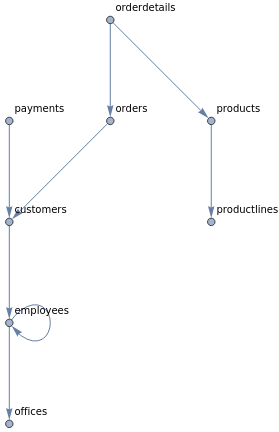
What’s the overall structure of the database?
In[]:=
Graph[Join@@(Thread[#schema[#,"ForeignKeys","ToTable"]]&/@schema["Tables"]),VertexLabels"Name"]
Out[]=
In[]:=
EntityStores[][[1]]
Out[]=
Here is a naked column:
In[]:=
EntityValue["employees","officeCode"]
Out[]=
{1,1,1,6,4,1,1,1,2,2,3,3,4,4,4,7,7,6,6,6,5,5,4}
Here is the same column expressed as an Entity:
In[]:=
EntityValue["employees","offices"]
Out[]=
,,,,,,,,,,,,,,,,,,,,,,
And the reverse relation:
In[]:=
EntityValue["offices","employees"]
Out[]=
{EntityClass[employees,{officeCode1}],EntityClass[employees,{officeCode2}],EntityClass[employees,{officeCode3}],EntityClass[employees,{officeCode4}],EntityClass[employees,{officeCode5}],EntityClass[employees,{officeCode6}],EntityClass[employees,{officeCode7}]}
A more complicated example:
In[]:=
EntityFunction[c,c["employees"]["firstName"]<>" "<>c["employees"]["lastName"]<>" is the sales representative for "<>c["customerName"]<>". Their manager is "<>c["employees"]["employees-reportsTo"]["firstName"]<>" "<>c["employees"]["employees-reportsTo"]["lastName"]][Entity["customers",103]]
Out[]=
Gerard Hernandez is the sales representative for Atelier graphique. Their manager is Gerard Bondur
Databases`Database`$DBQueryLogger=Echo;
The same thing without relations
CombinedEntityClass[CombinedEntityClass["customers","employees","salesRepEmployeeNumber"->"employeeNumber"],"manager"->"employees",{"reportsTo"->"employeeNumber"}][EntityFunction[c,c[EntityProperty["employees","firstName"]]<>" "<>c[EntityProperty["employees","lastName"]]<>" is the sales representative for "<>c["customerName"]<>". Their manager is "<>c[EntityProperty["manager"->"employees","firstName"]]<>" "<>c[EntityProperty["manager"->"employees","lastName"]]]]//First
Aggregation-less aggregations
In[]:=
EntityFunction[o,Total[o["orderdetails"]["priceEach"]*o["orderdetails"]["quantityOrdered"]]][Entity["orders",10100]]
Out[]=
10223.8
EmbeddedSQL and ExternalEvaluate
EmbeddedSQL and ExternalEvaluate
Useful for things we don’t or can’t support
In[]:=
EntityValue[Entity["offices","1"],EntityFunction[x,EmbeddedSQLExpression["date('now','start of year','+6 months','weekday 0')"]]]
Out[]=
2023-07-02
Supports binding things from the outer query
In[]:=
EntityValue["offices",{EntityFunction[x,EmbeddedSQLExpression["glob('U*',``)",{x["country"]}]],"country"}]
Out[]=
{{1,USA},{1,USA},{1,USA},{0,France},{0,Japan},{0,Australia},{1,UK}}
What if I want to have query-level EmbeddedSQL?
In[]:=
EmbeddedSQLEntityClass["WITH RECURSIVE fact_i (n, fct) AS ( VALUES (0, 1) UNION ALL SELECT n+1, fct * (n+1) FROM fact_i WHERE n < 10)SELECT * FROM fact_i",{"n","fct"}]//EntityProperties
Out[]=
{EntityProperty[EmbeddedSQLEntityClass[WITH RECURSIVE fact_i (n, fct) AS ( VALUES (0, 1) UNION ALL SELECT n+1, fct * (n+1) FROM fact_i WHERE n < 10)SELECT * FROM fact_i,{n,fct}],n],EntityProperty[EmbeddedSQLEntityClass[WITH RECURSIVE fact_i (n, fct) AS ( VALUES (0, 1) UNION ALL SELECT n+1, fct * (n+1) FROM fact_i WHERE n < 10)SELECT * FROM fact_i,{n,fct}],fct]}
Really arbitrary stuff:
In[]:=
ExternalEvaluate[DatabaseReference["sqlite://"],{"CREATE TABLE developers (name TEXT NON NULL, awesome INTEGER)","INSERT INTO developers (name, awesome) VALUES (\"carlo barbieri\", 1), (\"donald knuth\", 0)","SELECT name FROM developers where awesome"}]
Out[]=
Null,Null,
CITE THIS NOTEBOOK
CITE THIS NOTEBOOK
Wolfram R&D LIVE: Relational Databases in the Wolfram Language
by Carlo Barbieri
Wolfram Community, STAFF PICKS, April 25 2023
https://community.wolfram.com/groups/-/m/t/2907390
by Carlo Barbieri
Wolfram Community, STAFF PICKS, April 25 2023
https://community.wolfram.com/groups/-/m/t/2907390