ABSTRACT (original article): The spinning electron-electron interaction is described in classical terms by means of two possible classical interactions: The instantaneous Coulomb interaction between the charge centers of both particles and the Poincaré invariant interaction developed in a previous work. The numerical integrations are performed with several Mathematica notebooks that are available for the interested readers in the reference Section. One difference of these interactions is that the Poincaré invariant interaction does not satisfy the action-reaction principle in the synchronous description and, therefore, there is no conservation of the mechanical linear momentum. It is the total linear momentum of the system what is conserved.
In this synchronous description the interaction is not mediated by the retarded fields but is described in terms of the instantaneous positions, velocities and accelerations of the center of charge of both particles. In the Poincaré invariant description the net binding force that holds linked two Dirac particles is stronger than in the Coulomb case, thus forming a stable spin 1 system of 2 Dirac particles. This bosonic state of spin 1 does not correspond to a Cooper pair because the separation between the centers of mass of the Dirac particles is below Compton’s wavelength, smaller than the correlation distance of the Cooper pair. Since the Poincaré invariant interaction is relativistically invariant it can be used for analyzing high energy scattering processes. CITATION (original article): Juan Barandiaran, Martin Rivas (2025), Poincare invariant interaction between two Dirac particles, arXiv:2501.10445. https://doi.org/10.48550/arXiv.2501.10445
In this synchronous description the interaction is not mediated by the retarded fields but is described in terms of the instantaneous positions, velocities and accelerations of the center of charge of both particles. In the Poincaré invariant description the net binding force that holds linked two Dirac particles is stronger than in the Coulomb case, thus forming a stable spin 1 system of 2 Dirac particles. This bosonic state of spin 1 does not correspond to a Cooper pair because the separation between the centers of mass of the Dirac particles is below Compton’s wavelength, smaller than the correlation distance of the Cooper pair. Since the Poincaré invariant interaction is relativistically invariant it can be used for analyzing high energy scattering processes. CITATION (original article): Juan Barandiaran, Martin Rivas (2025), Poincare invariant interaction between two Dirac particles, arXiv:2501.10445. https://doi.org/10.48550/arXiv.2501.10445
Introduction
Introduction
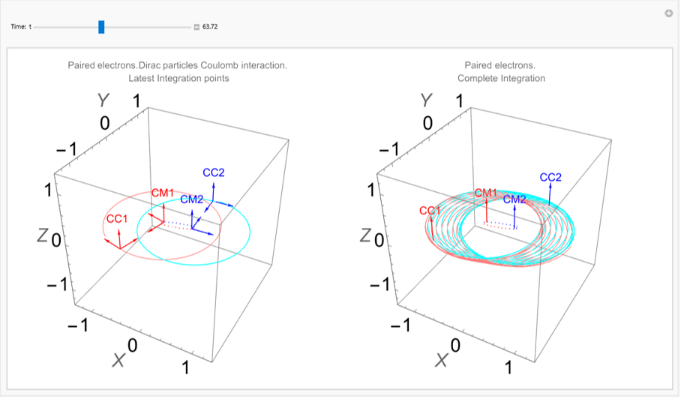
Electrons (or any elementary particle with spin 1/2) can be modeled by a center of charge point (CC) spinning around a center of mass point (CM), thus allowing to analyze interactions between spinning particles. Full lines describe the location of the CC's while dotted lines the CM's. Center of mass spins are depicted at some CM points.
This Demonstration computes the instantaneous Coulomb interaction between two Dirac particles thrown into each other from different positions at different speeds and initial spin orientations.
It is analyzed in the Center of mass at the Laboratory observer.
The velocity of the CM of the interacting particles is almost constant before and after the interaction region of order of few Compton's wavelength.
It is analyzed in the Center of mass at the Laboratory observer.
The velocity of the CM of the interacting particles is almost constant before and after the interaction region of order of few Compton's wavelength.
Many real-life results can be modeled: sharp angle scattering, forward scattering, paired electrons as boson condensates (negative charges with parallel spins, attracting each other and forming a stable bound state of spin 1).
Initialization Code
Initialization Code
Dynamical equations
Dynamical equations
Initial Conditions
Initial Conditions
Solve the dynamical equations
Solve the dynamical equations
Definition of the Plot 3D functions
Definition of the Plot 3D functions
Demonstration
Demonstration
In[]:=
regla=diffEqSolution[0,0,0,0.001,90*Degree,180*Degree,0,0.3,0.05,0,0,0,120*Degree,140];
In[]:=
cola=6;
In[]:=
resultado=ManipulateModule[{qq1x=First[q1x[time]/.regla],qq1y=First[q1y[time]/.regla],qq1z=First[q1z[time]/.regla],qq2x=First[q2x[time]/.regla],qq2y=First[q2y[time]/.regla],qq2z=First[q2z[time]/.regla],rr1x=First[r1x[time]/.regla],rr1y=First[r1y[time]/.regla],rr1z=First[r1z[time]/.regla],rr2x=First[r2x[time]/.regla],rr2y=First[r2y[time]/.regla],rr2z=First[r2z[time]/.regla],uu1x=First[u1x[time]/.regla],uu1y=First[u1y[time]/.regla],uu1z=First[u1z[time]/.regla],uu2x=First[u2x[time]/.regla],uu2y=First[u2y[time]/.regla],uu2z=First[u2z[time]/.regla]},Grid[{{Show[plot3DCC1[True,regla,time-cola,time],plot3DCC2[True,regla,time-cola,time],plot3DCM1[True,regla,0,time],plot3DCM2[True,regla,0,time],plotText["CM1",Red,qq1x,qq1y,0.6+qq1z],plotText["CM2",Blue,qq2x,qq2y,0.6+qq2z],plotText["CC1",Red,rr1x,rr1y,0.6+rr1z],plotText["CC2",Blue,rr2x,rr2y,0.6+rr2z],(*plotArrow[Red,qq1x,qq1y,qq1z,qq1x,qq1y,0.4+qq1z],plotArrow[Blue,qq2x,qq2y,qq2z,qq2x,qq2y,0.4+qq2z],plotArrow[Red,rr1x,rr1y,rr1z,rr1x,rr1y,0.4+rr1z],plotArrow[Blue,rr2x,rr2y,rr2z,rr2x,rr2y,0.4+rr2z],*)plotAxis[Red,qq1x,qq1y,qq1z,qq1x,qq1y,0.4+qq1z,qq1x+0.4*-(qq1x-rr1x)/Norm[{qq1x-rr1x,qq1y-rr1y,qq1z-rr1z}],qq1y+0.4*-(qq1y-rr1y)/Norm[{qq1x-rr1x,qq1y-rr1y,qq1z-rr1z}],qq1z+0.4*(qq1z-rr1z)/Norm[{qq1x-rr1x,qq1y-rr1y,qq1z-rr1z}],qq1x+0.4*(uu1x)/Norm[{uu1x,uu1y,uu1z}],qq1y+0.4*(uu1y)/Norm[{uu1x,uu1y,uu1z}],qq1z+0.4*(uu1z)/Norm[{uu1x,uu1y,uu1z}]],plotAxis[Blue,qq2x,qq2y,qq2z,qq2x,qq2y,0.4+qq2z,qq2x+0.4*-(qq2x-rr2x)/Norm[{qq2x-rr2x,qq2y-rr2y,qq2z-rr2z}],qq2y+0.4*-(qq2y-rr2y)/Norm[{qq2x-rr2x,qq2y-rr2y,qq2z-rr2z}],qq2z+0.4*(qq2z-rr2z)/Norm[{qq2x-rr2x,qq2y-rr2y,qq2z-rr2z}],qq2x+0.4*(uu2x)/Norm[{uu2x,uu2y,uu2z}],qq2y+0.4*(uu2y)/Norm[{uu2x,uu2y,uu2z}],qq2z+0.4*(uu2z)/Norm[{uu2x,uu2y,uu2z}]],plotAxis[Red,rr1x,rr1y,rr1z,rr1x,rr1y,0.4+rr1z,rr1x+0.4*(qq1x-rr1x)/Norm[{qq1x-rr1x,qq1y-rr1y,qq1z-rr1z}],rr1y+0.4*(qq1y-rr1y)/Norm[{qq1x-rr1x,qq1y-rr1y,qq1z-rr1z}],rr1z+0.4*(qq1z-rr1z)/Norm[{qq1x-rr1x,qq1y-rr1y,qq1z-rr1z}],rr1x+0.4*(uu1x)/Norm[{uu1x,uu1y,uu1z}],rr1y+0.4*(uu1y)/Norm[{uu1x,uu1y,uu1z}],rr1z+0.4*(uu1z)/Norm[{uu1x,uu1y,uu1z}]],plotAxis[Blue,rr2x,rr2y,rr2z,rr2x,rr2y,0.4+rr2z,rr2x+0.4*(qq2x-rr2x)/Norm[{qq2x-rr2x,qq2y-rr2y,qq2z-rr2z}],rr2y+0.4*(qq2y-rr2y)/Norm[{qq2x-rr2x,qq2y-rr2y,qq2z-rr2z}],rr2z+0.4*(qq2z-rr2z)/Norm[{qq2x-rr2x,qq2y-rr2y,qq2z-rr2z}],rr2x+0.4*(uu2x)/Norm[{uu2x,uu2y,uu2z}],rr2y+0.4*(uu2y)/Norm[{uu2x,uu2y,uu2z}],rr2z+0.4*(uu2z)/Norm[{uu2x,uu2y,uu2z}]],AxesLabel{X,Y,Z},PlotRange1.3,PlotLabel->"Paired electrons.Dirac particles Coulomb interaction. Latest Integration points",AspectRatioAutomatic,ImageSize.9{450,450}],Show[plot3DCC1[True,regla,0,time],plot3DCC2[True,regla,0,time],plot3DCM1[True,regla,0,time],plot3DCM2[True,regla,0,time],plotText["CM1",Red,q1x[time],q1y[time],0.6+q1z[time]]/.regla,plotText["CM2",Blue,q2x[time],q2y[time],0.6+q2z[time]]/.regla,plotText["CC1",Red,r1x[time],r1y[time],0.6+r1z[time]]/.regla,plotText["CC2",Blue,r2x[time],r2y[time],0.6+r2z[time]]/.regla,plotArrow[Red,q1x[time],q1y[time],q1z[time],q1x[time],q1y[time],0.5+q1z[time]]/.regla,plotArrow[Blue,q2x[time],q2y[time],q2z[time],q2x[time],q2y[time],0.5+q2z[time]]/.regla,plotArrow[Red,r1x[time],r1y[time],r1z[time],r1x[time],r1y[time],0.5+r1z[time]]/.regla,plotArrow[Blue,r2x[time],r2y[time],r2z[time],r2x[time],r2y[time],0.5+r2z[time]]/.regla,AxesLabel{X,Y,Z},PlotRange1.3,PlotLabel->"Paired electrons. Complete Integration",AspectRatioAutomatic,ImageSize.9{450,450}]}}]],{{time,100,"Time: t"},cola,140,Appearance->"Labeled"},"",
Out[]=
References
References
[1] M. Rivas, Kinematical Theory of Spinning Particles, Classical and Quantum Mechanical Formalism of Elementary Particles, Dordrecht: Kluwer Academic Publishers, 2001.
CITE THIS NOTEBOOK
CITE THIS NOTEBOOK
Poincare invariant interaction between two Dirac particles
by Juan Barandiaran, Martin Rivas
Wolfram Community, STAFF PICKS, February 12, 2025
https://community.wolfram.com/groups/-/m/t/3392847
by Juan Barandiaran, Martin Rivas
Wolfram Community, STAFF PICKS, February 12, 2025
https://community.wolfram.com/groups/-/m/t/3392847