In this project, the functions WordData and WordFrequencyData were used to return the sub-words associated with the given word and the mention frequency of the given words respectively. Used in conjunction, the mention frequency of all sub-words of a certain subject over history was found. This was then plotted using DateListPlot and Manipulate.
Finding Sub-Words Using WordData
Finding Sub-Words Using WordData
Different subject categories fall in and out of fashion over time; one way to track this is by looking at the frequency with which associated words are mentioned. For example, information science, as a field, is far more prevalent than it was, say, 100 years ago (perhaps because it had not even been invented at the time). This project aims to track the associated terms of a given word to attempt to gain an understanding of its popularity over time.
To begin with, the sub-words of the given word needed to be found. This was done using the "NarrowerTerms" property of WordData, which returns the related terms of the given word.
WordData was used to find related words:
In[]:=
WordData["art","NarrowerTerms"]
Out[]=
{{art,Noun,CreativeActivity}{arts and crafts,carving,ceramics,decalcomania,decoupage,drafting,draftsmanship,drawing,gastronomy,glyptography,origami,painting,perfumery,printmaking,sculpture,topiary},{art,Noun,FineArt}{artificial flower,commercial art,cyberart,dance,decoupage,diptych,gem,genre,graphic art,grotesque,kitsch,mosaic,plastic art,treasure,triptych,work of art},{art,Noun,SuperiorSkill}{airmanship,aviation,enology,eristic,falconry,fortification,homiletics,horology,minstrelsy,musicianship,oenology,puppetry,taxidermy,telescopy,ventriloquism,ventriloquy},{art,Noun,VisualCommunication}{drawing,illustration}}
Keeping in mind that the function WordFrequencyData is not usable with terms containing blank spaces, the process of finding the sub-words of the given word was summarized into a function.
The final function for obtaining the sub-categories and narrower terms of a given field:
In[]:=
getsubwords[subj_String]:=With[{word=WordData[subj,"NarrowerTerms"]},AssociationThread[Keys[word][[All,-1]],Table[Map[StringDelete[#," "]&,Values[word][[i]]],{i,1,Length[word]}]]]removemissing[keywords_]:=KeyDrop[keywords,Keys[Select[keywords,Length[#]==0&]]]cleangetsubwords[subj_String]:=removemissing[getsubwords[subj]]cleangetsubwords["art"]
Out[]=
CreativeActivity{artsandcrafts,carving,ceramics,decalcomania,decoupage,drafting,draftsmanship,drawing,gastronomy,glyptography,origami,painting,perfumery,printmaking,sculpture,topiary},FineArt{artificialflower,commercialart,cyberart,dance,decoupage,diptych,gem,genre,graphicart,grotesque,kitsch,mosaic,plasticart,treasure,triptych,workofart},SuperiorSkill{airmanship,aviation,enology,eristic,falconry,fortification,homiletics,horology,minstrelsy,musicianship,oenology,puppetry,taxidermy,telescopy,ventriloquism,ventriloquy},VisualCommunication{drawing,illustration}
Tracking Mention Frequency By WordFrequencyData
Tracking Mention Frequency By WordFrequencyData
After finding the sub-words of the given word, the mention frequency of each was found using the property "TimeSeries" of the function WordFrequencyData. This gives the mention frequency of the given word from approximately 1700 to modern day, using the Google Books English n-gram public dataset.
Using the option "TimeSeries" of the function WordFrequencyData, returns a TimeSeries of it's frequency mentioned:
In[]:=
WordFrequencyData["art","TimeSeries"]
Out[]=
TimeSeries


Before converting this into a function, it was also considered that graphs that showed up as "Missing" for unforeseen reasons would be deleted preemptively to not interfere with usage.
The final function for getting the mention frequency for each sub-word:
In[]:=
wordfreqts[subj_String]:=With[{words=cleangetsubwords[subj]},AssociationThread[Keys[words]->Map[DeleteMissing,Table[WordFrequencyData[words[[i]],"TimeSeries"],{i,1,Length[words]}]]]]
Plotting Data Using DateListPlot and Manipulate
Plotting Data Using DateListPlot and Manipulate
Using DateListPlot to plot WordFrequencyData of narrower terms:
In[]:=
DateListPlotWordFrequencyData["carving","TimeSeries"],
Out[]=
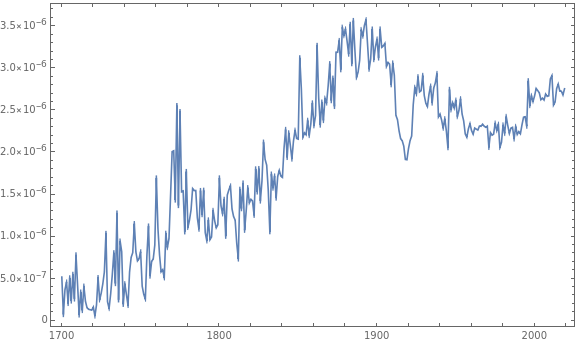
Via Mapping DateListPlot, WordFrequencyData of Narrower Terms in each Sub-Category can be displayed alone or with others to compare.
Creates a Manipulate displaying every narrower terms' WordFrequencyData as a DateListPlot:
Createsubjectmanipulate[subj_String]:=With{finaldata=wordfreqts[subj]},ManipulateMapDateListPlot#,&,Dynamic[KeyTake[finaldata[Subject],Field]],{Subject,Keys[finaldata],PopupMenu},{Field,Keys[finaldata[Subject]],TogglerBar,Appearance"Row"},
Conclusion
Conclusion
In conclusion, WordDataFrequency made it simple but interesting to track word usage throughout history. One of the findings were that within the arts, categories like drawing proved to be far more prevalent through most of history, especially in recent times; even when considering the rise of digital art and assisted drawing like drafting. An extension of this project could be looking for specific texts from the when the word was being most frequently used.
The Final Graphs
The Final Graphs
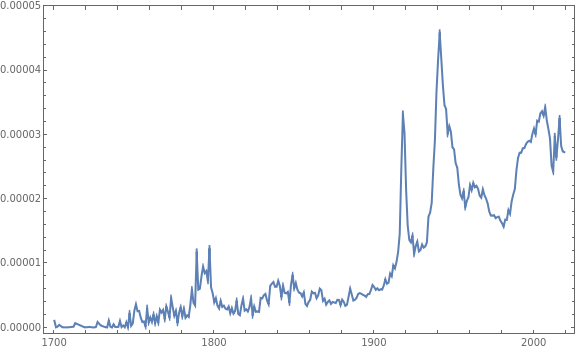
One Manipulate graph was created for each word of the following list: art, mathematics, and philosophy.
Art Subject WordDataFrequency Visualization
Art Subject WordDataFrequency Visualization
In[]:=
Createsubjectmanipulate["art"]
Out[]=

Mathematics Subject WordDataFrequency Visualization
Mathematics Subject WordDataFrequency Visualization
In[]:=
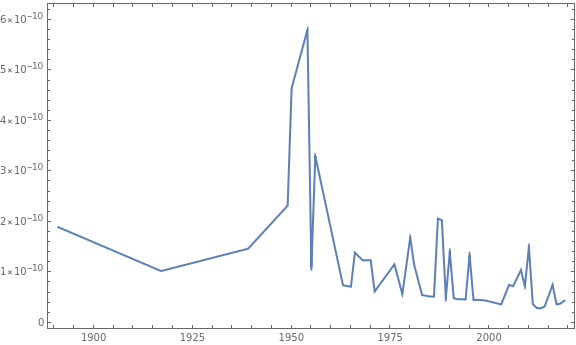
Createsubjectmanipulate["mathematics"]
Out[]=
Philosophy Subject WordDataFrequency Visualization
Philosophy Subject WordDataFrequency Visualization
Out[]=
◼
Keywords: Language, History, Frequency