The right sign is a matter of luck.
Wolfgang Pauli
Wolfgang Pauli
The main goal of this notebook is to solve this integral: (x)+xIt will also be necessary to solve this integral to achieve the main goal: xAs a secondary objective this integral is solved for : (x)+x
∞
∫
0
log(x+1)
2
x
2
log
2
π
∞
∫
0
1
(x+1-u)(x)+
2
log
2
π
n∈
∞
∫
0
1
n
(1+x)
2
log
2
π
To get these and more integrals and proofs, you can look here:
https://de.wikibooks.org/wiki/Formelsammlung_Mathematik:_Bestimmte_Integrale:_Form_R(x,log)
https://de.wikibooks.org/wiki/Formelsammlung_Mathematik:_Bestimmte_Integrale:_Form_R(x,log)
Some of these integrals can be solved directly with Mathematica (LightBlue), some can be solved but the answer ist not the simplest possible (LightPurple), some can not be solved (LightOrange) but can be checked numerically and some can not be solved and not even be checked numerically although a solution is known (LightRed).
This Notebook is about the LightOrange and LightRed cases:
Out[]=
Out[]=
Out[]=
Out[]=
Out[]=
Out[]=
Out[]=
Mathematica gives the same answer in disguise:
Out[]=
-πArcCosh[2]+6Log[7-4PolyLog2,1--PolyLog2,((2+)-+PolyLog2,≈2.6004
1
24
3
]+1
2
1/6
(-1)
1
2
3
)-PolyLog2,2
(2-)+
3
2
(2+)+
3
Out[]=
Out[]=
Mathematica gives the same answer in disguise:
Out[]=
1
2
1
2
2
1
2
2
1
4
4
1
4
4
This integral is to hard to solve (but still the answer is known), and it is even to hard to be computed numerically:
Out[]=
This integral is to hard to solve (but still the answer is known).
are Fontana numbers (Gregory’s coefficients) :
F
n
n∈
Out[]=
Mathematica can solve the case :
n=1
Out[]=
… and for example gives:
n=5
Out[]=
This can be checked numerically:
In[]:=
NIntegrate+,{x,0,∞}
1
5
(1+x)
2
Log[x]
2
π
Out[]=
0.01875
It’s all about the sum of the residues (there is only one residue here):
Out[]=
The Fontana numbers (Gregory’s coefficients) are discussed in the Addendum:
In[]:=
Fontana[5]
Out[]=
3
160
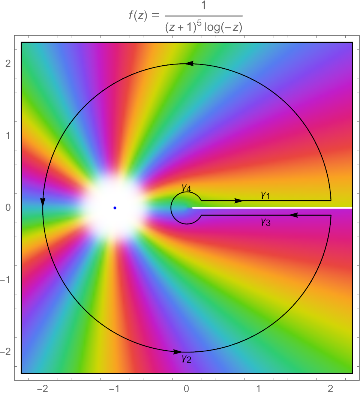
The integration path is like that:
Out[]=
https://en.wikipedia.org/wiki/Branch_point
The typical example of a branch cut is the complex logarithm. If a complex number is represented in polar form, then the logarithm of is
The typical example of a branch cut is the complex logarithm. If a complex number is represented in polar form
z=r
ϑ
z
Out[]=
Let be a point on , then ==.Let be a point on , then ==.
z=x+
+
0
γ
1
1
log(-z)
1
log(-x-)
+
0
1
log(x)-π
z=x-
+
0
γ
3
1
log(-z)
1
log(-x+)
+
0
1
log(x)+π
And we use this property of log for , i.e. :
x>0
x∈
+
In[]:=
With[{n=3},{Limit[1/Log[-(x+ε)],{x->n,ε->0},Direction->"FromAbove"],Limit[1/Log[-(x-ε)],{x->n,ε->0},Direction->"FromAbove"]}]
Out[]=
,
1
-π+Log[3]
1
π+Log[3]
And the minus in the next expression is because is integrated from ∞ to 0: f(z)z=f(x)x=-f(x)x
γ
3
∫
γ
3
0
∫
∞
∞
∫
0
And amazingly :
x∈
+
Out[]=
The integral over the path and go to zero, and the rest of the proof is as follows:
γ
2
γ
4
Out[]=
This integral is to hard (but still the answer is known):
Out[]=
The integration path is the same as above:
Out[]=
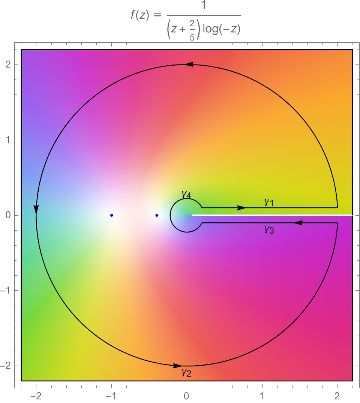
It’s all about the sum of the residues (there are only two here):
Out[]=
And we use this property of log for :
x>0
In[]:=
With[{n=3},{Limit[1/Log[-(x+ε)],{x->n,ε->0},Direction->"FromAbove"],Limit[1/Log[-(x-ε)],{x->n,ε->0},Direction->"FromAbove"]}]
Out[]=
,
1
-π+Log[3]
1
π+Log[3]
The integral along can be written as: f(z)z=f(x)x=-f(x)x
γ
3
∫
γ
3
0
∫
∞
∞
∫
0
The integral over the path and go to zero, and the rest of the proof is as follows:
γ
2
γ
4
Out[]=
Proof of (0.10)
Proof of (0.10)
First observe that:
Out[]=
(1)
Than replace the integrand by (1.5):
Out[]=
(2)
Than swap the integrals:
Out[]=
(3)
And observe that:
Out[]=
(4)
And inserting (4) into (3) is the final result:
Out[]=
(5)
Addendum: Fontana numbers (Gregory’s coefficients):
Addendum: Fontana numbers (Gregory’s coefficients):
Wolfram Mathematica Code
Wolfram Mathematica Code
CITE THIS NOTEBOOK
CITE THIS NOTEBOOK
A hard integral to solve part two
by Oliver Seipel
Wolfram Community, STAFF PICKS, January 2, 2023
https://community.wolfram.com/groups/-/m/t/3094086
by Oliver Seipel
Wolfram Community, STAFF PICKS, January 2, 2023
https://community.wolfram.com/groups/-/m/t/3094086