Michael Trott (1959-2025)
Michael Trott (1959-2025)
As a friend to Michael for thirty years, I remember him for all the way he played around with math and science to make it fun.
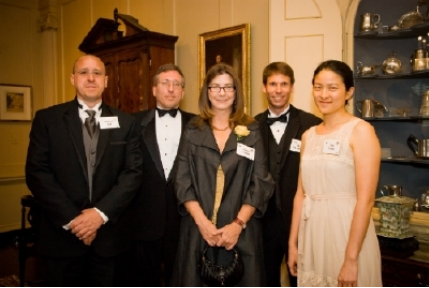
Here he is at the State Department, to collect the 2005 Carl Sagan Award for Public Appreciation of Science, for work on Numb3rs. There aren’t many awards higher for making science fun than the Carl Sagan award. I’m behind him, next to Cheryl Heuton, Eric Weisstein and Amy Young.
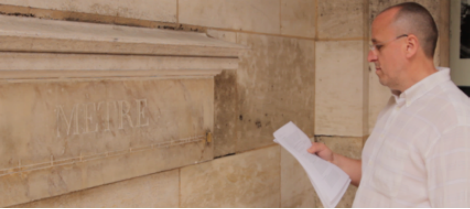
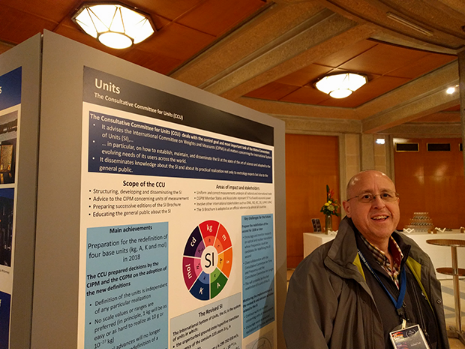
Fundamental Constants of Physics (c, h, e, k, NA) -- He was there at the conference.
“Michael, the candela is based on 555 nanometres green. They should switch the candela and ampere colors.”
“I know, but its too late.”
“Michael, the candela is based on 555 nanometres green. They should switch the candela and ampere colors.”
“I know, but its too late.”
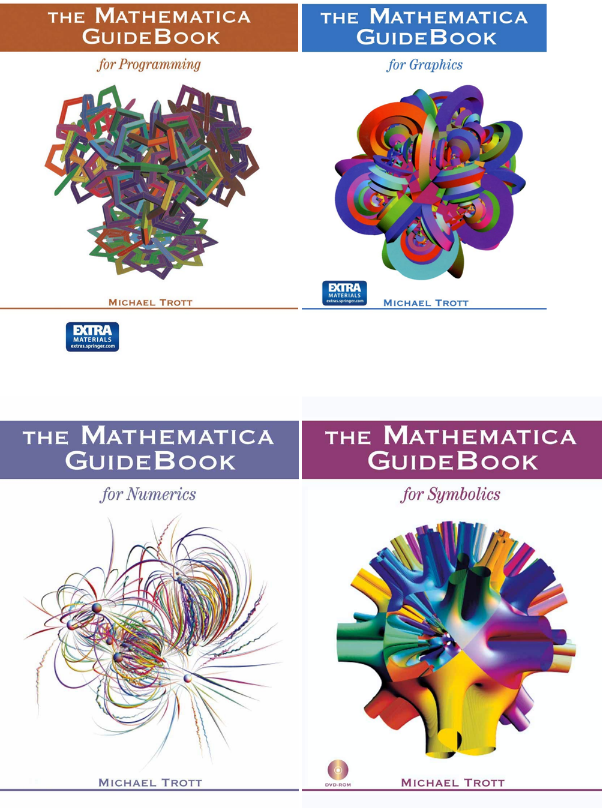
Some blogs. He also wrote the incredible Mathematica Guidebooks.
What did he do in his last weeks? He played around with math. He found that the Fricke-Macbeath graph was locally , so I found a nice embedding for him.
C
7
Out[]=
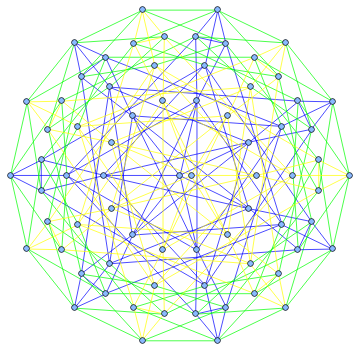
He wondered what other graphs had that property. He found this one.
Out[]=
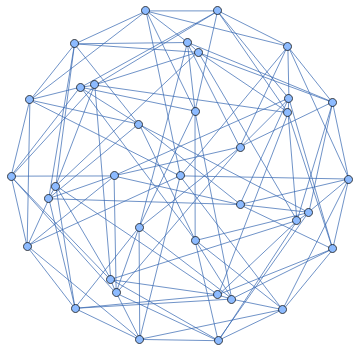
While looking at that, I found a new Klein graph embedding based on the Braced Heptagon. Funny story, after I found the unit-distance graph 20 years ago, Eric Weisstein thought it was interesting enough to add to GraphData. Many years later, in 2020, I realized the graph might be rigid. And it is. It’s so rigid that any two connected vertices can be ripped out and the graph will remain rigid. It sets a So we had to change the name in GraphData.
In[]:=
GraphData[{"BracedHeptagon",{42,1}}]
Out[]=
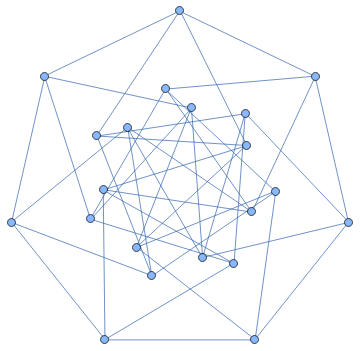
And while working on this with Michael, I noticed that connecting the extraordinary lines in the graph and connecting to the {7/1}, {7/2} and {7/3} star polygons would make the Klein graph.
Out[]=
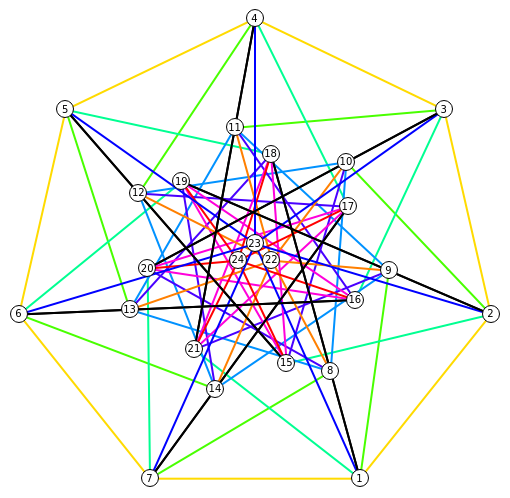
Messing around with hyperbolic tiling, I managed to make a new map for the hyperbolic version of the Klein quartic graph. Previous embeddings usually made it difficult to see what was happening with two of the vertices.
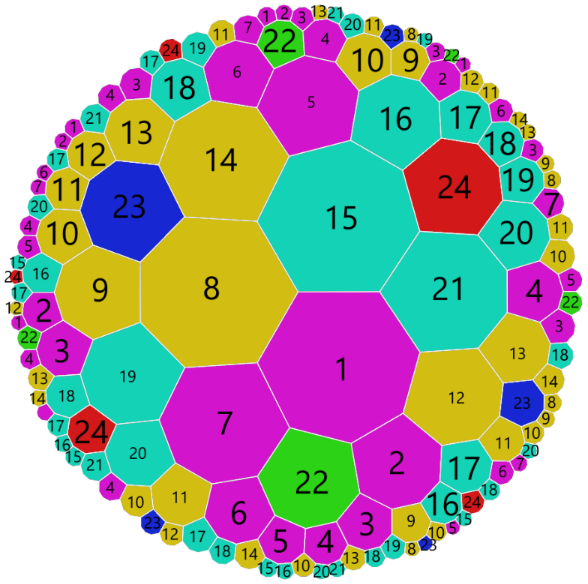
Michael thought that was really neat! And then he was gone.
Thank you, Michael, for being a cheerful inspiration for me, right to the end.