Bingham Fluid Flow in a Circular Tube
Bingham Fluid Flow in a Circular Tube


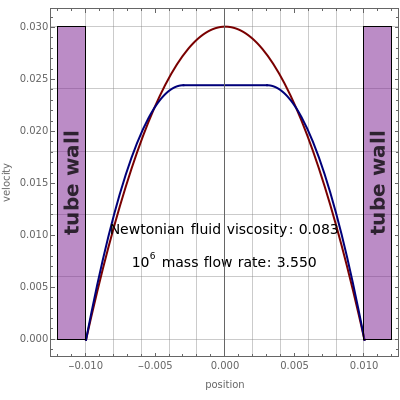
A Bingham fluid acts like a rigid body at low shear stress but flows like a viscous fluid at high shear.
Consider the laminar flow of a Bingham fluid in a long circular tube of radius and length . The fluid flows under the influence of a pressure difference . The fluid density is .
R=0.01m
L=1m
ΔP=100N/
2
m
ρ=0.75kg/l
One can derive an analytical expression for the velocity, given by http://www.syvum.com/cgi/online/serve.cgi/eng/fluid/fluid807.html:
v
z
ΔP
2
R
4L
μ
0
2
r
R
τ
0
μ
0
r
R
R⩾r⩾
r
0
v
z
ΔP
2
R
4L
μ
0
2
r
0
R
r⩽
r
0
where =.
r
0
2L
τ
0
ΔP
The mass flow rate is given by:
w=2πρrdr=1-+
R
∫
0
v
z
ΔPρπ
4
R
8L
μ
0
4
τ
0
3
τ
R
1
3
4
τ
0
τ
R
τ
R
ΔPR
2L
Here is the zero–shear viscosity and is the yield stress. You can vary these two parameters.
μ
0
τ
0
For a Newtonian fluid, the mass flow rate is given by the Hagen–Poiseuille equation: .
w=
ΔPρπ
4
R
8μL
This Demonstration plots the velocity profile (blue curve) and gives the value of the corresponding mass flow rate. In addition, the velocity profile for a Newtonian fluid is plotted (red curve). The viscosity, , of the Newtonian fluid is chosen such that both fluid mass flow rates are equal. The value of the viscosity, , is also shown.
μ
μ