Aristotle’s Wheel Paradox

Exploring the physics and mathematics behind the paradox of Aristotle’s wheels.
July 7, 2017—Mariano Cano Santos

History of the Paradox

In[]:=
ListAnimate[Import["w.gif"]]
Out[]=
This story is about a paradox mentioned in the Greek work Mechanica, dubiously attributed to Aristotle.
Consider a wheel consisting of two concentric circles of different diameters (that is, a wheel within a wheel, or a wheel with external axes). Then if we roll this wheel between two straight lines (at the bottom of each of circle), we can see that the distance developed by a point of the circle with greater diameter is apparently the same as the distance developed by a point on the small circle. So the wheel should travel the same distance regardless of whether it is rolled from left to right on the top straight line or on the bottom one. This seems to imply that the two circumferences of different-sized circles are equal, which is impossible—this is the paradox.
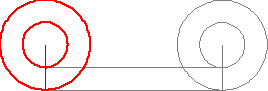
We are going to explain the paradox visually by coding the drawing of graphics step by step.

Visualization of the Paradox

Explanation of the Paradox

Related Topics

FURTHER EXPLORATIONS
In further explorations, it would be interesting to code with functions of colors the different kinds of motion (rolling and sliding) of the wheels for a better visualization of the paradox. A second exploration would be to improve the structure of the code and the drawing functions used to generalize, and at the same time make clearer the explanations.
AUTHORSHIP INFORMATION
Mariano Cano Santos
7/7/17