Spherical Harmonics

Spherical harmonics are special functions that appear ubiquitously in physical systems that admit spherical symmetry.
June 22, 2017—Himanshu Raj

Definition

Spherical harmonics are defined as the solution of the following Eigenvalue problem.
In[]:=
1
Sinϑ
∂
∂ϑ
Sinϑ
∂
∂ϑ
+
1
2
Sin
ϑ
2
∂
∂
2
φ
+l(l+1)
m
Y
l
(ϑ,φ)=0
Every solution to this equation, denoted by
m
Y
l
, is labeled by the integers l and m. The integer m is restricted to take values from -l to l and counts the degeneracy
g(l)=l(l+1)
. The harmonics
m
Y
l
and
-m
Y
l
are not really independent, but are related by a complex conjugation. They satisfy the relation:
In[]:=
*
m
Y
l
=
m
(-1)
-m
Y
l
In the Wolfram Language, spherical harmonics are implemented by the function SphericalHarmonicY.
Explicit expression for the first few spherical harmonics:
In[]:=
TableForm@Table[
m
Y
l
SphericalHarmonicY[l,m,θ,ϕ],{l,0,4},{m,0,l}]//TraditionalForm
Out[]=
0
Y
0

1
2
π
0
Y
1

1
2
3
π
cos(θ)
1
Y
1
-
1
2
3
2π
ϕ

sin(θ)
0
Y
2

1
4
5
π
(3
2
cos
(θ)-1)
1
Y
2
-
1
2
15
2π
ϕ

sin(θ)cos(θ)
2
Y
2

1
4
15
2π
2ϕ

2
sin
(θ)
0
Y
3

1
4
7
π
(5
3
cos
(θ)-3cos(θ))
1
Y
3
-
1
8
21
π
ϕ

sin(θ)(5
2
cos
(θ)-1)
2
Y
3

1
4
105
2π
2ϕ

2
sin
(θ)cos(θ)
3
Y
3
-
1
8
35
π
3ϕ

3
sin
(θ)
0
Y
4

3(35
4
cos
(θ)-30
2
cos
(θ)+3)
16
π
1
Y
4
-
3
8
5
π
ϕ

sin(θ)cos(θ)(7
2
cos
(θ)-3)
2
Y
4

3
8
5
2π
2ϕ

2
sin
(θ)(7
2
cos
(θ)-1)
3
Y
4
-
3
8
35
π
3ϕ

3
sin
(θ)cos(θ)
4
Y
4

3
16
35
2π
4ϕ

4
sin
(θ)
Using the Wolfram Language command Laplacian, it can be explicitly checked that these expressions satisfy the aforementioned Eigenvalue problem.
An explicit check that the spherical harmonics for a given value of (l, m) satisfy the aforementioned Eigenvalue problem:
In[]:=
With[{l=5,m=3},Simplify[
2
r
Laplacian[SphericalHarmonicY[l,m,θ,ϕ],{r,θ,ϕ},"Spherical"]+l(l+1)SphericalHarmonicY[l,m,θ,ϕ]]]
Out[]=
0
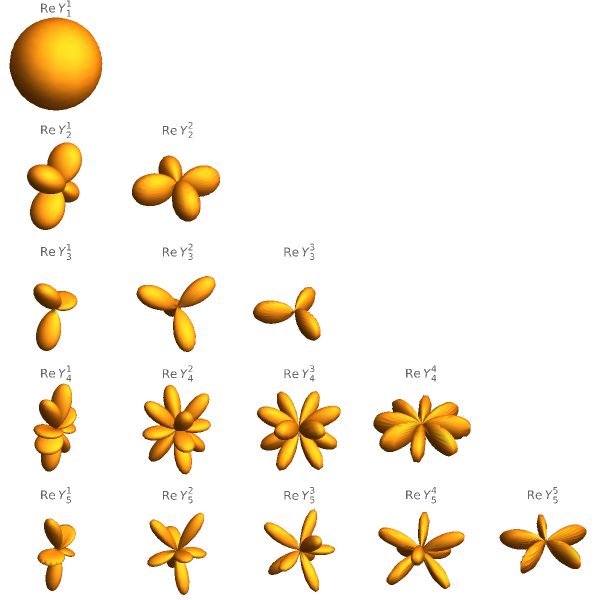
Spherical harmonics have nice 3D visualizations. Some 3D plots are displayed here.
3D visualization of first 10 spherical harmonics with m=0:
In[]:=
Row@TableSphericalPlot3DSphericalHarmonicY[l,0,θ,ϕ],{θ,0,Pi},{ϕ,0,2Pi},​​PlotLabel
0
Y
l
,AxesNone,BoxedFalse,ImageSize100,MeshFalse,PlotRangeAll,{l,0,10}
Out[]=
We see that all these images are azimuthal symmetric. This is because
0
Y
l
has no dependence on the coordinate ϕ. On the other hand, spherical harmonics with
m≠0
are complex and depend explicitly on ϕ; as such, they break azimuthal symmetry explicitly. 3D plots of the real and imaginary parts of the first few harmonics are plotted below.
3D visualization of the real and imaginary parts of first few spherical harmonics with
m≠0
:
In[]:=
g=GraphicsGrid[#,ImageSize600]&/@Table[SphericalPlot3D[part[SphericalHarmonicY[l,m,θ,ϕ]],{θ,0,Pi},{ϕ,0,2Pi},PlotLabelSubsuperscript[ReY,l,m],ImageSize100,AxesNone,BoxedFalse,MeshFalse,PlotRangeAll],{part,{Re,Im}},{l,1,5},{m,1,l}];​​​​TabView[{"Real part"g[[1]],"Imaginary part"g[[2]]}]
Out[]=
Real part
Imaginary part

Mathematical Properties

Completeness Relation

Spherical harmonics form a complete set. The completeness relation is:

Normalization and Orthogonality Condition

Spherical harmonics satisfy the following orthogonality condition.
Explicit check with examples:

Product Decomposition

A product of two spherical harmonics decomposes into a finite linear combination of spherical harmonics:
Explicit check with an example:

Addition Theorem

... where cos γ is given by:
Explicit check with an example:

Applications

Electromagnetism

The electric field components for a given multipole can also be expressed in terms of spherical harmonics and its derivatives. However, this representation is not very convenient to work with. A better way to describe a vector multipole field is with the vector spherical harmonic.

Quantum Mechanics

The simplest quantum mechanical system where spherical harmonics show up is the hydrogen atom. For a spherically symmetric potential due to a point charge, the normalized distribution function of the electron is given by the following solution of the Schrödinger equation:
Spherical harmonics also play an important role in the scattering processes under a central (i.e. spherically symmetric) potential.

Vector and Tensor Spherical Harmonics

The spherical harmonics we discussed so far are scalars in nature; they transform as scalars under coordinate transformations. However, there are many physical observables that are not scalar in nature; e.g. electromagnetic fields, gravitational fields, etc. Vector spherical harmonics are natural objects that describe phenomena related to electromagnetic radiation, whereas tensor spherical harmonics naturally appear in the theory of gravitational waves.

Relation to Group Theory and Higher-Dimensional Generalizations

In a d-dimensional space, the group of rotations is SO(d). By definition, spherical harmonics are eigenfunctions of the quadratic Casimir of the SO(d). From the representation theory of SO(d,) one can explicitly construct the spherical harmonics, their eigenvalues and degeneracies of all possible representations (scalars, spinors, vectors, symmetric tensors, antisymmetric tensors, vector-spinors) in a d-dimensional space. These objects play an important role in the dimensional reduction of string theory over higher-dimensional spheres.
FURTHER EXPLORATIONS
Special Functions
Functions Used in Optics
Functions Used in Quantum Mechanics
Representations of SO(d)
Multipole Expansion, Vector and Tensor Spherical Harmonics
Compactification in Strong Theory
AUTHORSHIP INFORMATION
Himanshu Raj
6/22/17