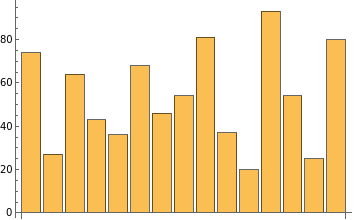
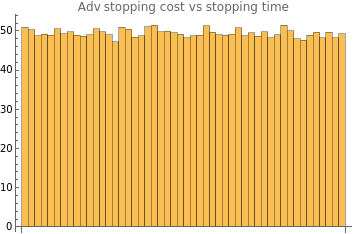
Exploring the optimal time to act in order to maximize reward.
June 22, 2017—Richard Hayes
An Interplanetary Diner
On your way out of Mars’s orbit, after a quick visit to your alien cousin’s fidget-spinner farm, you stop at a small fast-food restaurant on Phobos to purchase one of the galaxy’s most delicious burgers. You’ve been here many times before and know the owner, a computational burger scientist, has very strict ordering rules; when it’s time for a customer to order, they’re presented with a parade of burgers of varying quality, and must answer “yes” or “no” on the spot. To you, a well-trained burger classifier, a burger’s quality is immediately identifiable. However, you can only determine the quality of a burger when it’s directly in front of you, and if you reject a burger, it’s cast into a four-dimensional trash compacter from IKEA, never to be seen again.
Graph a list of 1,000 random integers less than 100 that represent burger quality levels: