Modeling a Submarine Using Potential Flow Analysis
Potential flow analysis can be used to model a variety of objects and how they interact with fluid flows.
June 21, 2017—Kaleb Alekel
Uniform Flow
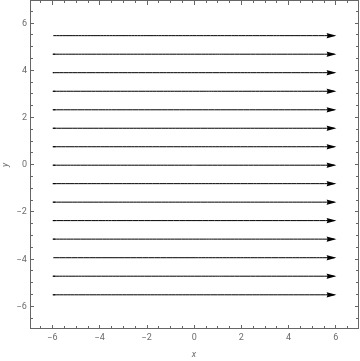
The most basic potential flow regime is a uniform stream in the x direction.
Let’s model a stream with velocity U=5:
I
n
[
]
:
=
U
=
5
;
The following are the stream function and velocity potential, respectively:
I
n
[
]
:
=
ψ
u
n
i
f
o
r
m
[
y
_
]
=
U
y
;
ϕ
u
n
i
f
o
r
m
[
x
_
]
=
U
x
;
Finding the x and y components of the velocity is trivial in this case, but it will help with understanding a more complex flow later.
To find the x component of the velocity of the stream, we take the derivative of the velocity potential with respect to x:
I
n
[
]
:
=
u
=
D
[
ϕ
u
n
i
f
o
r
m
[
x
]
,
x
]
O
u
t
[
]
=
5
To find the y component, we take the negative derivative of the stream function with respect to y:
I
n
[
]
:
=
v
=
-
D
[
ψ
u
n
i
f
o
r
m
[
x
]
,
y
]
O
u
t
[
]
=
0
Now let’s plot the streamlines of the flow:
I
n
[
]
:
=
S
t
r
e
a
m
P
l
o
t
[
{
u
,
v
}
,
{
x
,
-
6
,
6
}
,
{
y
,
-
6
,
6
}
,
S
t
r
e
a
m
S
c
a
l
e
F
u
l
l
,
F
r
a
m
e
L
a
b
e
l
{
x
,
y
}
,
S
t
r
e
a
m
S
t
y
l
e
{
A
r
r
o
w
h
e
a
d
s
[
.
0
3
]
,
B
l
a
c
k
}
]
O
u
t
[
]
=
Source or Sink at the Origin
Rankine Half-Body
FURTHER EXPLORATIONS
Try modeling a symmetrical airfoil using a series of sinks and sources in a uniform flow.
Try modeling an airfoil in a uniform stream near the ground by using an image airfoil.
AUTHORSHIP INFORMATION
Kaleb Alekel
6/21/17