Mendelian Inheritance

Mendelian inheritance is a type of biological inheritance that follows the law of segregation, the law of independent assortment and the law of dominance, proposed by Gregor Mendel.
June 23, 2017—Nae Eoun Lee

Mendel’s Law

Law of Segregation of Genes (the “First Law”)

The two members (alleles) of a gene pair segregate (separate) from each other in the formation of gametes (sex cells).
Parental genes (Aa;
F
1
generation) are randomly separated from the gametes so that a gamete contains only one gene (allele) of the pair, A or a:
In[]:=
StringJoin@@@Tuples[{"A","a"},1]
Out[]=
{A,a}
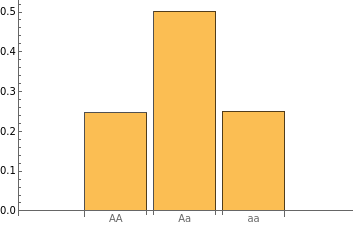
Offspring (
F
2
generation) therefore inherit one genetic allele from each Aa parent, and has one of three possible genotypes, AA, Aa (or aA) and aa:
In[]:=
StringJoin@@@Tuples[{"A","a"},2]
Out[]=
{AA,Aa,aA,aa}
In[]:=
f2=Table[StringJoin[RandomChoice[{"A","a"}],RandomChoice[{"A","a"}]],{i,100000}];​​BarChart[{Count[f2,"AA"],Total[Count[f2,#]&/@{"Aa","aA"}],Count[f2,"aa"]}/100000,ChartLabels{"AA","Aa","aa"}]
Out[]=

Law of Independent Assortment (the “Second Law”)

Genes for different traits assort independently of one another in the formation of gametes.
For two different traits (Aa and Bb), each on a different pair of genes, there are four possible types of gametes:
In[]:=
StringJoin@@@Tuples[{{"A","a"},{"B","b"}}]
Out[]=
{AB,Ab,aB,ab}
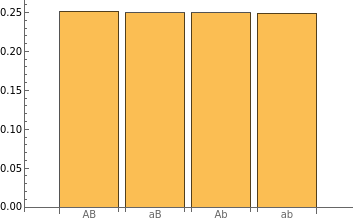
With the two pairs of genes, both parents produce 25% each of AB, Ab, aB and ab for 100,000 random gametes:
In[]:=
gamete=Table[StringJoin[RandomChoice[{"A","a"}],RandomChoice[{"B","b"}]],{i,100000}];​​BarChart[Counts[gamete]/100000,ChartLabels{"AB","aB","Ab","ab"}]
Out[]=
For
AaBb×AaBb
, each parent produces four different types of gametes, and these gametes combine with each other in
2
4
=16
different ways:
In[]:=
TableForm[{{AABB,AaBB,AABb,AaBb},{AaBB,aaBB,AaBb,aaBb},{AABb,AaBb,AAbb,Aabb},{AaBb,aaBb,Aabb,aabb}},TableHeadings{{AB,aB,Ab,ab},{AB,aB,Ab,ab}}]
Out[]=
AB
aB
Ab
ab
AB
AABB
AaBB
AABb
AaBb
aB
AaBB
aaBB
AaBb
aaBb
Ab
AABb
AaBb
AAbb
Aabb
ab
AaBb
aaBb
Aabb
aabb
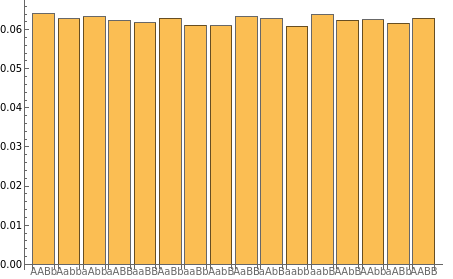
This can be experimentally (computationally) shown:
In[]:=
gamete1=Table[StringJoin[RandomChoice[{"A","a"}],RandomChoice[{"B","b"}]],{i,100000}];​​gamete2=Table[StringJoin[RandomChoice[{"A","a"}],RandomChoice[{"B","b"}]],{i,100000}];​​ff2=Table[StringJoin[StringTake[gamete1[[i]],1],StringTake[gamete2[[i]],1],StringTake[gamete1[[i]],{2}],StringTake[gamete2[[i]],{2}]],{i,100000}];​​DeleteDuplicates[ff2]
Out[]=
{AABb,Aabb,aAbb,aABB,aaBB,AaBb,aaBb,AabB,AaBB,aAbB,aabb,aabB,AAbB,AAbb,aABb,AABB}
In[]:=
BarChart[Counts[ff2]/100000,ChartLabelsAutomatic]
Out[]=

Law of Dominance (the “Third Law”)

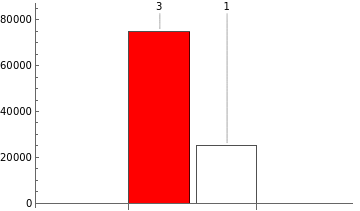
Some alleles (A or B) are dominant, while others (a or b) are recessive; an organism with at least one dominant allele will display the effect of the dominant allele. For example, when the dominant trait is red and the recessive trait is white, AA and Aa are red, and aa is white.
The phenotypes of self-fertilization of the F1 generation (Aa) show a 3 (red): 1 (white) ratio in the
F
2
generation:
In[]:=
BarChart{Count[f2,"AA"]+Total[Count[f2,#]&/@{"Aa","aA"}],Count[f2,"aa"]},ChartStyle{Red,White},ChartLabelsCallout[{"3","1"},Automatic],ChartLegends"AA or Aa\n"
,"aa\n"

Out[]=
AA or Aa
aa
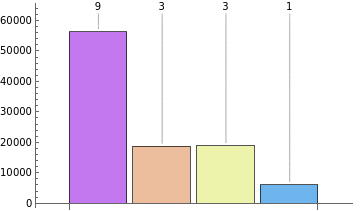
For the AaBb parents (A: yellow (dominant), a: green (recessive), B: round (dominant), b: wrinkly (recessive)), the phenotypes of two independent traits show a 9 (yellow, round): 3 (green, round): 3 (yellow, wrinkly): 1 (green, wrinkly) ratio in the
F
2
generation:
In[]:=
gen1=Total[Count[ff2,#]&/@{"AABB","AABb","AAbB","AaBB","AaBb","AabB","aABB","aABb","aAbB"}];​​gen2=Total[Count[ff2,#]&/@{"aaBB","aaBb","aabB"}];​​gen3=Total[Count[ff2,#]&/@{"AAbb","Aabb","aAbb"}];​​gen4=Total[Count[ff2,#]&/@{"aabb"}];​​BarChart{gen1,gen2,gen3,gen4},ChartStyle"Pastel",ChartLabelsCallout[{"9","3","3","1"},Automatic],ChartLegends
,
,
,

Out[]=
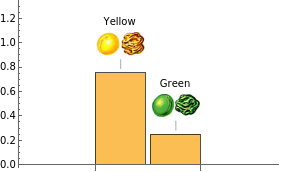
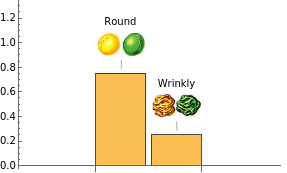
For each trait, the phenotypes show a 3 (dominant): 1 (recessive) ratio in the
F
2
generation, confirming the independent assortment:
In[]:=
BarChart{gen1+gen3,gen2+gen4}100000,ChartLabelsCallout"Yellow\n
","Green\n
",Top,BarChart{gen1+gen2,gen3+gen4}100000,ChartLabelsCallout"Round\n
","Wrinkly\n
",Top
Out[]=

,


Exception—Polygenic Inheritance

FURTHER EXPLORATIONS
Heredity
Non-Mendelian Inheritance
Incomplete Dominance
Multiple Alleles
AUTHORSHIP INFORMATION
Nae Eoun Lee
6/23/17