Introduction to Quantum Interference

Interference is an important wave phenomenon, and an essential concept in both classical and quantum physics. In this notebook, we will explore how interference figures in quantum theory.
June 23, 2017—Jacob Marks

What Is a Wave?

Waves are prominent in the natural world, from water waves to electromagnetic waves. Mathematically, a wave is described by periodic motion.
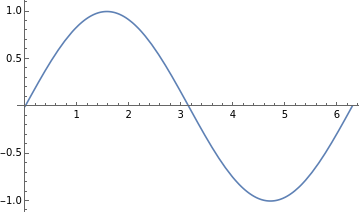
Sine wave:
In[]:=
Plot[Sin[x],{x,0,2Pi}]
Out[]=
Waves don’t have to be differentiable at every point.
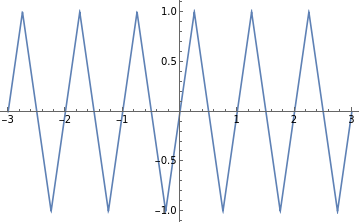
Triangle wave:
In[]:=
Plot[TriangleWave[x], {x, -3, 3}, ExclusionsStyle -> Dotted]
Out[]=
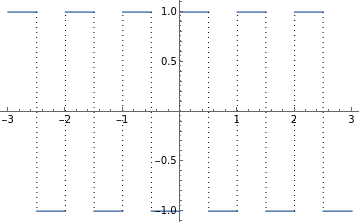
In fact, waves don’t even have to be continuous.
Square wave:
In[]:=
Plot[SquareWave[x], {x, -3, 3}, ExclusionsStyle -> Dotted]
Out[]=

Wave Properties

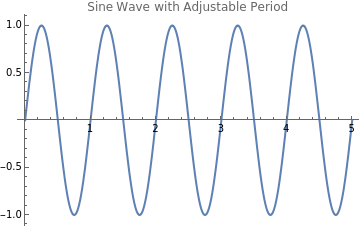
The period b of a wave is how long it takes to complete one full cycle:
In[]:=
Manipulate[Plot[Sin[2πx/b],{x,0,5},PlotLabel"Sine Wave with Adjustable Period"],{{b,1,"Period"},1,5}]
Out[]=
​
Period
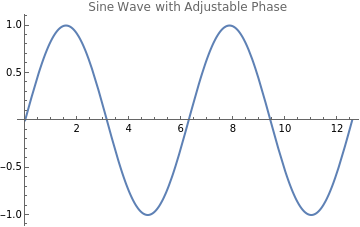
The phase ϕ translates the wave horizontally:
In[]:=
Manipulate[Plot[Sin[x+ϕ],{x,0,4π},PlotLabel"Sine Wave with Adjustable Phase"],{{ϕ,0,"Phase"},0,2π}]
Out[]=
​
Phase
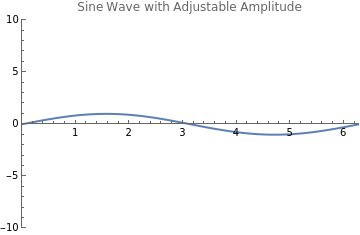
The amplitude A stretches or shrinks the wave vertically:
In[]:=
Manipulate[Plot[ASin[x],{x,0,2π},PlotLabel"Sine Wave with Adjustable Amplitude",PlotRange{{0,2Pi},{-10,10}}],{{A,1,"Amplitude"},0.5,10}]
Out[]=
​
Amplitude

Combining Waveforms

The Wavefunction

Exploring Diffraction

Conclusion

FURTHER EXPLORATION
Investigate Single-Slit Diffraction Where the Slit Admits a Continuum of Wavefronts
AUTHORSHIP INFORMATION
Jacob Marks
6/23/17