Ideas & Growth

The importance of good ideas for economic development.
June 23, 2017—Mirian Lima

Capital Accumulation

A country’s output (
Y
), i.e. its total production, is a function of its ability to accumulate physical capital (
K
), such as infrastructure or machines, and human capital (
eL
), i.e. skilled labor force and “ideas” (
A
).
Out[]=
Y=f(K, eL,A)
In order to demonstrate the importance of ideas, two supporting concepts must first be illustrated: diminishing returns of capital and depreciation.

Diminishing Returns of Capital

Let us simplify the function so as to imagine there are fixed levels of
eL
and
A
, and that the output level is solely dependent on changes in
K
accumulation. If
K
is continuously growing, the
th
n
unit of
K
will never be as productive as the first one. For instance, when a single tractor is acquired for the first time to assist in production, it will certainly wield a lot of output growth. But if more tractors keep getting added to the production line, the
th
n
tractor won’t produce as much as the first one. At some point, as available arable land becomes scared, the amount of work that can be done by the
th
n
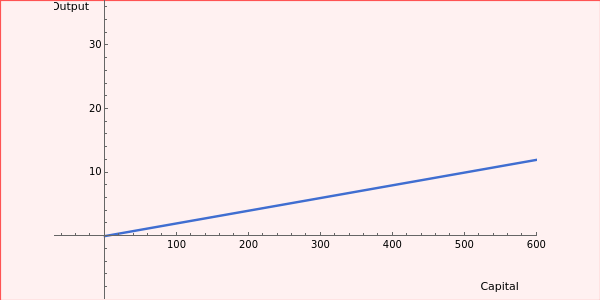
tractor won’t justify the cost of acquiring (and maintaining) a new machine. This reveals a fundamental property of the output function: the diminishing returns of capital, i.e. the more capital you have, the lesser the impact (per unit of capital) on output.
Out[]=
Y=
K
Here is a visual illustration of diminishing returns of physical capital (
K
):
Out[]=
​
Diminishing Returns of K
0.12
Plot Range
600
reset

Investment, Savings and Consumption

The output accumulated by capital can either be reinvested into further production or consumed—always one or the other. For simplicity, again, let’s assume that savings (s) is equal to investment (I); there is no idle money in the country, and the ratio of capital is a constant ratio. One will see that the ratio of investment will grow with capital accumulation. Does this mean an endless loop of accumulation and reinvestment? If that were the case, developed countries would always display higher growth rates than their developing counterparts, which does not happen. That is because depreciation (δ) “eats away” at the value of physical capital as the capital wears out from repeated use, just like a tractor or a highway would after many years of use. If we assume a constant rate of depreciation, when combined with the diminishing returns of capital, the country will only keep growing if it augments its physical capital. In developed countries, there is very little margin to add more infrastructure, as most of the land available for production may already be in use.
In the graph shown here, you can see how the model demonstrates how the dynamics of capital accumulation, savings and depreciation limit the possibility of endless output growth. Try moving their values around on the graph and mouse over the point where investment equals depreciation to see the steady state label.
Out[]=
​
savings rate γ
0.3
depreciation rate δ
0.02
plot range
600
reset
Notice how the higher the savings, the further away the steady state goes, and the longer a country continues to grow. The inverse happens when depreciation goes up. Because depreciation is a constant ratio of capital level, unless capital grows continuously, depreciation will catch up with the decreasing rate of return to capital. Is there a way for countries to escape the steady-state fate? Can a country continue to grow with the same level of capital and a linear depreciation rate? The good new is—yes! As ideas come into play in our graph, it will be possible to visualize just that.

The Importance of Ideas for Continuous Growth

FURTHER EXPLORATIONS
Entrepreneurship and Ideas
Technological Development
Education and Human Capital
AUTHORSHIP INFORMATION
Mirian Lima
6/23/17