Euclidean Vector Introduction
A vector is a quantity that has both a magnitude and a direction.
June 19, 2017—Ethan Truelove
Vector Basics
Let’s start by making a vector in the 2D Cartesian plane.
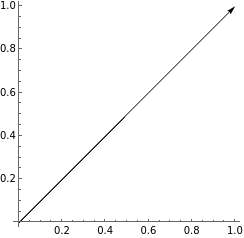
Draw the vector v starting at point (0,0) and ending at point (1,1):
I
n
[
]
:
=
G
r
a
p
h
i
c
s
[
{
A
r
r
o
w
[
{
{
0
,
0
}
,
{
1
,
1
}
}
]
}
,
A
x
e
s
T
r
u
e
]
O
u
t
[
]
=
T
h
i
s
v
e
c
t
o
r
d
e
s
c
r
i
b
e
s
a
q
u
a
n
t
i
t
y
t
h
a
t
i
s
p
o
i
n
t
e
d
i
n
t
h
e
n
o
r
t
h
e
a
s
t
d
i
r
e
c
t
i
o
n
.
I
t
s
n
o
r
m
,
o
r
m
a
g
n
i
t
u
d
e
,
i
s
d
e
f
i
n
e
d
a
s
2
(
x
2
-
x
1
)
+
2
(
y
2
-
y
1
)
.
Calculate the norm of v, or
Norm
[v].
I
n
[
]
:
=
S
q
r
t
[
(
1
-
0
)
^
2
+
(
1
-
0
)
^
2
]
O
u
t
[
]
=
2
Thus the magnitude of this vector v (||v||) can be said to be
2
. This vector v would be written as {1,1} because it moves over 1 unit in the x direction and up 1 unit in the y direction.
Unit Vectors
Unit vectors are vectors that have a direction, but have a magnitude of 1.
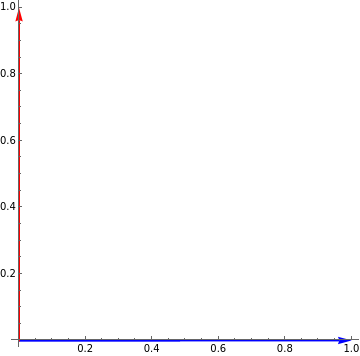
Show the unit vector i in blue and j in red:
I
n
[
]
:
=
G
r
a
p
h
i
c
s
[
{
B
l
u
e
,
T
h
i
c
k
,
A
r
r
o
w
[
{
{
0
,
0
}
,
{
1
,
0
}
}
]
,
R
e
d
,
A
r
r
o
w
[
{
{
0
,
0
}
,
{
0
,
1
}
}
]
}
,
A
x
e
s
T
r
u
e
]
O
u
t
[
]
=
The vector {1,1} could also be written as i + j, where both terms have a coefficient of 1. Unit vector i corresponds to the x component (horizontal), while j corresponds to the y component (vertical).
Vector Decomposition
Vector Addition and Subtraction
Vector Multiplication: Dot Product
Vectors in 3D
Vector Multiplication: Cross Product
FURTHER EXPLORATIONS
Parametric Equations of Vectors
Vector Fields
Tangent Vectors
AUTHORSHIP INFORMATION
Ethan Truelove
6/19/17