Coupled Pendulum System

Modeling the motion of a system of multiple pendulums connected by springs.
June 23, 2017—Emilio Andres Vázquez

Introduction

The purpose of the following text is to understand the process of modeling physical systems. More precisely, the purpose is to model a system of coupled pendulums. The text is first going to explain the basic physical modeling, and build on top of calculus and differential equation knowledge to develop a more complex system.

Physical Properties of Pendulums and Springs

In this section, the text is going to explain the concept of linear and constant kinematics, dynamics and the physical properties of pendulums and springs.

Understanding Position, Velocity and Acceleration

The position of an object is described by its location in space. The velocity of an object, on the other hand, can be explained by the change of position in space with respect to time, while the acceleration can be explained as the change of velocity with respect to time. It was Isaac Newton, who does not need an introduction, who found out that the position, velocity and acceleration of an object can be also represented mathematically—more exactly, as the derivatives and integrals of each other. This means that if one were to derivate the position, one would get the velocity, and if one derivates the position twice, one would get the acceleration. Moreover, by integrating the acceleration once, one will compute the velocity, and if one integrates acceleration twice, one will get the position of the same object, [x’’[ t ] = a[ t ], x’[ t ] = v[ t ], x[ t ] = x[ t ] ].
In the following diagram, the position, velocity and acceleration are represented as integrals and derivatives of each other, respectively.
You can input different acceleration ranging from -3m/s^2 to 3m/s^2!!
Out[]=
​
Initial Acceleration
1
2
3
4
5
-20
-10
10
20
In this plot, the horizontal axis is the time in seconds, and the vertical axis is the distance in meters, velocity in meters per second and acceleration in meters per second squared, respectively.

Describing Springs with Hooke’s Law to Understand Dynamics

It is important to remember that the dynamics of a system are the collection of forces acting on a system. This approach requires the three laws of Newton (inertia, action-reaction pair and F=ma).The use of dynamics is interesting to scientists and physicists because it allows them to model the motion of a system with differential equations.
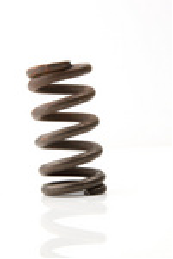
The string is a device that has the property of contracting and expanding depending on its displacement. The seventeenth-century physicist and chemist Robert Hooke was one of the first scientists to formalize the behavior of a spring. He noticed that, for instance, the force of the spring was proportional and in the opposite direction to the displacement. This is known as Hooke’s law, [F= k *x].
For purposes of this text, the focus is not going to be in deriving the differential equation; nevertheless, the knowledge of origin of this differential equation is going to be briefly described at the beginning of each section.

In[14]:=
two images of springs
images of springs
Result
springs
WORD

image

Out[]=
Out[]=
​
Spring constant
-3
-2
-1
1
2
3
-20
-10
10
20
In the plot above, the vertical axis is in Newtons and the horizontal axis is in centimeters.

Describing the Energy of a Spring

The potential energy of an object attached to a spring can be modeled to the following equation, [u=k/2*x^2]. (Note that potential energy is energy that can be acquired.)
On the other hand, the kinetic energy of an object attached to a spring is modeled as most objects in motion, [k=m/2*v^2]. (Note that kinetic energy is the one of moving object.)
The total energy of a system in a conservative system is just the sum of the potential and kinetic energy [E = u+k]. (Note that the definition of energy is not totally defined.)
Out[]=
​
Spring Constant
Toatl Energia
0.5
1.0
1.5
2.0
2.5
3.0
-20
-10
10
20
In the plot, the blue curve is the potential energy of a spring, the orange curve is the kinetic energy and the green line is the energy of the system. The horizontal axis represents the displacement in the x direction in meters, and the vertical axis represents the energy in terms of joules.

Understanding Angular Position, Velocity and Acceleration

Just like linear motion, the rotational motion of an object is primarily described by the angle between a vector and an axis, thus the term of angular position, velocity and acceleration. Moreover, the mathematical properties are the same as the ones for linear kinematics, [θ’’[ t ]= α [ t ], θ’[ t ] = ω[ t ], θ[ t ]=θ[ t ]].

Understanding Pendulum Dynamics

The forces acting on a pendulum can be reduced to the following equation since only gravity can be said to be acting in such system: [F= m*l*ω^2 ].

Describing the Energy of a Pendulum

The potential energy of a pendulum depends on the y displacement, assuming that the lowest point is the origin, and the kinetic energy is described by the common kinematic equation [u=mgy] [k=m/2*v^2][E = u+k].

Simulating a Single Pendulum

Simulating Two Spherical Masses Connected by a Spring

Simulating Two Pendulums Connected by a Spring

AUTHORSHIP INFORMATION
Emilio Andres Vázquez
6/23/17