Quiver: directed graph between objects (“collection of arrows”)
In[]:=
Identity[Graph[Table[ii+1,{i,10}]]]
Out[]=

Category: in addition has a composition rule for the morphisms
Morphisms:
In[]:=
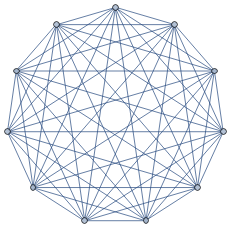
UndirectedGraph[TransitiveClosureGraph[Graph[Table[ii+1,{i,10}]]]]
Out[]=
“Computational category theory”
“Computational category theory”
Morphisms have a computational cost
What is the cost of the composed morphism?
Morphisms to represent partial functions [?]
Morphisms to represent partial functions [?]
What is the source of partiality?
Partial functions are represented by the presence of “hair” (AKA open) edges
(AKA “get lost” edge)
(AKA “get lost” edge)
Incompleteness theorem in multiway system
Incompleteness theorem in multiway system
[ Assume nodes are theorems; evolution edges are implications ]
[ Alternative: nodes are expressions; evolution edges are equality / or one-way equality ]
Entailment: pre-axiomatic; needs only substitution [ purely structural ] [purely WL pattern matching ]
Implication: has actual axioms
[ Alternative: nodes are expressions; evolution edges are equality / or one-way equality ]
Entailment: pre-axiomatic; needs only substitution [ purely structural ] [purely WL pattern matching ]
Implication: has actual axioms
FindEquationalProof: lemma construction is purely structural (FindReplacePath)
Critical pair lemmas: a ⊢ b && a ⊢ c then b==c (i.e. b ⊢ c && c ⊢ b) [ “ critical pair axiom “ ]
(May or may not be the case that there is a common normal form)
Extensionality: if there is a reduction r[a] === r[b] then a==b
If there isn’t confluence, then two things could equal according a critical pair lemma, but not reducible to the same normal form.
Things are “equal” if they have a common past light cone (critical pair axiom)
Things are equal if they have a common future light cone
e is evolution: do e[a] , e[b] evolve to a common normal form?
With transitivity of equality, any form of normalization (e.g. weak normalization) implies strong normalization
Critical pair lemmas: a ⊢ b && a ⊢ c then b==c (i.e. b ⊢ c && c ⊢ b) [ “ critical pair axiom “ ]
(May or may not be the case that there is a common normal form)
Extensionality: if there is a reduction r[a] === r[b] then a==b
If there isn’t confluence, then two things could equal according a critical pair lemma, but not reducible to the same normal form.
Things are “equal” if they have a common past light cone (critical pair axiom)
Things are equal if they have a common future light cone
e is evolution: do e[a] , e[b] evolve to a common normal form?
With transitivity of equality, any form of normalization (e.g. weak normalization) implies strong normalization
Out[]=
“Equality” had better satisfy equivalence relation axioms:
symmetric , a == a (reflexivity) , a == b && b==c => a==c
symmetric , a == a (reflexivity) , a == b && b==c => a==c
Case 1: there is no connection between two nodes (i.e. an antichain)
Construction of the ∞ category
Construction of the ∞ category
Jonathan’s way to do is by iterated completions. But .. there is no need for iterated completions if the iterate completion procedures terminate, generating a “finished” confluent system
Incorrect: [[[If there is an “unfailing completion” procedure, then if the system is decidable, the iterated completion procedure will terminate]]]
If unfailing completion terminates, then the system is decidable
When does unfailing completion fail to terminate even when the system is decidable?
[ When does FindEquationalProof, and what does it mean when it does? ]
Incorrect: [[[If there is an “unfailing completion” procedure, then if the system is decidable, the iterated completion procedure will terminate]]]
If unfailing completion terminates, then the system is decidable
When does unfailing completion fail to terminate even when the system is decidable?
[ When does FindEquationalProof, and what does it mean when it does? ]
If the underlying theory is universal, then the infinity category is “constructible” by iterated completion.
The rulial multiway system does not need completions
The rulial multiway system does not need completions
To say that forward light cones intersect means “equality” is a statement of propositional extensionality
Then if equality is assumed transitive, this must also imply that the past light cones intersect.
Equality a==b means there’s a path from a to b
Then if equality is assumed transitive, this must also imply that the past light cones intersect.
Equality a==b means there’s a path from a to b
What is the characterization of theories where unfailing completion does not terminate, but in fact the theories are decidable?
What is the characterization of theories where unfailing completion does not terminate, but in fact the theories are decidable?
Is Grothendieck’s hypothesis true for these?
Or are they e.g. like LFSRs?
What if space wasn’t really microscopically irreducible but was somehow e.g. equidistributed
Champernowne vs. pi
How realistically are emulating the continuum?
Jonathan’s definition of “weak ergodicity” is statistical isotropy of [individual edge] causal fluxes
General case: is there a true notion of “space” without being “made of particles”
[i.e. is there a notion of open sets?]
Champernowne vs. pi
How realistically are emulating the continuum?
Jonathan’s definition of “weak ergodicity” is statistical isotropy of [individual edge] causal fluxes
General case: is there a true notion of “space” without being “made of particles”
[i.e. is there a notion of open sets?]
Computational complexity analog:
Computational complexity analog:
“Particles” are the x-complete problems
Because they obstruct continuous deformation of branchlike surfaces
[quasiconformal wrt to the computational complexity class]
“Individual problem instances” are geodesics
“All TSPs” are a geodesic ball
Completeness of a problem means it’s distinct from the background space
Because they obstruct continuous deformation of branchlike surfaces
[quasiconformal wrt to the computational complexity class]
“Individual problem instances” are geodesics
“All TSPs” are a geodesic ball
Completeness of a problem means it’s distinct from the background space
Metamathematical analog
Metamathematical analog
Transform the basis in math (e.g. change the underlying axiom system) [in computation theory, “change of axiom system” is like change of underlying computation system, e.g. different kind of Turing machine..., or different problem encoding (i.e. different data structures)]
In math, like changing from one axiom system to another...
(in math, one can define an intuitive notion like natural numbers using different data structures)
(proof complexity : analog of computational complexity)
< Cf. commutativity in the minimal Boolean algebra axiom system >
( Particles = difficult, general theorems of a theory)
[ What the irreducibly hard theorems of arithmetic? ]
In math, like changing from one axiom system to another...
(in math, one can define an intuitive notion like natural numbers using different data structures)
(proof complexity : analog of computational complexity)
< Cf. commutativity in the minimal Boolean algebra axiom system >
( Particles = difficult, general theorems of a theory)
[ What the irreducibly hard theorems of arithmetic? ]
[ If math consisted of a limited number of hard problems, and nothing else ... then there would be no incremental progress, no cohesion in metamathematical space ]
[ If math consisted of a limited number of hard problems, and nothing else ... then there would be no incremental progress, no cohesion in metamathematical space ]
If physics only consisted of a limited number of particles, there would be no continuum space (like a rarefied gas)
Is it worth having a computational language, or just a special-purpose thing that solves particular problems?
Language is like a collection of open sets
Language is like a collection of open sets
“Foliation function”
“Foliation function”
Given a spacelike/branchlike hypersurface, give me the next one....
Given a spacelike/branchlike hypersurface, give me the next one....
“Evolutionary” Hilbert space
“Evolutionary” Hilbert space
What is to Hilbert space as Minkowski space is to Euclidean space?
Observers
Observers
Being an observer means you are an “integrated entity” (you have an “identity”)
Being an observer means you are an “integrated entity” (you have an “identity”)
Would an alien spanning a cosmological event horizon perform spacetime completions...
Would an alien spanning a cosmological event horizon perform spacetime completions...
“Horse alien case” / “Rabbit alien case”
[related to space demons]
What happens if you live across two forks in repository
Is the corpus callosum an operationalization of completion?
Human communication as synchronization AKA completion
Human communication as synchronization AKA completion
Claim (Jonathan’s QM paper): [[if the observer is macroscopic, then if they have enough completions to be internally coherent]]
Claim (Jonathan’s QM paper): [[if the observer is macroscopic, then if they have enough completions to be internally coherent]]
“An observer” can be thought of as completions that knit together a local patch in branchial space
“Conscious” (i.e. conscious of what’s going around them) means that they remain causal invariant even when they are buffeted by the facts of the world.
“Conscious” (i.e. conscious of what’s going around them) means that they remain causal invariant even when they are buffeted by the facts of the world.
Can the universe be completed / is it cohesive?
Analog between qubits and observers
Analog between qubits and observers
[qubits decohere ....]
Consciousness:
Consciousness:
Enough geodesic convergence to make an identifiable+inuslated lump (e.g. in space with a black hole)
To be “conscious”, it should be “conscious of ...” : geodesic convergence / critical pair lemmas
[I.e. to have the being be coherent, that will force coherence on outside world]
Eventually it can integrate information from the world around it...
[I.e. to have the being be coherent, that will force coherence on outside world]
Eventually it can integrate information from the world around it...
Is black hole formation the analog of the formation of consciousness?
Black holes are “entangled” (in a causal sense) with the whole universe.
Black holes are “entangled” (in a causal sense) with the whole universe.
Omniscient consciousness
Omniscient consciousness
Given universality, can’t have this....
Metamathematical “consciousness”
Metamathematical “consciousness”
(Automated) theorem prover
(Automated) theorem prover
Generating critical pair lemmas that induce geodesic convergence, and lead to decidable results.....
Observer is forming a coherent picture, which might only be doable locally
Observer is forming a coherent picture, which might only be doable locally
The difficult cases for having an observer are when things are “strongly quantum mechanical” (i.e. not completable to something classical) [an example: entanglement horizon]
< Is this related to fermions : continued branching; not confluent >
< Is this related to fermions : continued branching; not confluent >
What makes math “non-completable”?
What makes math “non-completable”?
“Necessarily higher-order stuff” like axiom schemas...
(i.e. quantification over functions...)
[Algebra requires quantification over number; analysis quantifies over functions; topology quantifies over function spaces...]
(i.e. quantification over functions...)
[Algebra requires quantification over number; analysis quantifies over functions; topology quantifies over function spaces...]
The presence of higher-order theories goes against geometrization of metamathematics
The presence of higher-order theories goes against geometrization of metamathematics
Fermions effectively have horizons in branchial space
Decidable fragments in mathematics have horizons between them
Fermions effectively have horizons in branchial space
Decidable fragments in mathematics have horizons between them
Decidable fragments in mathematics have horizons between them
Exclusion principle: there are an infinite number of distinct axioms that could be added to Peano arithmetic; none occupying the same space.
[ How much mileage from a single new piece of reducibility? ]
[ How much mileage from a single new piece of reducibility? ]