
Sum[(1)^k 2Sin(kpi/3)/k^2,{k,1,∞}]
related computations
full Wolfram|Alpha results
In[1]:=
Sum[1^k*2*(Sin[(k*Pi)/3]/k^2), {k, 1, Infinity}]
Out[1]=

Li
2
-
2/3
(-1)
-
Li
2

3
-1


In[2]:=
Sum[(1)^k2Sin(kpi/3)/k^2,{k,1,∞}]
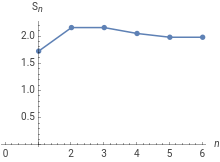
Infinite sum:
Fewer digits
More digits
∞
∑
k=1
k
1
2sin
kπ
3

2
k

Li
2
(-
2/3
(-1)
)-
Li
2

3
-1
≈2.029883212819307250042405+0.×
-25
10

Sum convergence:
∞
∑
k=1
k
1
2sin
kπ
3

2
k
converges
Partial sum formula:
n
∑
k=1
k
1
2sin
kπ
3

2
k
0
Partial sums:
More terms
Show points
Expanded form:

Li
2
(-
2/3
(-1)
)-
Li
2

3
-1

Alternate forms:
More
-
Li
2

3
-1
-
Li
2
(-
2/3
(-1)
)

Li
2
1
2
(1-
3
)-
Li
2
1
2
(1+
3
)
-

(1)
ψ

1
6

12
3
-

(1)
ψ

1
3

12
3
+

(1)
ψ

2
3

12
3
+

(1)
ψ

5
6

12
3
polygamma(n, x) is the nth derivative of the digamma function »
Series representations:
More
-
Li
2

3
-1
+
Li
2
(-
2/3
(-1)
)
2π
3
+
1
3
πlog(9)-
2
3
πlog(π)+
∞
∑
j=2
-

-1/2jπ

(-1+
jπ

)
j

π
3

ζ(2-j)
j!
-
Li
2

3
-1
+
Li
2
(-
2/3
(-1)
)
∞
∑
k=0
k
∑
j=0
-

Li
2-j
(
z
0
)
(j)
S
k

k

3
-1
-
z
0

-
k
-
2/3
(-1)
-
z
0


-k
z
0
k!
for (not (

0
∈ and 1≤

0
<∞))
-
Li
2

3
-1
+
Li
2
(-
2/3
(-1)
)-2π
arg-
3
-1
+x
2π
log(x)+2π
arg(
2/3
(-1)
+x)
2π
log(x)+
∞
∑
k=1
-

k

3
-1
-x
-
k
(-
2/3
(-1)
-x)

2
F
1
(k,k;1+k;x)
2
k
for (x∈ and x>1)
-
Li
2

3
-1
+
Li
2
(-
2/3
(-1)
)-2π
arg-
3
-1
+x
2π
log(x)+2π
arg(
2/3
(-1)
+x)
2π
log(x)+
∞
∑
k=1
-

k

3
-1
-x
-
k
(-
2/3
(-1)
-x)

-k
x
Β
x
(k,1-k)
k
for (x∈ and x>1)
log(x) is the natural logarithm »
n! is the factorial function »
ζ(s) is the Riemann zeta function »
S_n^(m) is the Stirling number of the first kind »
R is the set of real numbers »
arg(z) is the complex argument »
floor(x) is the floor function »
2F1(a, b, c, x) is the hypergeometric function »
beta(x, a, b) is the incomplete beta function »
More information »

2.029883212819307250042405
full Wolfram|Alpha results
In[3]:=
2.029883212819307250042405`25.300000000000004
Out[3]=
2.029883212819307250042405

In[4]:=
2.029883212819307250042405
Input interpretation:
2.029883212819307250042405
Number line:
Rational form:
405976642563861450008481
200000000000000000000000
= 2 +
5976642563861450008481
200000000000000000000000
Number name:
two point zero two nine eight eight three two one two eight one nine three one
Continued fraction:
Fraction form
[2; 33, 2, 6, 2, 1, 2, 2, 5, 1, 1, 7, 1, 1, 1, 113, 1, 4, 5, 1, 5, 1, 1, 1, 1, 1, 2]
Possible closed forms:
More
2

Gi
≈2.02988321281930725004240510854
V
fe
≈2.02988321281930725004240510854
1944802649π
3009915879
≈2.029883212819307249989
G_Gi is Gieseking's constant »
V_fe is the figure eight knot hyperbolic volume »

Sum[(-1)^k 2Sin(kpi/3)/k^2,{k,1,∞}]
related computations
full Wolfram|Alpha results
In[5]:=
Sum[(-1)^k*2*(Sin[(k*Pi)/3]/k^2), {k, 1, Infinity}]
Out[5]=
-
Li
2
-
3
-1
-
Li
2

2/3
(-1)


In[6]:=
Sum[(-1)^k 2Sin(kpi/3)/k^2,{k,1,∞}]
Infinite sum:
Fewer digits
More digits
∞
∑
k=1
k
(-1)
2sin
kπ
3

2
k
-
Li
2
-
3
-1
-
Li
2
(
2/3
(-1)
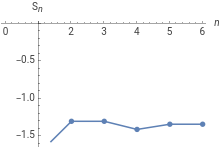
)≈-1.3532554752128715000282701+0.×
-26
10

Sum convergence:
∞
∑
k=1
k
(-1)
2sin
kπ
3

2
k
converges
Partial sums:
More terms
Show points
Alternate forms:
More
(1)
ψ

2
3
-
(1)
ψ

1
3

3
3
-

(1)
ψ

2
3

3
3
-

(1)
ψ

1
3

3
3
-
Li
2
1
2
(-1-
3
)-
Li
2
1
2
(-1+
3
)
polygamma(n, x) is the nth derivative of the digamma function »
Expanded form:

Li
2
(
2/3
(-1)
)-
Li
2
-
3
-1

Series representations:
More
-
Li
2
-
3
-1
-
Li
2
(
2/3
(-1)
)-
4π
3
-
2
3
πlog
9
4
+
4
3
πlog(π)+
∞
∑
j=2
-
(
j
(-)
-
(jπ)/2

)
j

2π
3

ζ(2-j)
j!
-
Li
2
-
3
-1
-
Li
2
(
2/3
(-1)
)
∞
∑
k=0
k
∑
j=0
-

Li
2-j
(
z
0
)
(j)
S
k

k
-
3
-1
-
z
0

-
k

2/3
(-1)
-
z
0


-k
z
0
k!
for (not (

0
∈ and 1≤

0
<∞))
-
Li
2
-
3
-1
-
Li
2
(
2/3
(-1)
)-2π
arg
3
-1
+x
2π
log(x)+2π
arg(-
2/3
(-1)
+x)
2π
log(x)+
∞
∑
k=1
-

k
-
3
-1
-x
-
k
(
2/3
(-1)
-x)

2
F
1
(k,k;1+k;x)
2
k
for (x∈ and x>1)
-
Li
2
-
3
-1
-
Li
2
(
2/3
(-1)
)-2π
arg
3
-1
+x
2π
log(x)+2π
arg(-
2/3
(-1)
+x)
2π
log(x)+
∞
∑
k=1
-

k
-
3
-1
-x
-
k
(
2/3
(-1)
-x)

-k
x
Β
x
(k,1-k)
k
for (x∈ and x>1)
log(x) is the natural logarithm »
n! is the factorial function »
ζ(s) is the Riemann zeta function »
S_n^(m) is the Stirling number of the first kind »
R is the set of real numbers »
arg(z) is the complex argument »
floor(x) is the floor function »
2F1(a, b, c, x) is the hypergeometric function »
beta(x, a, b) is the incomplete beta function »
More information »

In[21]:=
-1.3532554752128

In[19]:=
-1.3532554

In[17]:=
-1.35325547521

In[31]:=
Sum[(1)^k 2 cos (kpi/3)/k^2,{k,1,∞}]

In[33]:=
0.5483113556160754788241384

In[35]:=
Sum[(-1)^k 2 cos (kpi/3)/k^2,{k,1,∞}]

In[41]:=
-1.096622711232

In[43]:=
Sum[(1)^k 2 tan (kpi/3)/k^2,{k,1,∞}]

In[45]:=
2.70651095042574300005654

In[47]:=
Sum[(-1)^k 2 tan (kpi/3)/k^2,{k,1,∞}]

In[2]:=
Sum[(1)^k 2 secant (kpi/3)/k^2,{k,1,∞}]

In[4]:=
2.7415567780803773941206919444100419820315831686779973962259303822

In[6]:=
Sum[(-1)^k 2 secant (kpi/3)/k^2,{k,1,∞}]

In[12]:=
-5.478119

In[14]:=
Sum[(1)^k 2 cosecant (kpi/3)/k^2,{k,1,∞}]

In[16]:=
Sum[(-1)^k 2 cosecant (kpi/3)/k^2,{k,1,∞}]

In[18]:=
Sum[(1)^k 2 cotangent (kpi/3)/k^2,{k,1,∞}]

In[20]:=
Sum[(-1)^k 2 cotangent (kpi/3)/k^2,{k,1,∞}]

Hyperbolic Trig Functions


In[24]:=
Sum[(1)^k 2 hyperbolic sine (kpi/3)/k^2,{k,1,∞}]

In[26]:=
Sum[(-1)^k 2 hyperbolic sine (kpi/3)/k^2,{k,1,∞}]

In[28]:=
Sum[(1)^k 2 hyperbolic cosine (kpi/3)/k^2,{k,1,∞}]

In[30]:=
Sum[(-1)^k 2 hyperbolic cosine (kpi/3)/k^2,{k,1,∞}]

In[34]:=
Sum[(1)^k 2 hyperbolic tangent (kpi/3)/k^2,{k,1,∞}]

In[36]:=
2.83547

In[38]:=
Sum[(-1)^k 2 hyperbolic tangent (kpi/3)/k^2,{k,1,∞}]

In[40]:=
-1.22053

In[42]:=
-1.220533

In[44]:=
Sum[(1)^k 2 hyperbolic secant (kpi/3)/k^2,{k,1,∞}]

In[46]:=
1.39517

In[48]:=
1.395177

In[50]:=
Sum[(-1)^k 2 hyperbolic secant (kpi/3)/k^2,{k,1,∞}]

In[52]:=
-1.14454

In[54]:=
-1.144543

In[56]:=
-1.1445

In[58]:=
Sum[(1)^k 2 hyperbolic cosecant (kpi/3)/k^2,{k,1,∞}]

In[62]:=
1.750021

In[60]:=
1.750025

In[64]:=
Sum[(-1)^k 2 hyperbolic cosecant (kpi/3)/k^2,{k,1,∞}]

In[66]:=
-1.49191

In[69]:=
-1.491913

In[71]:=
Sum[(1)^k 2 hyperbolic cotangent (kpi/3)/k^2,{k,1,∞}]

In[73]:=
3.86792

In[75]:=
3.867924

In[77]:=
Sum[(-1)^k 2 hyperbolic cotangent (kpi/3)/k^2,{k,1,∞}]

In[80]:=
-2.19207

In[83]:=
-2.192077

In[82]:=
-2.192077

In[85]:=
-2.192066

K Cubed Construction

Trig Functions


In[87]:=
Sum[(1)^k 2 sin (kpi/3)/k^3,{k,1,∞}]

In[89]:=
1.9139676963148037145355750041420614322361289238200683761817616113

In[91]:=
1.9139676

In[93]:=
1.91396

In[95]:=
Sum[(-1)^k 2 sin (kpi/3)/k^3,{k,1,∞}]

In[102]:=
-1.5311741570518429

In[104]:=
Sum[(1)^k 2 cos (kpi/3)/k^3,{k,1,∞}]

In[106]:=
0.8013712687730628569331587743409666605099908615603325878615143702

In[108]:=
0.801371

In[111]:=
Sum[(-1)^k 2 cos (kpi/3)/k^3,{k,1,∞}]

In[115]:=
-1.068495