Qubit Explained
Qubit Explained
Bloch Sphere, SU(2) Rotations, Time Evolution, and Measurements
A Guided, Computation-First Narrative with the Wolfram Language
A Guided, Computation-First Narrative with the Wolfram Language
Mads Bahrami (last updated: Mar 17, 2026)
Wolfram Research Inc, USA
Live Demo: Wolfram × Qolab at APS March Meeting 2026Join us at 11:30 AM, Wednesday, March 18 at the Wolfram Booth (#2307), APS 2026 Exhibition Hall in Denver, for a live demonstration of the Wolfram Mathematica connected to Qolab’s superconducting qubit hardware — featuring John Martinis, 2025 Nobel Laureate in Physics and CTO of Qolab.cSee real quantum computations run from Wolfram Language on cloud-accessible superconducting qubits, live.Here is the notebook we will represent: https://www.wolframcloud.com/obj/mohammadb/Published/TransmonLab-Public.nb📍 Colorado Convention Center, Exhibition Hall, Booth 2307🕦 Wednesday, March 18 · 11:30 AM
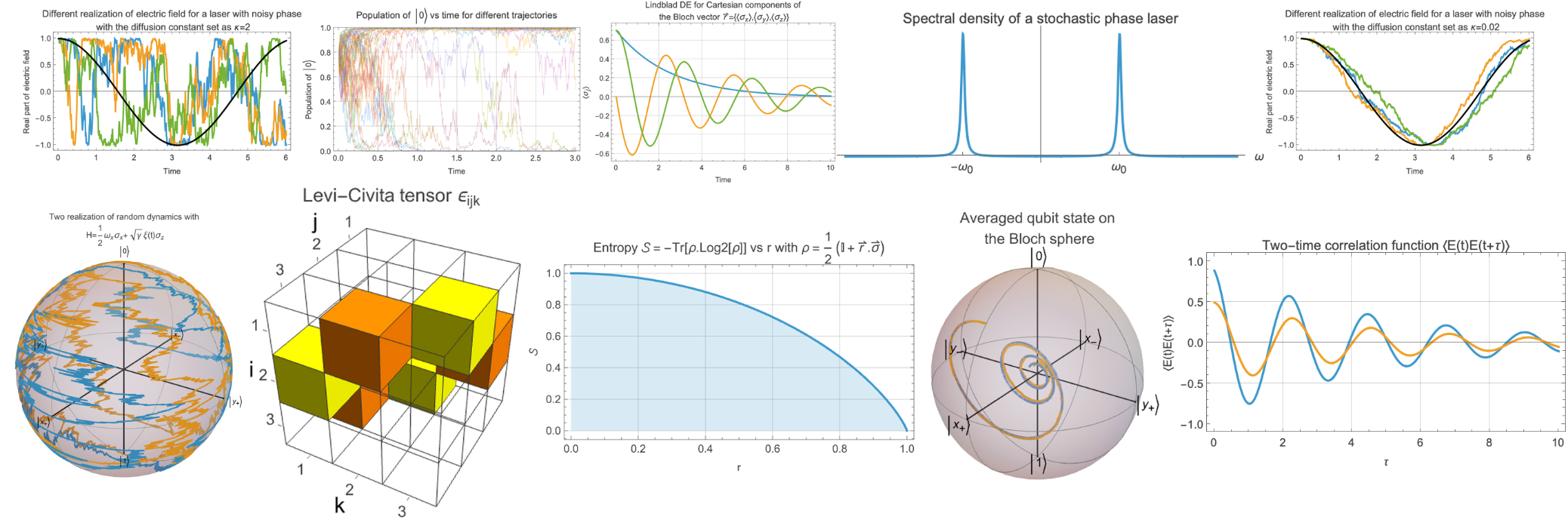
Setting the Stage: How This Notebook Flows
Setting the Stage: How This Notebook Flows
Complex Numbers as Two Degrees of Freedom
Complex Numbers as Two Degrees of Freedom
State Vectors and Normalization (Norms, Global Phase, Degrees of Freedom)
State Vectors and Normalization (Norms, Global Phase, Degrees of Freedom)
The Most General Pure Qubit State
The Most General Pure Qubit State
Bra–Ket Notation and Inner Products
Bra–Ket Notation and Inner Products
Computational Basis and Superposition
Computational Basis and Superposition
The Bloch Vector Map: Turning a Qubit into Geometry
The Bloch Vector Map: Turning a Qubit into Geometry
The Bloch Vector: Cartesian and Spherical Coordinates
The Bloch Vector: Cartesian and Spherical Coordinates
Pauli Matrices Appear: Axes, Eigenstates, and Bloch-Sphere Landmarks
Pauli Matrices Appear: Axes, Eigenstates, and Bloch-Sphere Landmarks
Changing Basis: Unitary Matrices as Basis Machines
Changing Basis: Unitary Matrices as Basis Machines
Coordinates of the Same State in Different Bases
Coordinates of the Same State in Different Bases
Measurement as Probabilities: Born Rule in the Eigenbasis
Measurement as Probabilities: Born Rule in the Eigenbasis
Expectation Values: Two Equivalent Computations
Expectation Values: Two Equivalent Computations
Why Pure-State Vectors Aren’t Enough: The Stern–Gerlach Experiment
Why Pure-State Vectors Aren’t Enough: The Stern–Gerlach Experiment
No Pure State Can Be Unpolarized in Every Basis
No Pure State Can Be Unpolarized in Every Basis
Density Matrices: What They Are and How to Read Their Entries
Density Matrices: What They Are and How to Read Their Entries
Basis-Dependence Returns: Density Matrices in Different Bases
Basis-Dependence Returns: Density Matrices in Different Bases
Outer Products and Projectors
Outer Products and Projectors
Expectation Values via Trace
Expectation Values via Trace
Hermiticity Condition on Density Matrices
Hermiticity Condition on Density Matrices
Positivity, Eigenvalues, and the Meaning of Bloch Vector’s Length
Positivity, Eigenvalues, and the Meaning of Bloch Vector’s Length
Purity and von Neumann Entropy: Quantifying Mixedness
Purity and von Neumann Entropy: Quantifying Mixedness
Hilbert–Schmidt Operator Basis: Why the Pauli Expansion Always Works
Hilbert–Schmidt Operator Basis: Why the Pauli Expansion Always Works
How Density Matrices Transform Under Basis Change
How Density Matrices Transform Under Basis Change
Unitaries and SU(2): The Home of Single-Qubit Dynamics
Unitaries and SU(2): The Home of Single-Qubit Dynamics
Lie Groups and Lie Algebras: Generators, Exponentials, and Conventions
Lie Groups and Lie Algebras: Generators, Exponentials, and Conventions
Commutators, Levi–Civita, and the Pauli Product Identity
Commutators, Levi–Civita, and the Pauli Product Identity
From Algebra to Rotations
From Algebra to Rotations
SU(2) Acts as SO(3) on the Bloch Vector
SU(2) Acts as SO(3) on the Bloch Vector
The Double Cover: Why 2π Looks Like Identity on the Sphere but Not in SU(2)
The Double Cover: Why 2π Looks Like Identity on the Sphere but Not in SU(2)
Splitting Exponentials and Ignoring the Identity Term (Zassenhaus Insight)
Splitting Exponentials and Ignoring the Identity Term (Zassenhaus Insight)
Euler Angles: Decomposition of a Unitary Transformation
Euler Angles: Decomposition of a Unitary Transformation
Projectors as Measurements: Yes/No Questions and State Filtering
Projectors as Measurements: Yes/No Questions and State Filtering
General Spin Measurement
General Spin Measurement
Born Rule in Bloch Form
Born Rule in Bloch Form
Beyond Projective Measurements: POVMs
Beyond Projective Measurements: POVMs
POVMs: Post-Measurement States
POVMs: Post-Measurement States
POVMs and Quantum Channels
POVMs and Quantum Channels
POVMs: Same Statistics, Different Measurements
POVMs: Same Statistics, Different Measurements
Time Evolution: Schrodinger Equation
Time Evolution: Schrodinger Equation
Time Evolution: Stationary States
Time Evolution: Stationary States
Time Evolution: the Liouville–von Neumann Equation
Time Evolution: the Liouville–von Neumann Equation
Time Evolution: Pulses
Time Evolution: Pulses
Drunken Sailor: Open Quantum Systems
Drunken Sailor: Open Quantum Systems
From Sailor to Brownian Particle
From Sailor to Brownian Particle
Noisy Phase of a Laser: Brownian Motion!
Noisy Phase of a Laser: Brownian Motion!
White Noise: Stratonovich Viewpoint
White Noise: Stratonovich Viewpoint
From Noise-Averaging to the Lindbald Equation
From Noise-Averaging to the Lindbald Equation
Collapse as Dynamical Equation and not a Postulate:
Collapse as Dynamical Equation and not a Postulate:
Where This Leaves Us (and What Comes Next)
Where This Leaves Us (and What Comes Next)
Acknowledgment
Acknowledgment