Cross-Validation: Lean vs. Wolfram
Cross-Validation: Lean vs. Wolfram
Systematic comparison of Lean definitions against independent Wolfram implementations. If the same machine on the same input produces the same output in both systems, the definitions are likely correct. A disagreement on any input proves a bug.
Setup
(*NoLeanLinkneeded—thisnotebookusesonlybuilt-inWolframfunctions*)(*asanindependentcross-checkagainsttheLeandefinitions*)
1. Bi-Infinite Turing Machine: Wolfram's (2,3) UTM
The Lean definition in defines as a 3-state, 3-symbol machine. Lean verifies concrete steps via .
Machines/BiInfiniteTuringMachine/Defs.lean
wolfram23
native_decide
Lean reference values
Lean reference values
From and (verified by ):
wolfram23Step1
wolfram23Step2
native_decide
◼
Initial: state=1, tape=...0000000... (head on bold)
◼
After 1 step: state=2, tape=...0010000... (head moved right, wrote 1)
◼
After 2 steps: state=1, tape=...0001200... (head moved left)
Wolfram cross-check
Wolfram cross-check
wolfram23Rules={{1,0}->{2,1,1},{1,1}->{1,2,-1},{1,2}->{1,1,-1},{2,0}->{1,2,-1},{2,1}->{2,2,1},{2,2}->{1,0,1}};tmEvolution=TuringMachine[wolfram23Rules,{1,{0}},5];<|"FirstThreeConfigurations"->tmEvolution[[1;;3]],"StillRunningAfter20Steps"->MatchQ[Last@TuringMachine[wolfram23Rules,{1,{0}},20],{{_,_,_},_}],"RulePlot"->RulePlot[TuringMachine[wolfram23Rules],{1,{0}},50]|>
FirstThreeConfigurations{{{1,1,0},{0}},{{2,1,1},{1}},{{2,1,2},{2}}},StillRunningAfter20StepsTrue,RulePlot

2. Elementary Cellular Automaton: Rule 110
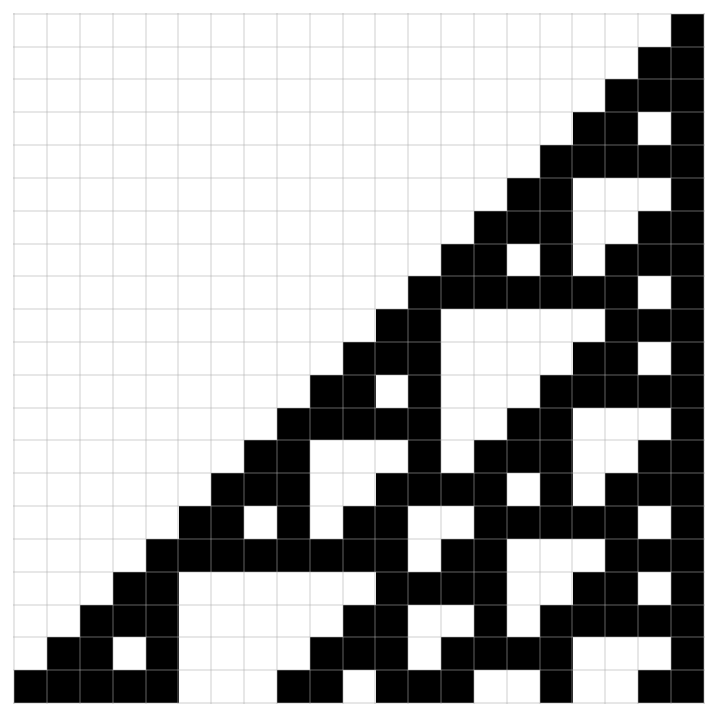
The Lean definition in defines via which extracts the rule from the binary representation of 110.
Machines/ElementaryCellularAutomaton/Defs.lean
rule110
ruleTable 110
Lean reference
Lean reference
The theorem (verified by ) confirms: for all .
mirrorProperty
decide
rule110(a,b,c) = rule124(c,b,a)
a, b, c : Fin 2
Rule 110 in binary: 01101110
◼
Neighborhood 111 → 0
◼
Neighborhood 110 → 1
◼
Neighborhood 101 → 1
◼
Neighborhood 100 → 0
◼
Neighborhood 011 → 1
◼
Neighborhood 010 → 1
◼
Neighborhood 001 → 1
◼
Neighborhood 000 → 0
Wolfram cross-check
Wolfram cross-check
ruleValue[rule_Integer,triple_List]:=CellularAutomaton[rule,triple,1][[-1,2]]triples=Tuples[{0,1},3];rule110Table=AssociationThread[triples,ruleValue[110,#]&/@triples];<|"Rule110Table"->rule110Table,"MirrorProperty"->And@@(ruleValue[110,#]===ruleValue[124,Reverse@#]&/@triples),"EvolutionPlot"->ArrayPlot[CellularAutomaton[110,{{1},0},20],Mesh->True]|>
Rule110Table{0,0,0}0,{0,0,1}1,{0,1,0}1,{0,1,1}1,{1,0,0}0,{1,0,1}1,{1,1,0}1,{1,1,1}0,MirrorPropertyTrue,EvolutionPlot
3. Tag System: 2-Tag Example
The Lean definition in defines :
Proofs/TagSystemToCyclicTagSystem.lean
exampleTag2
◼
Alphabet: {0, 1} (k=2)
◼
Productions: 0 → [1, 0], 1 → [0]
◼
Deletion number: 2
Lean reference values
Lean reference values
Tag system steps (verified by the simulation theorems):
◼
[0, 1, 0]
[0, 1, 0]
◼
[1, 0, 1]
[1, 0]
◼
[0, 0, 1, 1]
[1, 1, 1, 0]
Wolfram cross-check
Wolfram cross-check
(*2-tagsystem:delete2,productions0->[1,0],1->[0]*)tagProductions={{1,0},{0}};(*Manualstepfunctionfor2-tag*)tagStep[word_List]:=If[Length[word]<2,word,Join[Drop[word,2],tagProductions[[word[[1]]+1]]]];(*OrusetheResourceFunction*)(*ResourceFunction["TagSystem"][{2,{{{1,0},{0}}}},{0,1,0},1]*)<|"[0,1,0]"->tagStep[{0,1,0}],"[1,0,1]"->tagStep[{1,0,1}],"[0,0,1,1]"->tagStep[{0,0,1,1}]|>
[0,1,0]{0,,0},[1,0,1]{,0},[0,0,1,1]{,,,0}
2
Null
2
Null
2
Null
2
Null
2
Null
4. Cyclic Tag System: Cook's Encoding
The Lean definition constructs a CTS from with appendants (where T=true, F=false, using 2k=4 appendants).
exampleTag2
[[F,T,T,F], [T,F], [], []]
Lean reference values
Lean reference values
From the simulation verification theorems (verified by ):
native_decide
◼
Encoded = → after 4 CTS steps → encoded =
[0,1,0]
[T,F,F,T,T,F]
[0,1,0]
[T,F,F,T,T,F]
◼
Encoded = → after 4 CTS steps → encoded =
[1,0,1]
[F,T,T,F,F,T]
[1,0]
[F,T,T,F]
◼
Encoded = → after 4 CTS steps → encoded =
[0,0,1,1]
[T,F,T,F,F,T,F,T]
[1,1,1,0]
[F,T,F,T,F,T,T,F]
Wolfram cross-check
Wolfram cross-check
(*One-hotencoding:symboliink-alphabet→k-bitwordwithTrueatpositioni+1*)symbolEncode[k_,i_]:=Table[j==i,{j,0,k-1}];tagWordEncode[k_,word_]:=Flatten[symbolEncode[k,#]&/@word];(*BuildCTSfromtagsystem:2kappendants*)(*Production0→[1,0]:encodeastagWordEncode[2,{1,0}]={False,True,True,False}*)(*Production1→[0]:encodeastagWordEncode[2,{0}]={True,False}*)(*Thenkemptyappendants*)appendants={tagWordEncode[2,{1,0}],(*productionforsymbol0*)tagWordEncode[2,{0}],(*productionforsymbol1*){},(*empty—padding*){}(*empty—padding*)};(*CTSstepfunction*)ctsStep[data_List,phase_Integer,app_List]:=Module[{newData,newPhase},If[data==={},{data,phase},newPhase=Mod[phase+1,Length[app]];newData=If[First[data],Join[Rest[data],app[[phase+1]]],Rest[data]];{newData,newPhase}]];(*Run4CTSstepsonencoded[0,1,0]*)encoded010=tagWordEncode[2,{0,1,0}];{data,phase}={encoded010,0};Do[{data,phase}=ctsStep[data,phase,appendants],{4}];match010=data===tagWordEncode[2,{0,1,0}];(*Run4CTSstepsonencoded[1,0,1]*)encoded101=tagWordEncode[2,{1,0,1}];{data,phase}={encoded101,0};Do[{data,phase}=ctsStep[data,phase,appendants],{4}];result101=data;match101=data===tagWordEncode[2,{1,0}];(*Run4CTSstepsonencoded[0,0,1,1]*)encoded0011=tagWordEncode[2,{0,0,1,1}];{data,phase}={encoded0011,0};Do[{data,phase}=ctsStep[data,phase,appendants],{4}];<|"symbolEncode(2,0)"->symbolEncode[2,0],"symbolEncode(2,1)"->symbolEncode[2,1],"tagWordEncode(2,{0,1})"->tagWordEncode[2,{0,1}],"Appendants"->appendants,"Match010"->match010,"Result101"->result101,"Match101"->match101,"Result0011"->data,"Match0011"->(data===tagWordEncode[2,{1,1,1,0}])|>
5. Generalized Shift: TM ↔ GS Roundtrip
Lean reference
Lean reference
◼
(1,0) → write=1, state=2, R
◼
(1,1) → write=1, state=1, L
◼
(2,0) → write=1, state=1, L
◼
(2,1) → write=0, state=2, R
The encoding merges state into the tape alphabet (extended alphabet size = states * symbols + symbols = 2*2+2 = 6). Window width = 3.
Wolfram cross-check
Wolfram cross-check
Summary
If all cross-checks produce matching results, the Lean definitions agree with Wolfram's independent implementations. Any disagreement identifies a definition bug that must be fixed before the formal proofs built on that definition can be trusted.