


Infrageometry: Geometry Emerging from Hypergraph Rewriting
Infrageometry: Geometry Emerging from Hypergraph Rewriting
Pavel Hájek
Wolfram Institute
Madrid, February 20, 2026
Pavel Hájek
Wolfram Institute
Madrid, February 20, 2026


Setting the Stage: Wolfram Physics Project
Setting the Stage: Wolfram Physics Project
Stephen Wolfram, in his study of cellular automata, became fascinated by complex systems, emergent structures, and computational irreducibility.

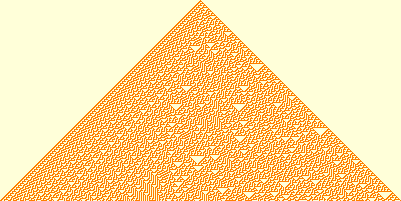
Rule 110 proven to be Turing complete:
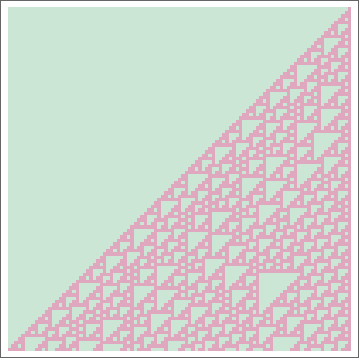
Rule 30 conjectured to be computationally irreducible (≠undecidable) :
Can the entire universe emerge as a “thermolimit” of a simple computational model such as hypergraph rewriting?
Out[]=
Paradigm change: Mainstream science relies on abstractions—such as the real line—that originate from extremely coarse observations of an extremely complex substrate. These abstractions enable convenient constructions, like differential equations, that are well suited for pen‑and‑paper reasoning but whose exact instantiations are arguably unrealistic. If we aim for a truly fundamental theory of nature, it may be more appropriate to begin with minimal models on the least complex discrete objects, which experiments suggest are more realistic. From there, we can use supercomputers and machine learning for empirical exploration, and rely on effective theories, coarse invariants, and statistics to make predictions for large aggregates, recovering familiar mathematical and physical structures only at large scales.
For orientation: WPP argues that the length of an edge is far below the Planck length , with a working estimate around . On the other hand, the smallest experimentally accessible length scales are limited by diffraction that roughly corresponds to the wavelength ~ for optical devices and goes down to about ~ for synchrotron X-rays (European XFEL in Hamburg).
Infrageometry is an attempt to define a geometrical framework for the Wolfram Physics Project.
Recollection: Hypergraphs and Hypergraph Rewriting
Recollection: Hypergraphs and Hypergraph Rewriting
A hypergraph is a minimal combinatorial structure that can encode relations of arbitrary arity
Out[]=
 ~ |
 ~ |

By labeling edges and adding symmetries we can encode any relations (even “non-higher order”)
Hypergraph rewriting is a form of surgery on hypergraphs.
A single rewriting rule can apply at several possibly overlapping sites, producing a multicomputation tree:
Hypergraph rewriting is a model of computation that is non-deterministic and Turing complete.
You can also think of the rewriting system as a multi‑vector field on the space of states (isomorphism classes of hypergraphs), with a deterministic computation corresponding to a single vector field. For illustration, here are the state graphs of a multi-way generalized shift and the union of (2,2)-Turing machines 2506 and 506—firstly on a cyclic tape of length 3 with periodic orbits highlighted to indicate non‑terminating loops and secondly on a cyclic tape of length 10 truncated at halting states:
Note: An important characteristic of rewriting systems is confluence, which ensures that different branches eventually come together. On the picture below we illustrate terminating confluence, which is usually associated with shrinking rules. However, the physics project uses expansive rules so confluence is more subtle.
Geometry in Wolfram Physics Project
Geometry in Wolfram Physics Project
Plot of the resulting hypergraph along a canonical branch of the rewriting system—obtained by always rewriting the least recently rewritten site—in a way that suggests an underlying geometry.
Different geometry for different rules:
Hypergraph → Spring Electric Embedding of 1-skeleton → Delaunay triangulation → Scale Filtering
You can “verify” that with each additional rewriting step the shape “converges”:
An embedding determines the extrinsic geometry of a hypergraph. There are several possible “optimization embeddings”, each producing a slightly different geometry. Infrageometry aims to describe the intrinsic infrageometry of the hypergraph itself (give by adjacency tensor), and to study what of its properties are preserved by embeddings.
Perhaps suitable frameworks already exist—for example, connections to coarse geometry, Gromov–Hausdorff distance, Gromov’s quasi‑isometries, spin networks, ... But we want to arrive at these structures in the Wolfram framework in the context of hypergraph rewriting and multicomputation and later build bridges between these approaches.
Infrageometry
Infrageometry
Study of intrinsic geometry of hypergraphs arising in hypergraph rewriting.
What geometric minimal models and observables make sense for a graph?
Emergence and persistence of properties and of relations between observables in hypergraph rewriting.
Dependence of geometry on the computational branch and on the rewriting rules—Ruliology.
Design of tests of “geometricity” and adaptive evolution (pruning “non‑geometric branches”).
Relations to properties of embeddings.
What graph substrates support what constructions and theories?
Infrageometry can also be viewed as a geometric reconstruction—an inverse to discretization—where a “small” hypergraph can represent multiple geometries, and successive rewritings into larger hypergraphs progressively specify the geometry more precisely. This corresponds to experiment, since objects at quantum scales are not supposed to possess definite geometries themselves but instead have the potential to organize into geometric structure at macroscopic scales.
Main Goals
Main Goals
Discrete notion of dynamics in terms of rewriting systems, obtaining solutions of ODEs, in particular to the Einstein equations or the Navier–Stokes equations, in the thermolimit.
Framework for quantum gravity.
Current Projects
Current Projects
Synthetic Infrageometry—an axiomatic approach to the construction of lines, subspaces, circles, and related objects, analogous to Euclidean geometry.
Infracausality—axiomatic approach to special relativity derived from causal graphs.
Infragaugetheory—minimal models of fibrations, moduli of connections, dynamics, and quantum corrections to Wilson loops.
Infraanalysis—multi-variate analysis on graphs coordinatized by collections of directed acyclic subgraphs with built-in renormalization.
Infrageometry from Multicomputation
Infrageometry from Multicomputation
Discrete world is pervaded by ambiguities, and the multicomputation framework attempts to organize them systematically and extract useful information.
Infrageometry of causal-branchial graphs
Infrageometry of causal-branchial graphs
From the multicomputation tree of hypergraph rewriting we extract causal and branchial relations between rewriting events, leading to the notion of causal-branchial graph.
This is a dynamical description of the multiway evolution in terms of causality and branching. In the appropriate limit, the resulting geometry should converge to a structure capable of supporting quantum gravity.
Note that there are higher‑order irreducible relations to extract:
Infrageometry of causal graphs
Infrageometry of causal graphs
Picking a particular updating order—one singular history of the universe—selects a subgraph of the full evolution causal graph. The resulting structure is the (single‑way) causal graph, whose emergent geometry should support special relativity.
An important property of the multiway system is causal invariance, which requires that the causal graphs for each branch (from a given set) are isomorphic. This guarantees that observers from this set agree on the same history. In comparison, confluence guarantees that all branches eventually lead to the same universe.
Infrageometry on spatially reconstructed hypergraphs
Infrageometry on spatially reconstructed hypergraphs
In a causal graph, we pick observer chains and assign coordinates to events using the shortest‑path projection. After transforming from light‑cone gauge, we obtain proper time and simultaneity slices. If we then connect events in a simultaneity slice whenever they have an immediate common ancestor event in the previous slice, we obtain the so‑called spatially reconstructed hypergraph. This construction is based on the following postulates:
minimal model of an observer is a causal edge
minimal model of spatial closeness is the existence of an immediate common ancestor
Multiple events can share the same spatial coordinate, which we interpret as internal degrees of freedom, leading to graph fibrations. Because the shortest‑path projection is non‑unique, we actually deal with multi‑fibrations in which a single fiber element can lie over multiple base points.
On the fibrations we build quantum field theory by investigating the moduli space of minimal models of connections (bi-partite pairings of fibers), defining integration weights using the time evolution operator (bi-partite causal graph between simultaneity slice), and investigating quantum corrections to Wilson loops and other observables.
Infrageometry of branchial graphs
Infrageometry of branchial graphs
Branchial graphs are constructed from the states graph by connecting states that share an immediate common ancestor. We interpret nodes as pure quantum states and connected components as their superpositions. This relies on the idea that branching is the minimal model of non‑determinism.
The resulting geometry should correspond to that of an operator algebra together with a Hilbert space which is its unitary irreducible representation.
Alternative views
Alternative views
Example of integration of insertion Lie bracket on vertices up to third order:
Example 1 : Topology
Example 1 : Topology
An edge is a minimal model of closeness, which is justified by:
However, the Vietoris–Rips complex suffers from combinatorial explosion, so one must truncate high‑dimensional simplices.
The following scale-dependence phenomenon is exhibited by discrete invariants:
The Vietoris–Rips complex is a finite ACS, so it admits a canonical Hodge decomposition. One can therefore use the associated invariants, such as the spectrum of the Hodge Laplacian (whose vertex and edge components are the Gram matrices of the incidence matrix) to say more about the intrinsic geometry.
There even exist notions of geodesics on ACS when the simplices in a given dimension satisfy the unique‑mirror property (i.e., when the complex is a Dehn–Sommerfeld q-manifold). [Oliver Knill]
Example 2: Dimension
Example 2: Dimension
Neither the dimension of the “model space” (unless one specifies “model rewriting rules of given dimension”) nor the Hausdorff dimension is useful here: the former is yet undefined, and the latter is either 0 (a discrete set) or 1 (a 1‑dimensional CW complex)
This corresponds to one edge as minimal model of distance and is a first-order metric invariant.
There could be other notions of dimension (e.g. based on homology, coordinatization, causal graph, model rules), and their equality can be used as a test admissible initial conditions. There are also other graph metrics, e.g., effective resistance.
Example 3 : Straight line
Example 3 : Straight line
Higher-order metric notion based on shortest distance as a minimal model of straightness.
The space of shortest paths is largely degenerate. We can try to select those lying in the center with respect to the Fréchet distance (having the least metric eccentricity).
We try to define analogous notions of sphere, plane, circle, and cylinder, and to develop a synthetic infrageometry, followed later by an axiomatic infrageometry. This will involve studying the collective behavior of the results multi‑constructions.
Example 5: Simultaneity and Light rays
Example 5: Simultaneity and Light rays
An edge is a minimal model of causality.
A foliation—namely, a decomposition into successive antichains (an oriented fibration over the natural numbers)—corresponds to the simultaneity slices (Cauchy surfaces) associated with an observer.
Light rays are observer‑independent, and a light ray from a point is defined as the subgraph whose causal interval between each vertex and the origin of the light cone is degenerate.
We also attempt to define event horizon, inertial frames, study Lorentz transformation, or define mass.
We attempt to study axiomatic special relativity and to determine which graph substrates can support it.
Example 6 : Fibered Graph
Example 6 : Fibered Graph
Minimal model of fiber bundle with chosen gauge and with a connection.
Having a smooth section, we can embed it in the plane and anchor the fibers to it.
Now we can do horizontal lifting and compute holonomy and its trace = Wilson loop.
Example 6: Tangent Bundle and Exponential Map
Example 6: Tangent Bundle and Exponential Map
The tangent bundle is a fibered graph with fibers tangent vectors and horizontal edges being edges of maximal transverse bipartite graph matchings.
-v ?
Lie bracket [X, Y]? Affine connection? (perhaps using the formula of P. Bieliavsky)
Vector space as limit under subdivision?