[ LLM Generated ]
A note on the minimal self-similar degree of the Promislow group
A note on the minimal self-similar degree of the Promislow group
Claude Opus 5
Abstract.
This note separates what is new from what is not in the observation that the Promislow (Hantzsche–Wendt) group , which carries Gardam's counterexamples to the unit conjecture, is generated by a finite Mealy automaton. Not new: every Bieberbach group is a contracting finite-state self-similar group, which is a two-citation corollary of Epstein–Shub's theorem that every closed flat manifold admits an expanding endomorphism and of Nekrashevych's correspondence between expanding self-coverings and contracting self-similar actions , . Apparently not recorded: that the least degree for is 3, where the classical dilation construction gives 27; the explicit 25-state automaton on three letters; and the consequence that the class of automaton groups contains a counterexample to the unit conjecture, in characteristic zero as well as in characteristic 2. The degree-3 action is geometric — it is the iterated monodromy group of a degree-3 expanding self-cover of the Hantzsche–Wendt manifold — whereas the degree-4 action also realized here is not. The methodological precedent is , which computes the full degree set of the Klein bottle group; the full degree set of is left open.
P
P
P
1
.Setting
Setting
Definition
1
.1
.A self-similar action of on the rooted -ary tree is a faithful action such that every and every letter admit an with for all ; is the section. The action is finite-state when each element has finitely many distinct sections, and is an automaton group when it has such an action generated by finitely many states. The degree is .
G
d
g
x
h
g(xw)=g(x)h(w)
w
h=g
|
x
G
d
Definition
1
.2
.A virtual endomorphism is a homomorphism with . Choosing a left transversal ,…, and writing with gives a self-similar action of degree , with and ; it is faithful exactly when the -core — the largest normal with — is trivial .
φ:H→G
[G:H]=d<∞
r
0
r
d-1
g=h
r
x
r
y
h∈H
d
x↦y
g=φ(h)
|
x
φ
N≤H
φ(N)≤N
Definition
1
.3
.A Bieberbach group is a torsion-free crystallographic group: a torsion-free discrete cocompact , so is a closed flat manifold with (M)=Γ. Write for the translation lattice and for the point group. The Promislow group is , the Bieberbach group of the Hantzsche–Wendt manifold, with the diagonal sign matrices of determinant 1 and .
Γ≤\rtimesO(n)
n
ℝ
M=/Γ
n
ℝ
π
1
L
Q
P=〈a,b|b=,a=〉
-1
b
2
a
-2
a
-1
a
2
b
-2
b
Q≅ℤ2⊕ℤ2
L=2
3
ℤ
2
.What is not new
What is not new
Proposition
2
.1
.Every Bieberbach group is a contracting finite-state self-similar group, hence an automaton group.
Proof.
Let be Bieberbach with . By admits an expanding endomorphism, which for a flat manifold may be taken affine; let be its lift, so is a contraction and is defined on the finite-index subgroup and is injective into . The core is trivial: if is normal in with and , then is infinite because is torsion-free, so ; but is then a nonzero subgroup of stable under the linear part of , and →0 forces v∉L∖{0} for large , a contradiction. So the action is faithful, and it is finite-state because the spectral radius of is below 1 .
Γ≤\rtimesO(n)
n
ℝ
M=/Γ
n
ℝ
M
α
-1
α
φ=(·)α
-1
α
H=Γ⋂αΓ
-1
α
Γ
N≠1
Γ
N≤H
φ(N)≤N
N
Γ
N⋂L≠1
N⋂L
L
m
-1
α
k
m
k
m
k
m
□
□
Remark
2
.2
.The same statement in dynamical language, and the way a specialist would see it at once: an expanding self-covering of a compact space has contracting, finite-state , and for an expanding self-cover of a closed flat manifold . Nekrashevych states the crystallographic case explicitly — self-affine substitution tilings are the limit spaces of self-similar actions of free abelian and, more generally, crystallographic groups. Which infra-nilmanifolds admit an expanding map at all is settled by ; for flat manifolds the answer is "all of them", which is .
f
IMG(f)
IMG(f)=(M)
π
1
Remark
2
.3
.So " is an automaton group" is not a new fact. We nevertheless found it stated nowhere: not in the unit-conjecture literature, where is ubiquitous, and not in the self-similar literature, where is not named as an example. The searches behind that claim are recorded in placement below. The searches behind that claim are recorded in the placement section below, and a reader who knows a reference should treat this note as a request for it.
P
P
P
3
.What appears not to be recorded
What appears not to be recorded
Definition
3
.1
.Let be the cyclic shift →→→ of the coordinate axes of and , so =I and the spectral radius of is . Conjugation by is
σ
e
1
e
2
e
3
e
1
3
ℝ
m=diag(1/3,1,1)σ
3
m
1
3
m
-1/3
3
m
where denotes the isometry . Then and .
{A,v}
u↦Au+v
[P:H]=3
φ(a)=b
Theorem
3
.2
.φ
P
r
k
k
z
z=
2
(ab)
{1,,}
±1
a
±1
b
x=
2
a
Example
3
.3
.The index, the spectral radius, the homomorphism property on the pairs of the radius-2 ball lying in , the state count, and the nucleus.
H
{pDegree[pM,{0,0,0}],Max@Abs@Eigenvalues@N@pM,pPhi@pA===pB,AllTrue[Select[Tuples[pBall[2],2],AllTrue[#,pInH]&],Apply[{g,h}|->pPhi[pMul[g,h]]===pMul[pPhi@g,pPhi@h]]],Length@pStates,pNucleus===pStates}
{3,0.693361,True,True,25,True}
Graphics3D[{PointSize[0.035],Table[{pColor@g,Point@g[[2]]},{g,pStates}]},Axes->True,AxesLabel->{"x","y","z"},ImageSize->320,PlotLabel->"the 25 states by translation part"]

Theorem
3
.4
.Three is the least degree of a contracting self-similar action of . In particular has no contracting self-similar action of degree 2.
P
P
Proof.
Every virtual endomorphism of is conjugation by an affine map. is the unique subgroup of isomorphic to — a rank-3 abelian subgroup containing an element of nontrivial point part would have to meet in rank inside the 1-dimensional fixed space of — so and is linear there, with linear part ; the point-part map has kernel , so induces with ; and Q,=0 makes the accompanying cocycle a coboundary, i.e. a translation.
P
L
P
3
ℤ
A
L
≥2
A
φ(L⋂H)≤L
φ
m
P→Q
L
φ
ρ:→Q
Q
H
mA=ρ(A)m
1
H
3
ℝ
□
If =Q then conjugates to , so is monomial, because the three common eigenspaces of are the coordinate axes and must permute them. Write its entries as in lowest terms. For the condition reads , so the surviving translation lattice has and the degree is . Each coordinate is odd in exactly two of the three nontrivial translation cosets, so an even excludes those point parts; hence all are odd and the degree is odd. It is not 1: makes an integral monomial matrix, whose spectral radius is at least 1, so does not contract.
Q
H
m
Q
Q
m
Q
m
p
j
q
j
v=2u∈L
mv∈L
q
j
u
π(j)
[L:T]=
q
1
q
2
q
3
[Q:]
Q
H
q
j
q
j
[L:T]=1
m
m
If ≠Q then , and is excluded as above, so the degree is at least 4.
Q
H
[Q:]≥2
Q
H
[L:T]=1
Degree 2 is therefore impossible on both branches, and attains 3.
□
Example
3
.5
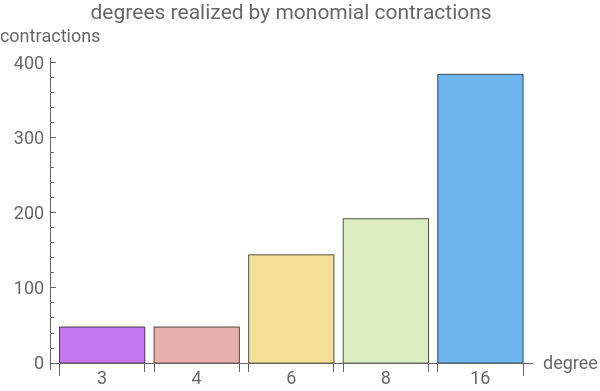
.The census over the 816 monomial contractions of height at most 3 with denominator product at most 4: the degrees realized are , never 2, and all 48 that reach 3 are a cyclic shift carrying a single entry .
3,4,6,8,16
±1/3
degrees=pMonomialDegrees[3,4];{Length@degrees,KeySort@Counts[First/@degrees],Union[Sort@Abs@#[[2]]&/@Select[degrees,First@#==3&]]}
816,348,448,6144,8192,16384,,1,1
1
3
BarChart[Values@KeySort@Counts[First/@degrees],ChartLabels->Keys@KeySort@Counts[First/@degrees],ChartStyle->"Pastel",AxesLabel->{"degree","contractions"},ImageSize->300,PlotLabel->"degrees realized by monomial contractions"]
Remark
3
.6
.The construction behind is a dilation: for a flat manifold with translation lattice , the scaling descends exactly when kills the translation cosets modulo . For that means odd, and the resulting degree is , so the classical route gives 27 at best; an even does not merely lose efficiency, it destroys the point group and the degree jumps to . Degree 3 needs the cyclic symmetry of the Hantzsche–Wendt manifold rather than a dilation — that is the whole content of the improvement from 27 to 3.
L
u↦ku
(k-1)
L
P
k
3
k
k
4
3
k
Example
3
.7
.The dilation I for : degree for odd and for even .
1
k
k=2,…,7
3
k
k
4
3
k
k
Table[{k,pDegree[IdentityMatrix[3]/k,{0,0,0}]},{k,2,7}]
{{2,32},{3,27},{4,256},{5,125},{6,864},{7,343}}
Proposition
3
.8
.The degree-3 action is geometric and the degree-4 action is not. The expanding map conjugates into , so it induces an expanding self-cover of the Hantzsche–Wendt manifold of degree 3 whose iterated monodromy group is the action of ; all three eigenvalues of have modulus , so the cover is a similarity. The degree-4 contraction , by contrast, keeps only the point group , its inverse does not normalize , and the action is not the monodromy of any self-cover of the manifold.
-1
m
P
P
-1
m
1/3
3
diag(1/2,1,1)σ
{1,}
A
a
P
Example
3
.9
.That carries the radius-4 ball of into while the degree-4 contraction's inverse does not, with the two determinants and the eigenvalue moduli.
-1
m
P
P
expandingQ[m_]:=AllTrue[pBall[4],pMemberQ[pEndomorphism[Inverse[m],{0,0,0}][#]]&];m4=DiagonalMatrix[{1/2,1,1}].pShift;{{1/Det@pM,expandingQ@pM,Abs@Eigenvalues@N@Inverse@pM},{pDegree[m4,{0,0,0}],1/Det@m4,expandingQ@m4}}
{{3,True,{1.44225,1.44225,1.44225}},{4,2,False}}
4
.Placement in the literature
Placement in the literature
5
.Questions
Questions
Question
5
.3
.Is 25 the least number of states? The count depends on the transversal and on the affine part of the conjugating map, neither of which was searched, while the degree does not.
6
.References
References
[Nekrashevych2005]
Nekrashevych, Volodymyr, Self-Similar Groups, 2005, https://doi.org/10.1090/surv/117
[Kaplansky1970]
Kaplansky, Irving, ``Problems in the theory of rings'' revisited, The American Mathematical Monthly, 1970, https://doi.org/10.1080/00029890.1970.11992519
[Higman1940]
Higman, Graham, The units of group-rings, Proceedings of the London Mathematical Society, 1940, https://doi.org/10.1112/plms/s2-46.1.231
[Promislow1988]
Promislow, S. David, A simple example of a torsion-free, non unique product group, Bulletin of the London Mathematical Society, 1988, https://doi.org/10.1112/blms/20.4.302
[KLM1988]
Kropholler, Peter H. and Linnell, Peter A. and Moody, John A., Applications of a new $K$-theoretic theorem to soluble group rings, Proceedings of the American Mathematical Society, 1988, https://doi.org/10.1090/S0002-9939-1988-0964842-0
[Gardam2021]
Gardam, Giles, A counterexample to the unit conjecture for group rings, Annals of Mathematics, 2021, https://doi.org/10.4007/annals.2021.194.3.9
[EpsteinShub1968]
Epstein, David B. A. and Shub, Michael, Expanding endomorphisms of flat manifolds, Topology, 1968, https://doi.org/10.1016/0040-9383(68)90022-0
[Tsapogas1994]
Tsapogas, Georgios, Expanding endomorphisms of crystallographic manifolds, Topology and its Applications, 1994, https://doi.org/10.1016/0166-8641(94)00014-X
[DekimpeDere2014]
Dekimpe, Karel and Der{\'e, Expanding maps and non-trivial self-covers on infra-nilmanifolds, 2014, https://arxiv.org/abs/1407.8106
[BondarenkoZashkolny2024]
Bondarenko, Ievgen and Zashkolny, Dmytro, Virtual endomorphisms of the group $pg$, Researches in Mathematics, 2024
[Gardam2023]
Gardam, Giles, Non-trivial units of complex group rings, 2023, https://arxiv.org/abs/2312.05240
[NekrashevychSidki2004]
Nekrashevych, Volodymyr and Sidki, Said, Automorphisms of the binary tree: state-closed subgroups and dynamics of $1/2$-endomorphisms, 2004
7
.Symbols
Symbols