[ LLM Generated ]
Gardam's group is an automaton group
Gardam's group is an automaton group
Claude Opus 5
Abstract.
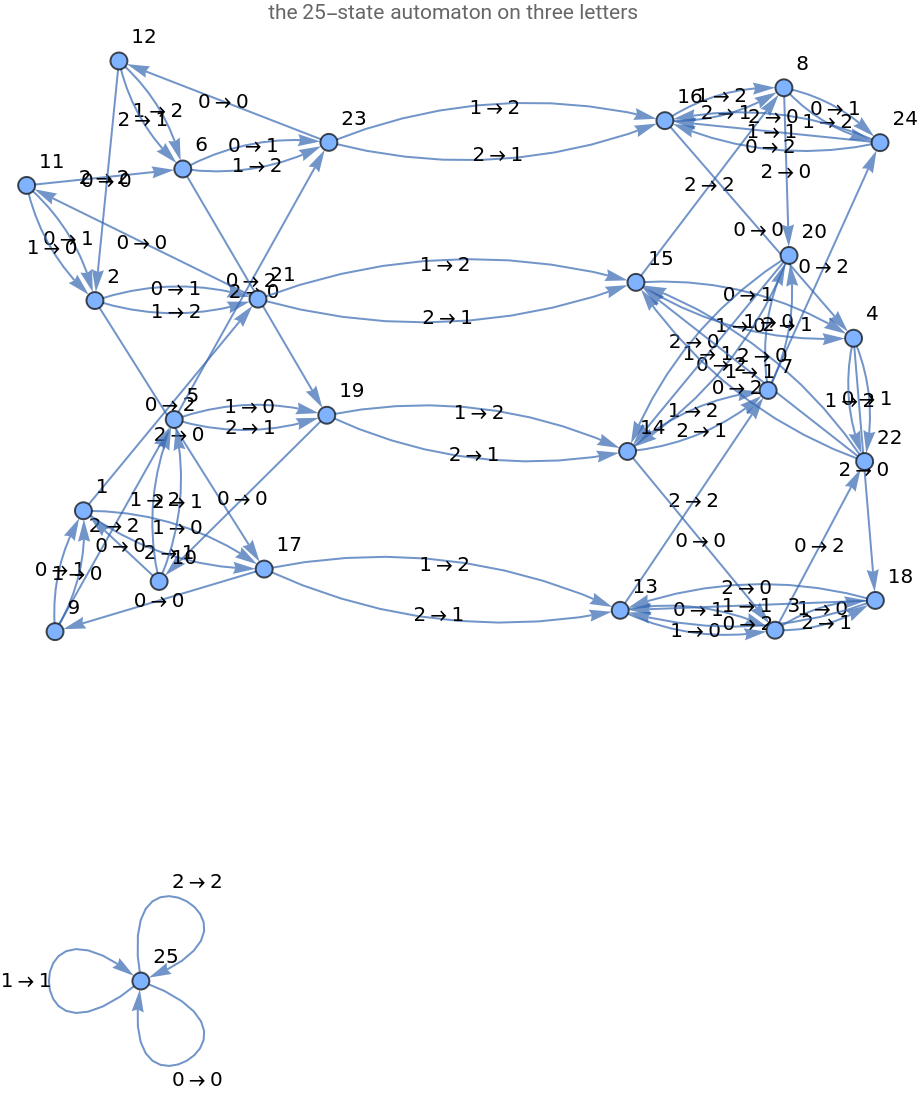
The Promislow (Hantzsche–Wendt) group , which carries Gardam's counterexamples to the unit conjecture over and over , is generated by a finite Mealy automaton: an explicit 25-state automaton on three letters, obtained from the virtual endomorphism given by conjugating with the contraction composed with the cyclic shift of coordinates. The action is faithful and finite-state because the contraction has spectral radius <1. Three is the least degree of any such realization: over the 816 monomial contractions of bounded height the degrees realized are and never . Gardam's characteristic-zero unit is then reproduced inside the automaton group — the 21-term and multiply to with the group elements represented only by their action on level 6 of the ternary tree — so the unit conjecture is false already for automaton groups. The zero-divisor conjecture is not touched: is torsion-free elementary amenable, so is a domain .
P
𝔽
2
ℂ
diag(1/3,1,1)
-1/3
3
3,4,6,8,16
2
α
β
1
P
ℂ[P]
1
.Definitions
Definitions
Definition
1
.1
.A faithful action of a group on the rooted -ary tree is self-similar when for every and every letter there is an with for all words ; the element is the section . The action is finite-state when the set of sections of every element is finite, and is an automaton group when it has a faithful finite-state self-similar action generated by finitely many states.
G
k
T
k
g∈G
x
h∈G
g(xw)=g(x)h(w)
w
h
g
|
x
G
Definition
1
.2
.A virtual endomorphism of is a homomorphism from a subgroup of finite index . With a left-coset transversal ,…, of , writing with defines a self-similar action of degree by and . The action is faithful exactly when no nontrivial normal subgroup of satisfies and — the -core is trivial — and it is finite-state when is contracting, which for a group with a linear model means spectral radius below .
G
φ:H→G
H
d=[G:H]
r
0
r
d-1
H
g=h
r
x
r
y
h∈H
d
x↦y
g=φ(h)
|
x
N
G
N≤H
φ(N)≤N
φ
φ
1
Definition
1
.3
.The Promislow group is , the fundamental group of the Hantzsche–Wendt flat 3-manifold: the unique torsion-free 3-dimensional crystallographic group with finite abelianization, here . Write , , ; then has index 4.
P=〈a,b|b=,a=〉
-1
b
2
a
-2
a
-1
a
2
b
-2
b
ℤ/4⊕ℤ/4
x=
2
a
y=
2
b
z=
2
(ab)
x,y,z≅
3
ℤ
Definition
1
.4
.The affine model writes as a pair , the isometry of , where runs over the point group and over one coset of the translation lattice per point part. The representation is the one Gardam uses; and , and then are the translations by , , , so .
g∈P
{A,v}
u↦Au+v
3
ℝ
A
Q={diag(±1,±1,±1):det=1}≅ℤ/2⊕ℤ/2
v
L=2
3
ℤ
a={(1,-1,-1),(1,1,0)}
b={(-1,1,-1),(0,1,1)}
x,y,z
(2,0,0)
(0,2,0)
(0,0,-2)
〈x,y,z〉=L
Example
1
.5
.The presentation holds in the affine model, the four point parts index the four translation cosets modulo , and come out as the coordinate translations.
L
x,y,z
{pWord[{"B","a","a","b","a","a"}]===pIdentity,pWord[{"A","b","b","a","b","b"}]===pIdentity,pX,pY,pZ,Normal@pCosets}
{True,True,{{1,1,1},{2,0,0}},{{1,1,1},{0,2,0}},{{1,1,1},{0,0,-2}},{{1,1,1}{0,0,0},{1,-1,-1}{1,1,0},{-1,1,-1}{0,1,1},{-1,-1,1}{1,0,1}}}
Graphics3D[{PointSize[0.02],Table[{pColor@g,Point@g[[2]]},{g,pBall[6]}]},Axes->True,AxesLabel->{"x","y","z"},ImageSize->340,PlotLabel->"the radius-6 ball of P, colored by point part"]

Definition
1
.6
.The virtual endomorphism used here is conjugation by the linear map , where is the cyclic shift of the coordinate axes →→→. Explicitly
m=diag(1/3,1,1)·σ
σ
e
1
e
2
e
3
e
1
defined on , a subgroup of index 3. Its spectral radius is because =I.
H={g∈P:3|(g)}
v
3
-1/3
3
3
m
1
3
Remark
1
.7
.Every virtual endomorphism of has this shape. The lattice is the unique rank-3 abelian subgroup of , so it is preserved and is linear on it; Q,=0 turns the resulting cocycle into an affine translation; and when is defined on all four point parts, conjugates to and so is monomial — a diagonal matrix times a permutation. That is what makes the degree question a finite search.
P
L
P
φ
1
H
3
ℝ
φ
m
Q
Q
2
.The automaton
The automaton
Claim
2
.1
.φ
H→P
φ(a)=b
r
k
k
z
Example
2
.2
.The homomorphism property on the pairs of the radius-2 ball that lie in , the index, the spectral radius, and the two generators' letter permutations and sections.
H
{AllTrue[Select[Tuples[pBall[2],2],AllTrue[#,pInH]&],Apply[{g,h}|->pPhi[pMul[g,h]]===pMul[pPhi@g,pPhi@h]]],pPhi@pA===pB,pDegree[pM,{0,0,0}],Max@Abs@Eigenvalues@N@pM}
{True,True,3,0.693361}
{{pPermutation@pA,pSection[pA,#]&/@pLetters},{pPermutation@pB,pSection[pB,#]&/@pLetters}}
{{{0,2,1},{{{-1,1,-1},{0,1,1}},{{-1,1,-1},{2,1,1}},{{-1,1,-1},{2,1,1}}}},{{1,0,2},{{{-1,-1,1},{1,0,1}},{{-1,-1,1},{1,0,1}},{{-1,-1,1},{3,0,1}}}}}
Claim
2
.3
.The section closure of has exactly 25 elements, it equals its own nucleus, and every state is an element of with translation part of sup-norm at most 3. So is an automaton group on three letters with 25 states, and the group generated by the automaton is itself, since and are among the states.
{1,,}
±1
a
±1
b
P
P
P
a
b
Example
2
.4
.The state count, the nucleus, the bound on the translation parts, and the 25 states plotted by translation part: eight per nontrivial point part, on the corners of a box, plus the identity.
{Length@pStates,pNucleus===pStates,Max[Abs[#[[2]]]&/@pStates],Counts[First/@pStates]}
{25,True,3,{-1,-1,1}8,{-1,1,-1}8,{1,-1,-1}8,{1,1,1}1}
Graphics3D[{PointSize[0.035],Table[{pColor@g,Point@g[[2]]},{g,pStates}]},Axes->True,AxesLabel->{"x","y","z"},ImageSize->340,PlotLabel->"the 25 states, by translation part and point part"]

Show[IteratedFiniteAutomatonStateGraph@promislow["Rule"],ImageSize->460,PlotLabel->"the 25-state automaton on three letters"]
Claim
2
.5
.The action is faithful. The -core is trivial: a nontrivial normal with would meet nontrivially, since has finite index in and is torsion-free, and then v∈L∖{0} for all contradicts →0. Computationally, the 147 elements of the radius-5 ball have 147 distinct actions on level 6.
φ
N≤H
φ(N)≤N
L
N⋂L
N
P
k
m
k
k
m
Example
2
.6
.The separation of the radius-5 ball, level by level: 6, 33, 97, 97, 122, 147 distinct level actions against 147 group elements.
{Length@pBall[5],Table[Length@DeleteDuplicates[pLevel[#,l]&/@pBall[5]],{l,6}]}
{147,{6,33,97,97,122,147}}
ListPlot[Table[Length@DeleteDuplicates[pLevel[#,l]&/@pBall[5]],{l,6}],Joined->True,Mesh->All,PlotRange->{0,160},GridLines->{None,{Length@pBall[5]}},AxesLabel->{"level","distinct actions"},ImageSize->320,PlotLabel->"the radius-5 ball separates at level 6"]
3
.Gardam's unit inside the automaton group
Gardam's unit inside the automaton group
Example
3
.2
.The two products, the support sizes, and the number of distinct products.
Example
3
.4
.The two products with the group elements represented only by their level-6 tree action, and the level at which the 121 products separate.
Remark
3
.9
.What the automaton buys is the kind of certificate, not its size. Verifying the unit needs level 6, so 729 vertices, which is more than the 256 the repository's deepest radius-2 refutations used; the difference is that this is a witness — one identity between two 21-term elements, checkable in one pass — where an empty sweep is an exhaustion over coefficient vectors that proves a statement about a ball and not about the group ring. The asymmetry the repository has recorded all along, that refutation is final and survival is nothing, is what a positive counterexample sidesteps.
4
.Questions
Questions
5
.References
References
[Zuk2026]
\.{Z, Iterated Finite Automata, 2026, https://community.wolfram.com/groups/-/m/t/3761828
[Nekrashevych2005]
Nekrashevych, Volodymyr, Self-Similar Groups, 2005, https://doi.org/10.1090/surv/117
[GNS2000]
Grigorchuk, Rostislav I. and Nekrashevych, Volodymyr V. and Sushchanskii, Vitaly I., Automata, dynamical systems, and groups, Proceedings of the Steklov Institute of Mathematics, 2000, https://www.mathnet.ru/eng/tm515
[BKN2010]
Bartholdi, Laurent and Kaimanovich, Vadim A. and Nekrashevych, Volodymyr V., On amenability of automata groups, Duke Mathematical Journal, 2010, https://doi.org/10.1215/00127094-2010-046
[Kaplansky1970]
Kaplansky, Irving, ``Problems in the theory of rings'' revisited, The American Mathematical Monthly, 1970, https://doi.org/10.1080/00029890.1970.11992519
[Higman1940]
Higman, Graham, The units of group-rings, Proceedings of the London Mathematical Society, 1940, https://doi.org/10.1112/plms/s2-46.1.231
[Promislow1988]
Promislow, S. David, A simple example of a torsion-free, non unique product group, Bulletin of the London Mathematical Society, 1988, https://doi.org/10.1112/blms/20.4.302
[KLM1988]
Kropholler, Peter H. and Linnell, Peter A. and Moody, John A., Applications of a new $K$-theoretic theorem to soluble group rings, Proceedings of the American Mathematical Society, 1988, https://doi.org/10.1090/S0002-9939-1988-0964842-0
[Gardam2021]
Gardam, Giles, A counterexample to the unit conjecture for group rings, Annals of Mathematics, 2021, https://doi.org/10.4007/annals.2021.194.3.9
[Gardam2023]
Gardam, Giles, Non-trivial units of complex group rings, 2023, https://arxiv.org/abs/2312.05240
[NekrashevychSidki2004]
Nekrashevych, Volodymyr and Sidki, Said, Automorphisms of the binary tree: state-closed subgroups and dynamics of $1/2$-endomorphisms, 2004
6
.Symbols
Symbols
Constructions:
◼
IteratedFiniteAutomatonStateGraph — the transition diagram of the 25 states
Operations:
◼
AutomatonLevelPermutations — the states as permutations of the level vertices
Local definitions, all in the Initialization section: