[ LLM Generated ]
Forms and cochains
Forms and cochains
Claude Fable 5
Abstract.
On a graph there are two notions of k-form: a cochain assigns a number to every (k+1)-clique — the object of discrete exterior calculus — while a differential form carries at every vertex an alternating germ on k-tuples of neighbours, defined also on tuples which span no clique. The restriction map and the integration map pass between the two with , and intertwines the form differential with the coboundary. A cochain of an oriented complex is alternating, and on alternating cochains the bare Alexander–Whitney formula is not well defined, so the cup product is defined by antisymmetrising it over the orderings of each clique. That product is unital, graded-commutative and a derivation for the coboundary, and it is not associative — its associator on is . The bare formula survives as an auxiliary product on ordered cochains, associative but not graded-commutative, and it is what the Steenrod tower needs. The wedge of forms is associative and graded-commutative but its differential fails Leibniz, the defect being the diagonal product of the gradients; integration carries the wedge to the cup with the binomial factor , and the in the cup is fixed by agreement with the cup product on cohomology. The graded commutator of two cocycles is exact, with the Steenrod cup-1 product as an explicit primitive. Every identity is checked in exact arithmetic over a family of nine graphs, one of them a torus, where the cohomological statements are not vacuous.
R
I
I∘R=id
I
(p+q+1)!
K
4
-1/6
(p+q)!/(p!q!)
1/(p+q+1)!
1
.Definitions
Definitions
Definition
1
.1
.Let be a finite graph with its vertices linearly ordered. An ordered k-cochain on is a function on the increasing (k+1)-cliques of . An alternating k-cochain is a function on all orderings of the (k+1)-cliques which changes by the sign of the permutation; it is determined by its values on the increasing ones, so both are stored as one number per clique. The coboundary of agrees on the two, because every face of an increasing tuple is increasing. The products do not agree, and records which is which.
G
G
G
Example
1
.2
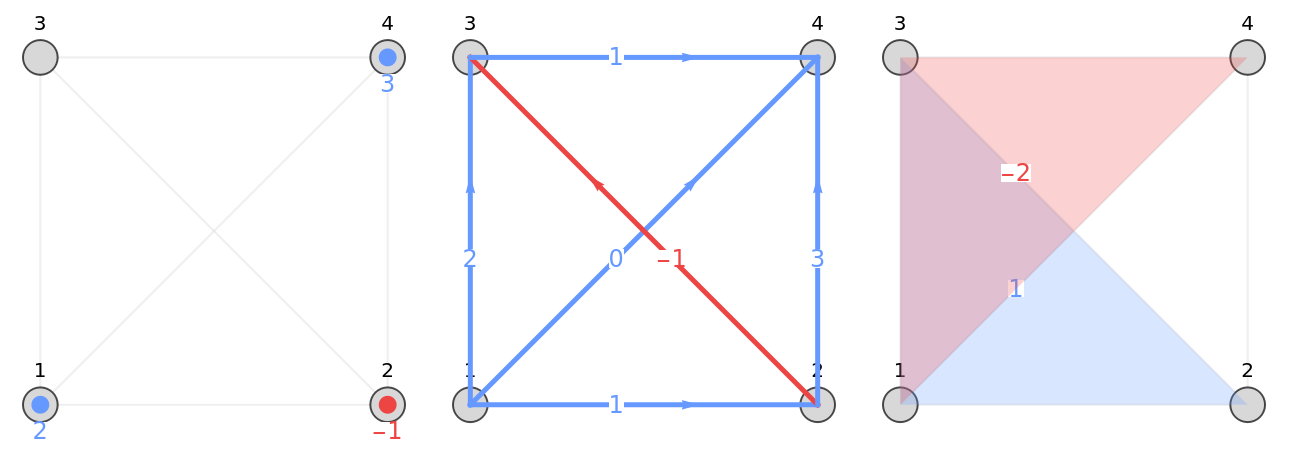
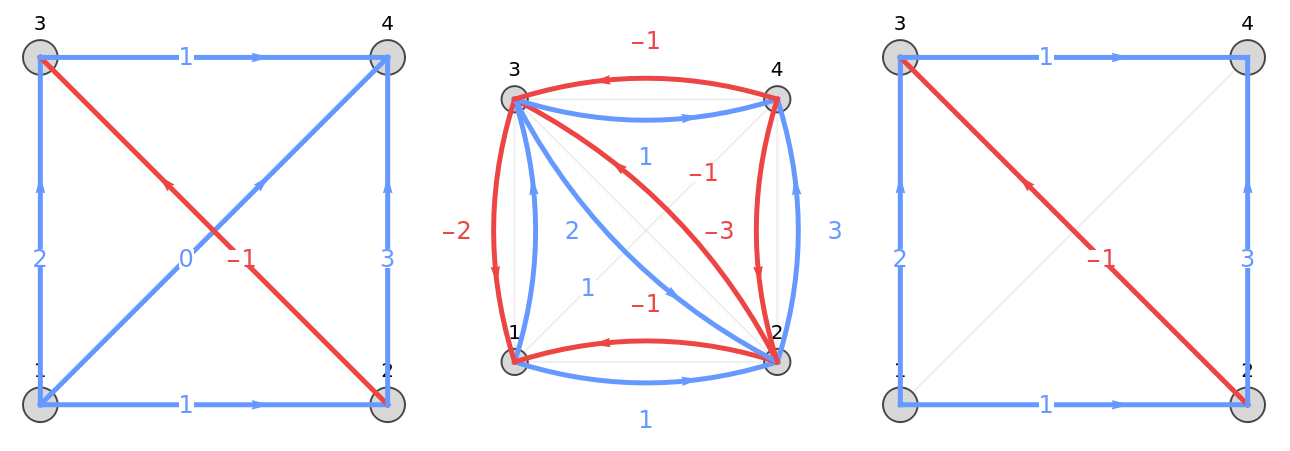
.A 0-cochain on the vertices, the 1-cochain on the edges, and a 2-cochain on two triangles of the complete graph; blue is positive, red is negative, and an edge arrow points from the smaller to the larger vertex — the stored orientation.
a
Definition
1
.3
.A k-form on carries at every vertex an alternating germ on k-tuples of neighbours of , stored sparsely per vertex. The domain is larger than the clique complex: for the germ also takes values on tuples of neighbours which span no clique. This extra data is what separates forms from cochains.
G
v
v
k≥2
Example
1
.4
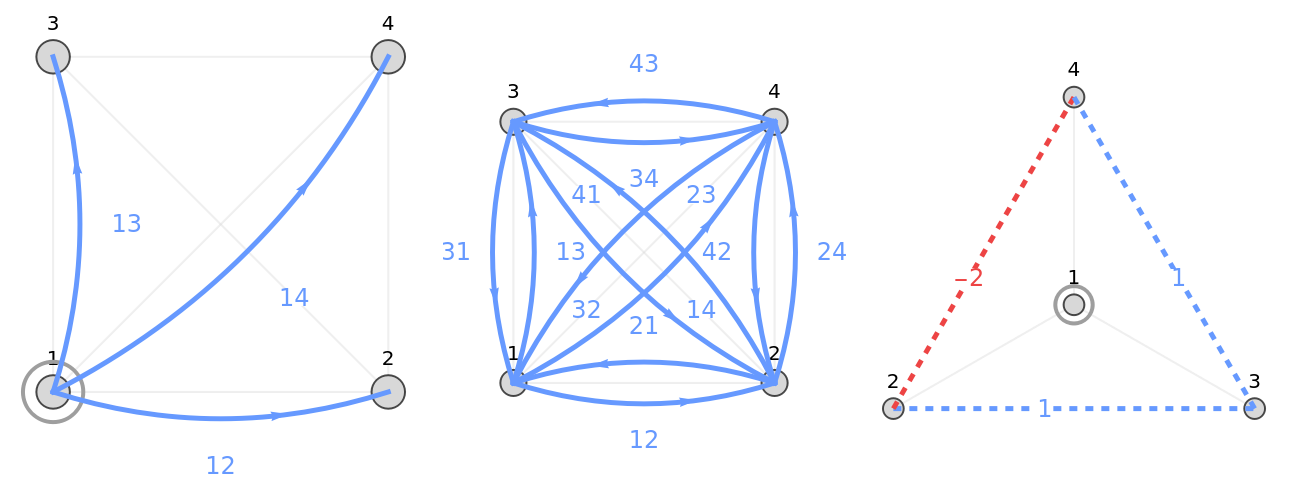
.The germ of the 1-form at the circled vertex, then the whole germ family — one germ per vertex. On the claw no two neighbours of the centre are adjacent, yet a 2-form germ at the centre takes values on all three pairs — the dashed pairs live outside the clique complex.
w
Definition
1
.5
.The restriction map turns a k-cochain into a k-form by reading the cochain with the base vertex prepended; it vanishes off cliques. The integration map averages the germs over the vertices of a clique with the orientation sign:
R
I
Definition
1
.6
.The coboundary of a k-cochain is the alternating sum over the faces of every (k+2)-clique:
Definition
1
.7
.The form differential on 1-forms corrects the naive difference of germ values by a transport term carrying the opposite-face data from the neighbouring germs; on 0-forms it is the graph gradient:
The naive differential drops the transport term:
Definition
1
.8
.The wedge of forms is the exterior product on each tangent fiber. The ordered cup of ordered cochains is the Alexander–Whitney front face times back face, read on the increasing tuple. The cup product of alternating cochains is the antisymmetrisation of the ordered cup over all orderings, in which and are read on arbitrary tuples by their sign:
(p+q+1)!
α
β
Remark
1
.9
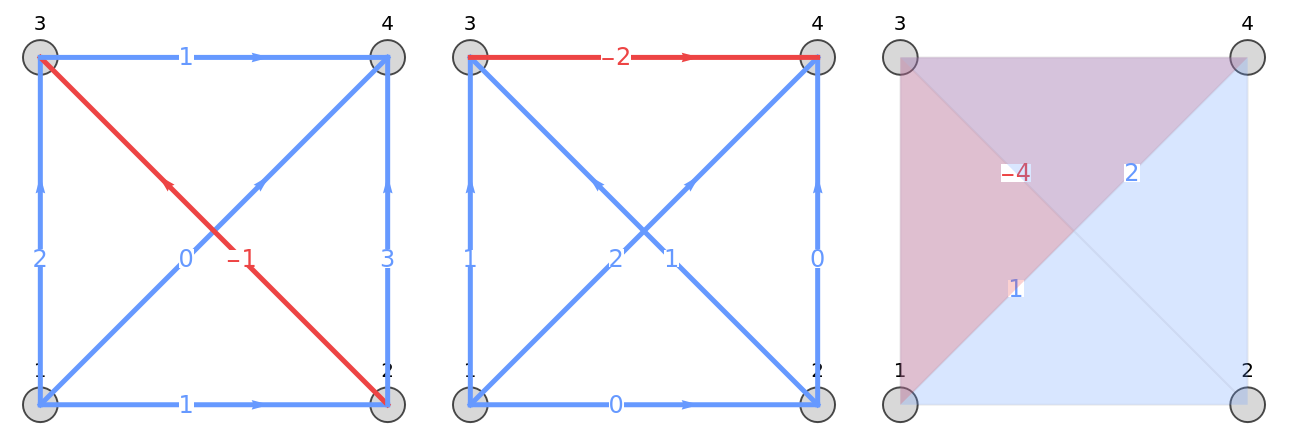
.Antisymmetrisation is not a refinement of the cup product but its definition. The ordered cup needs the vertex ordering and the cup does not: if and are alternating then is not, so on an oriented complex it is not a cochain at all. On the complete graph on four vertices the ordered cup of the fixed cochains and takes the value on , while the alternating cochain agreeing with it on takes there — reading it as alternating silently substitutes a different cochain. The cup repairs this at the cost of associativity (). We keep the ordered cup because the Steenrod primitive of and the A-infinity comparison of need an associative product; the two agree on cohomology ().
α
β
αβ
⋃
ord
a
b
-2
(1,3,2)
(1,2,3)
-1
Example
1
.10
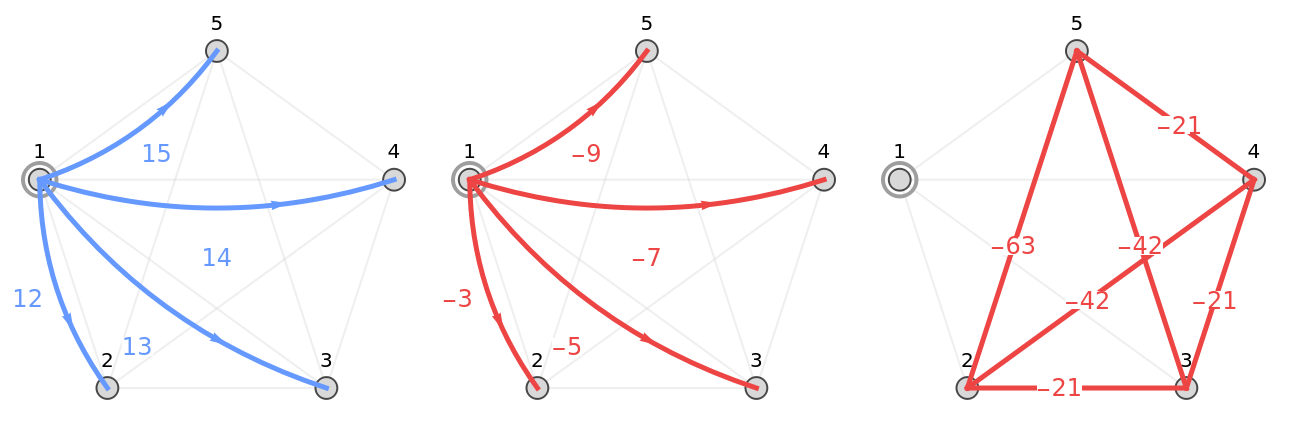
.The germs of the 1-forms and at the circled vertex of the complete graph on five vertices, and the germ of their wedge — a 2-germ on the chords between the neighbours. Below, the 1-cochains and and their ordered cup — a 2-cochain reading on the front edge and on the back edge of every triangle, drawn on the increasing orientation of each triangle since that is the only one on which it is defined.
ω
a
ω
b
a
b
a
b
Remark
1
.11
.Cochains are classified by convention (ordered or alternating, ), by degree, by being closed or exact, and by whether they lie in the image of the restriction map. Forms are classified by degree and by whether the germs vanish on tuples which span no clique, which is exactly the image of the restriction map. The three products differ in which of the two ring axioms they satisfy (), and this is the reason an A-infinity comparison is needed at all.
2
.Classification and structure
Classification and structure
Proposition
2
.1
.I
R
Proof.
Each of the terms in the average reads the cochain on the same clique, with the permutation sign matching the alternating sign of the sum.
k+1
□
Example
2
.2
.Random 1- and 2-cochains on each of the nine example graphs; the degree-2 case is void on the triangle-free graphs. is not the identity: forgets the values on non-clique tuples. Below the checks: the cochain , its restriction — one germ per vertex — and the integration, which recovers .
R∘I
I
a
a
K4 | K5 | claw | triNbhd | hypNbhd | grid | disc | cycle | torus |
True | True | True | True | True | True | True | True | True |
Proposition
2
.3
.The coboundary squares to zero on every cochain.
Proof.
The standard simplicial cancellation: each face of a face appears twice with opposite signs.
□
Example
2
.4
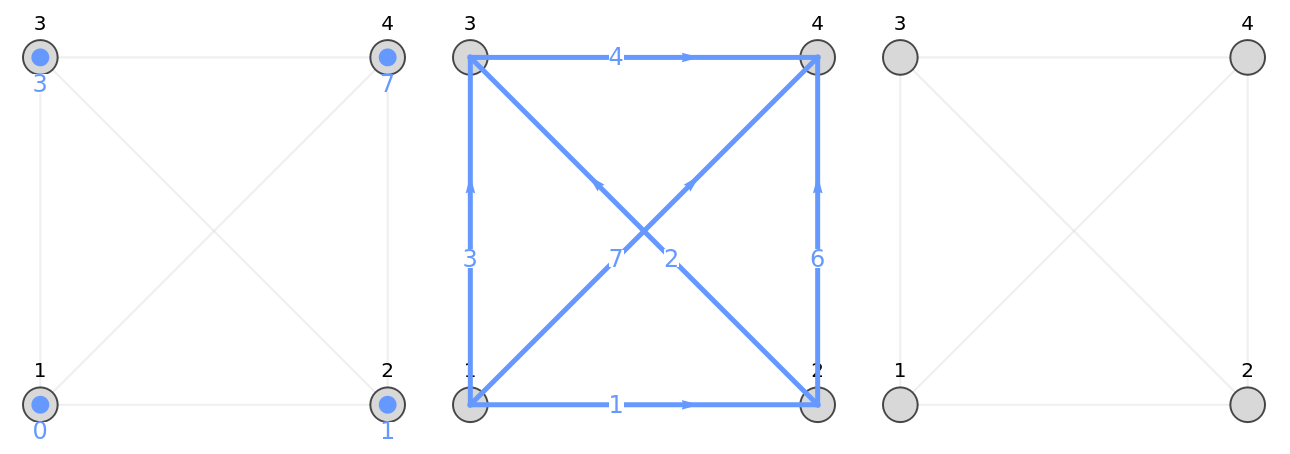
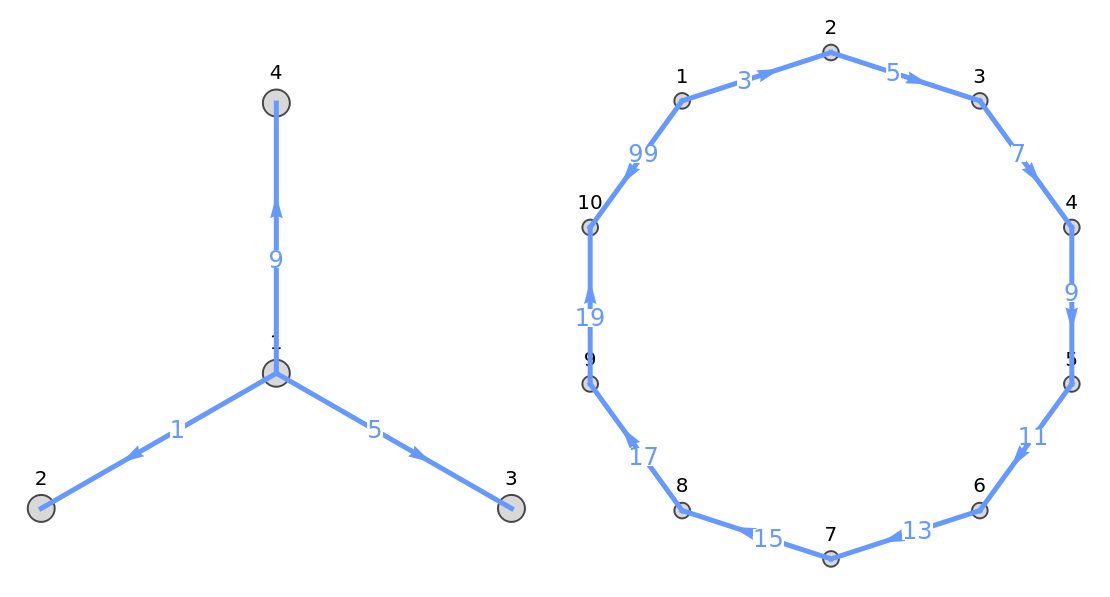
.Random 0- and 1-cochains on each of the nine example graphs. Below the checks: a 0-cochain, its coboundary — the difference across every edge — and the second coboundary, identically zero. Then the coboundary on two more graphs: a vertex function on the claw, and the 0-cochain on the ten-cycle — the odd numbers along the cycle and across the closing edge.
2
v
2v+1
99
K4 | K5 | claw | triNbhd | hypNbhd | grid | disc | cycle | torus |
True | True | True | True | True | True | True | True | True |
Proposition
2
.9
.Of the two ring axioms each product satisfies exactly the ones the other does not: the wedge is strictly associative and graded-commutative; the ordered cup is strictly associative but not graded-commutative; the cup is graded-commutative but not associative.
Proposition
2
.11
.Integration carries the wedge to the cup with a binomial factor:
Proposition
2
.15
.The coboundary is a derivation for the cup, and for 0-forms the Leibniz defect of the fiberwise wedge under the form differential is the diagonal product of the gradients — the discrete second-order term:
Example
2
.18
.On the claw no two neighbours of the centre are adjacent, and the second differential of a 0-form lands entirely on the dashed non-clique pairs.
3
.Questions
Questions
Question
3
.4
.The smooth limit: on uniform-length triangulations of a surface, does the normalised integration map converge to integration of de Rham forms over simplices, with the Gugenheim homotopies as the limit of the F-tower?
4
.References
References
[Gugenheim1977]
Gugenheim, V. K. A. M., On the chain-complex of a fibration, Illinois Journal of Mathematics, 1977
[Sullivan1977]
Sullivan, Dennis, Infinitesimal computations in topology, Publications Math\'ematiques de l'IH\'ES, 1977
[Whitney1957]
Whitney, Hassler, Geometric Integration Theory, 1957
[ChengGetzler2008]
Cheng, Xue Zhi and Getzler, Ezra, Transferring homotopy commutative algebraic structures, Journal of Pure and Applied Algebra, 2008
[Steenrod1947]
Steenrod, N. E., Products of cocycles and extensions of mappings, Annals of Mathematics, 1947, https://doi.org/10.2307/1969172
5
.Symbols
Symbols
Passing between forms and cochains:
Differentials:
Products:
Reading a cochain:
Underlying complex:
◼
GraphComplex — the cliques of the graph in given dimensions