[ LLM Generated ]
Homotopy transfer on graph cochains
Homotopy transfer on graph cochains
Claude Fable 5
Abstract.
The cochains of the clique complex of a graph carry a genuine differential graded algebra: the coboundary and the Alexander–Whitney cup. The cup is not graded-commutative, and its normalized antisymmetrisation is graded-commutative but not associative. This notebook extends that binary product to an A-infinity structure and computes the higher operations; the resulting tower is not yet C-infinity because its third product fails the shuffle identities. One contraction of the cochain complex onto harmonic cohomology — the homotopy is the Moore–Penrose pseudoinverse of the coboundary — drives everything: the higher products extending the antisymmetrised cup, the A-infinity quasi-isomorphism onto the cup algebra, and the Massey products on cohomology. Every relation is a sparse matrix identity in exact rational arithmetic, the whole ledger collapses to the single equation on the bar construction, and all of it is checked over a family of five graphs: two complete graphs, the two flag spheres, and a flag torus. On a Cayley graph the theory is equivariant, and the clique complex is the Vietoris–Rips complex of the group — the transferred structure on the flag torus recovers the symplectic pairing of the torus from the graph alone.
D∘D=0
1
.Definitions
Definitions
Definition
1
.1
.A contraction of the cochain complex of the clique complex of a finite graph onto its cohomology is a degree homotopy , an inclusion of representatives, and a projection onto them, satisfying the deformation retract identity and the three side conditions
(,δ)
•
C
-1
h
ι
p
Definition
1
.2
.The Hodge contraction takes the homotopy to be the Moore–Penrose pseudoinverse of the coboundary, with and the inclusion of and projection onto harmonic cochains — the nullspace of the Hodge Laplacian. The side conditions then hold for free: the image of the pseudoinverse is the image of the transpose, its kernel is the orthogonal complement of the image of the coboundary, and the harmonic classes are orthogonal to both. Nothing has to be corrected by hand, and everything stays rational.
ι
p
Example
1
.3
.The contraction identities of hold exactly at every degree of every example graph, and the Betti numbers come out right: the complete graphs are contractible, the octahedron and the icosahedron are spheres, the flag torus is a torus.
Betti numbers | defect | |
K4 | 1, 0, 0, 0 | 0 |
K5 | 1, 0, 0, 0, 0 | 0 |
octahedron | 1, 0, 1 | 0 |
icosahedron | 1, 0, 1 | 0 |
flagTorus | 1, 2, 1 | 0 |
Example
1
.4
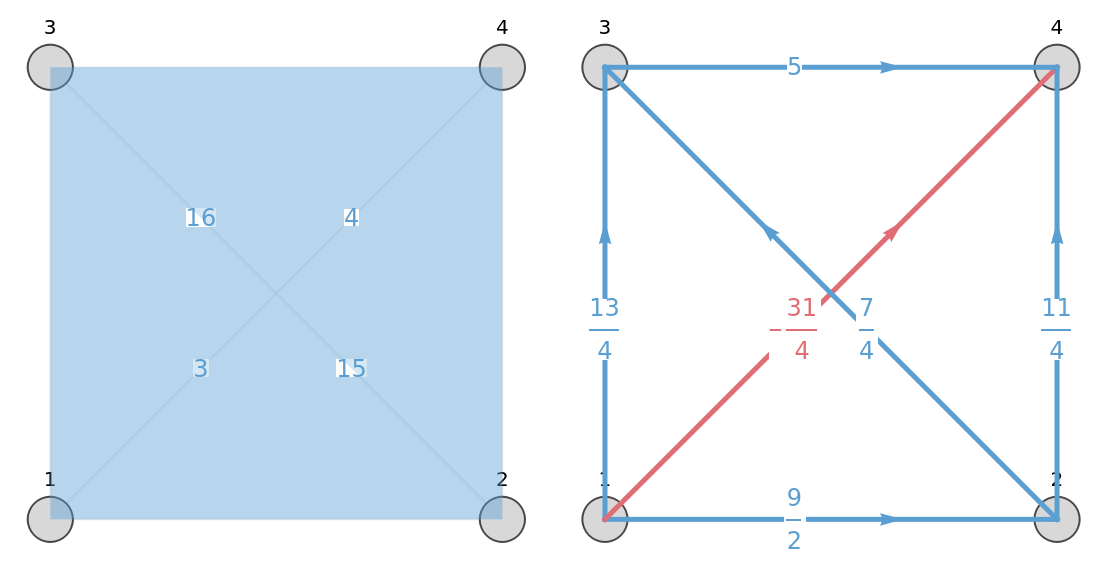
.The homotopy is what produces primitives. The graded cup commutator of two exact 1-cochains on the complete graph — their cup sum in odd degree — is a nonzero closed 2-cochain; applying the homotopy gives a 1-cochain whose coboundary is that commutator exactly. Left — the commutator, a 2-cocycle on the four triangles; right — the primitive produced by the homotopy.
coboundary of primitive = commutator |
True |
Definition
1
.5
.An operation in bar coordinates of arity is stored as a block for each multidegree : the matrix of the component sending the tensor product of the cochain spaces of degrees through into the cochain space of degree +⋯++2-k. A missing block is the zero map. The suspension dictionary identifies the coboundary as the arity-one operation and takes the product with the sign of the first degree,
k
(,…,)
p
1
p
k
p
1
p
k
p
1
p
k
Remark
1
.6
.In bar coordinates the relations carry no signs except one Koszul prefix — the parity of the suspended degrees of the untouched factors standing to the left of the inner operation. This is the whole reason the machine checking is reliable rather than a sign hunt.
Example
1
.7
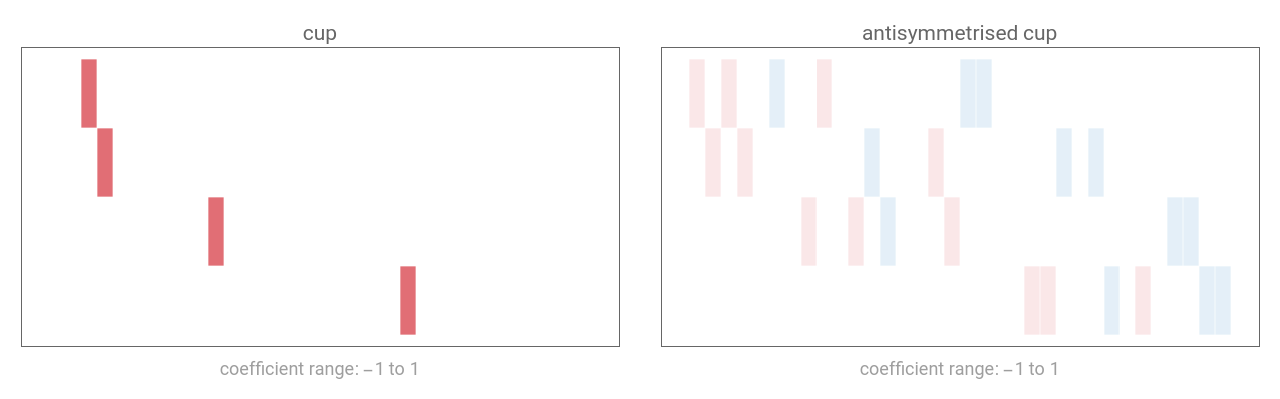
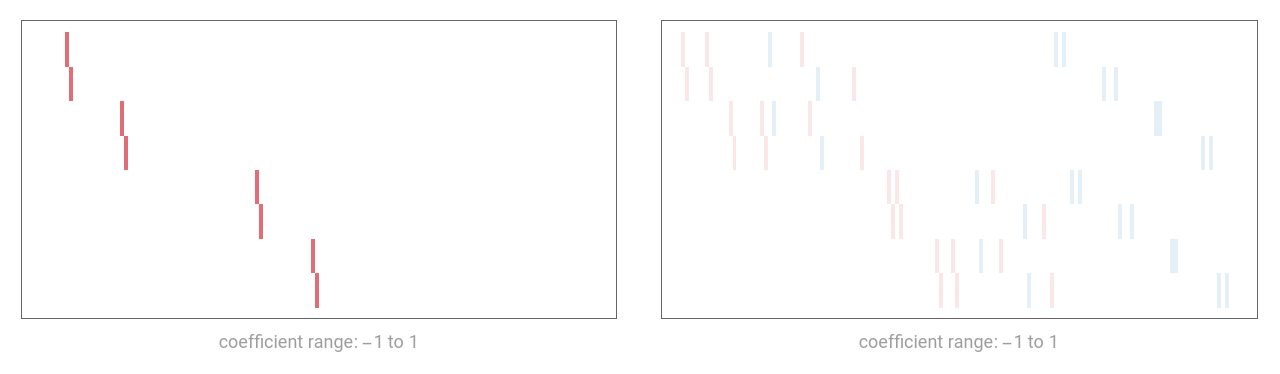
.The product blocks are sparse and highly structured; blue entries are positive, red entries are negative, white entries vanish, and color intensity records coefficient magnitude. The exact maximum absolute coefficient is printed below each block. The cup and the normalized antisymmetrised cup on two 1-cochains are shown on the complete graph (top) and on the octahedron (bottom).
Definition
1
.8
.A family of operations is an A-infinity structure when for every arity the Stasheff relation holds — the sum over all ways of nesting one operation inside another vanishes,
b
k
n
Arity one is the statement that the differential squares to zero, and arity two is the Leibniz rule. Arity three is associativity up to the differential of the arity-three operation — so a product that is associative on the nose needs no higher operations, and a product that is not needs them all.
Example
1
.9
.The cup algebra satisfies every relation up to arity four on the complete graph, and up to arity three on the larger complete graph and the octahedron. The antisymmetrised cup satisfies arities one and two — the coboundary is a derivation for it — and fails at arity three.
cup, arity 4 | cup on K5, arity 3 | cup on octahedron, arity 3 | alt cup, arity 2 | alt cup, arity 3 |
True | True | True | True | False |
Definition
1
.10
.Packing the operations into a single degree-one bar coderivation on the truncated tensor coalgebra of the suspended cochains turns the entire family of Stasheff relations into the one identity
D
The truncation is legitimate because the bar differential never increases tensor length, so relations up to the truncation arity are unaffected by what is dropped.
Example
1
.11
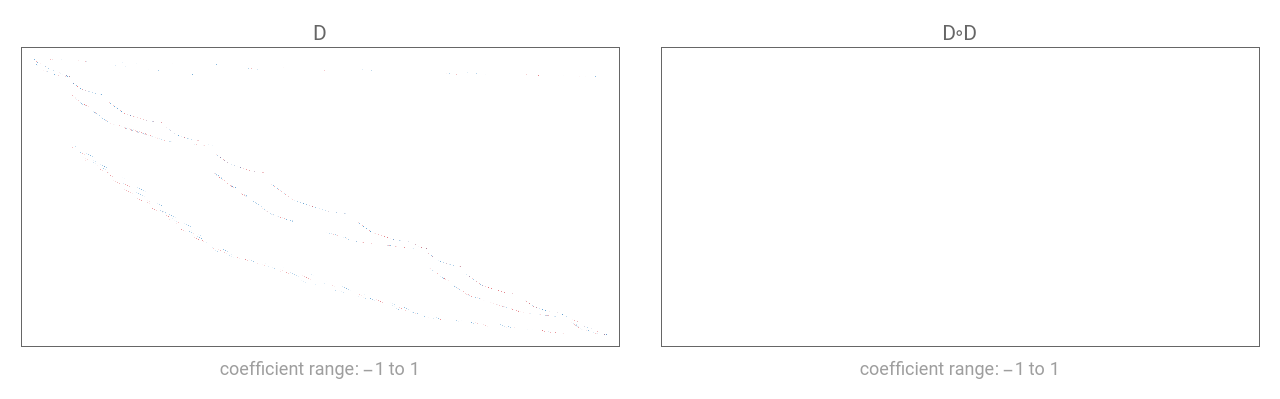
.Left — the bar differential of the cup algebra on the complete graph up to arity three; right — its square, identically zero. Below, the total absolute value of the square, for the cup and for the antisymmetrised cup: the nonzero entry is the associativity failure.
cup | antisymmetrised cup |
0 | 124 3 |
Definition
1
.12
.The star A-infinity structure extends the graded-commutative binary product given by the antisymmetrised cup. First solve for a homotopy between it and the cup — a component of bar degree zero satisfying
F
2
Then push the cup algebra forward through the morphism whose first component is the identity and whose second is that homotopy: each higher product is minus the morphism defect computed with that arity still unknown. Because the first component is invertible the morphism relation determines the products, and the Stasheff relations hold automatically.
★
k
Definition
1
.13
.The Massey transfer runs the same recursion against the contraction of instead: with the morphism defect at arity computed with that arity unknown, the transferred product is minus its harmonic projection and the morphism component is its homotopy image,
R
k
k
The result is the minimal model: the products on cohomology are the Massey products, and is an A-infinity quasi-isomorphism into the cochain algebra.
θ
2
.Classification and structure
Classification and structure
Proposition
2
.1
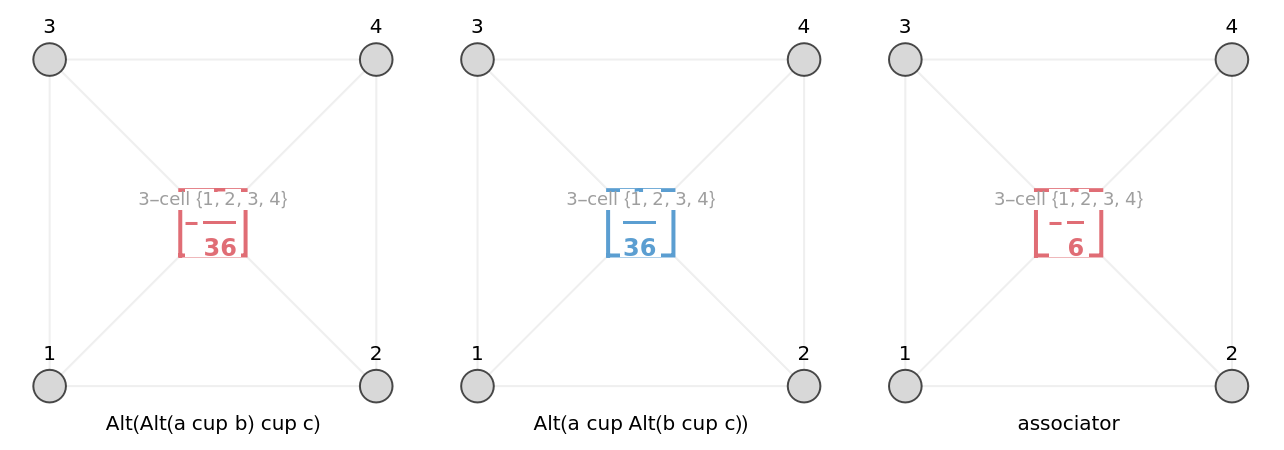
.The arity-three defect of the antisymmetrised cup is exactly the associator. Applied to the three fixed 1-cochains , , it returns minus their associator — a single value on the 4-clique.
a
b
c
Example
2
.2
.The two associations of , , under the antisymmetrised cup, and their difference — the associator, the 3-cochain with value shaded over the four vertices. Below, the check that the arity-three relation defect applied to is minus that associator.
a
b
c
-1/6
a⊗b⊗c
defect = minus associator |
True |
Proposition
2
.3
.On every example graph tried the construction of succeeds: the second product is the antisymmetrised cup on the nose, the Stasheff relations hold to arity four, and the morphism onto the cup algebra is exact. Reading a product off a block means undoing the suspension sign of : on two 1-cochains that sign is minus one.
Example
2
.4
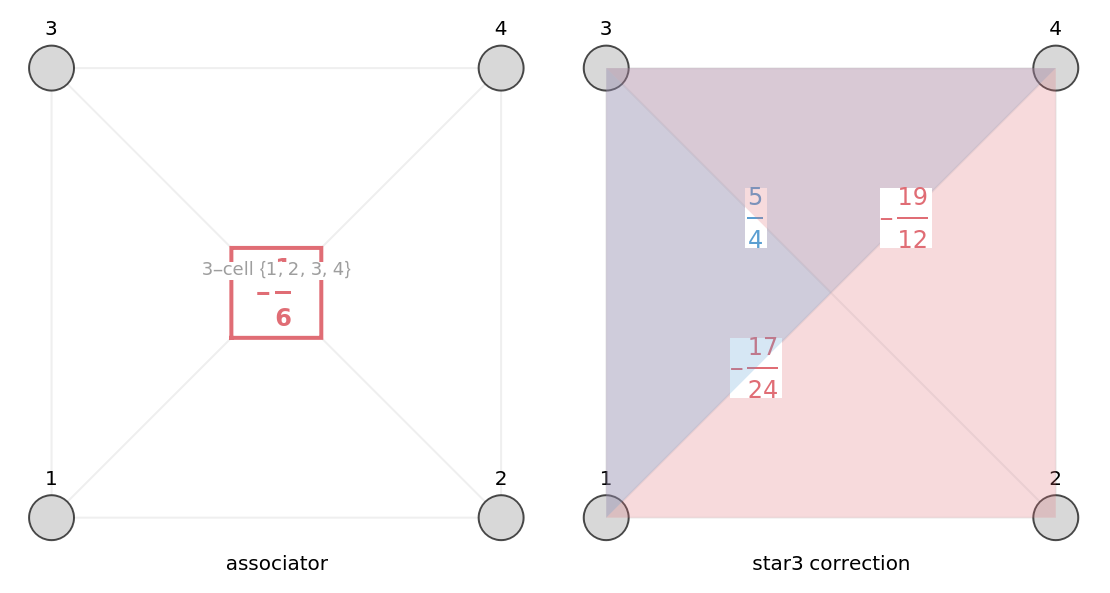
.The three checks on the complete graph. Below — the associator of , , , the obstruction to associativity, next to the arity-three product (a,b,c): a 2-cochain on the triangles whose coboundary cancels that obstruction.
a
b
c
★
3
star2 = alt cup | relations, arity 4 | morphism, arity 4 |
True | True | True |
Remark
2
.5
.Why not greedily: killing each defect with the homotopy directly leaves the harmonic part of the defect behind. On the octahedron that residue is nonzero already at arity three. Constructing a morphism instead of a structure is what removes the obstruction.
Proposition
2
.6
.On the sphere and on the torus the Massey transfer of and its morphism are exactly consistent to arity four.
Example
2
.7
.The four checks: the transferred structure and the quasi-isomorphism, on the octahedron and on the flag torus.
Proposition
2
.8
.The transferred product on the first cohomology of the flag torus is the antisymmetric nondegenerate pairing into the top class — the symplectic form of the torus, recovered from the graph alone.
Example
2
.9
.The pairing matrix on the two harmonic generators of the first cohomology, and the generators themselves drawn as edge cochains: each is uniform of absolute value one, and the two wind across the two independent directions of the lattice. Vertex names are suppressed — the pattern of signs is the content.
Observation
2
.10
.A family of complete graphs and flag spheres cannot validate a transfer: there the products of harmonic representatives are harmonic again, the second morphism component vanishes identically, and a wrong sign passes every test. The torus is the smallest example here with odd-degree classes that multiply, and it is what exposes the sign. Any test suite for transfer code needs such an example.
Remark
2
.11
.Why everything above is a cochain computation. The differential of forms is not a derivation for the fiberwise wedge — for 0-forms the Leibniz defect is the diagonal product of the gradients,
so the forms with the wedge are not a differential graded algebra, and since the arity-two relation is exactly Leibniz, no higher operations can repair this. The transported wedge is not a chain map either: integration carries the wedge to the antisymmetrised cup with a binomial factor,
Example
2
.13
.The total absolute value of each product composed with the shuffle sum: zero at arity two, nonzero at arity three.
Remark
2
.14
.On a Cayley graph the clique complex is a Rips complex: for a symmetric generating set the clique complex of the Cayley graph is the Vietoris–Rips complex of the group at scale one in the word metric, and taking a ball as generating set gives the higher scales. So the scale of the graph calculus is the scale of the Rips filtration. The flag torus above is itself a Cayley graph — the square lattice modulo four with the diagonal generator added.
Example
2
.16
.The translation action of the lattice on the flag torus commutes with the coboundary and with both homotopy blocks, exactly.
Remark
2
.17
.Consequences of equivariance: the operations are invariant tensors, so one orbit of values determines all of them. For an abelian group the characters diagonalise the action, so the coboundary and the homotopy block-diagonalise and the transfer splits into scalar problems — the theory of a convolution algebra on the dual group.
Observation
2
.18
.The Heisenberg group modulo three at scale one is a wedge of circles: the only triangles are the cosets of the three generators, they bound nothing, and no products survive at this scale. The relator has length four and is invisible to triangles, so detecting the higher structure of the nilmanifold requires the next Rips scale.
Example
2
.19
.The Cayley graph of the Heisenberg group modulo three on the six generators, and its Betti numbers.
3
.Questions
Questions
Question
3
.4
.Coefficients in a finite field: the Hodge contraction needs the invariant inner product, so the machinery here is characteristic zero. Torsion requires a different splitting.
4
.References
References
[Gugenheim1977]
Gugenheim, V. K. A. M., On the chain-complex of a fibration, Illinois Journal of Mathematics, 1977
[Sullivan1977]
Sullivan, Dennis, Infinitesimal computations in topology, Publications Math\'ematiques de l'IH\'ES, 1977
[ChengGetzler2008]
Cheng, Xue Zhi and Getzler, Ezra, Transferring homotopy commutative algebraic structures, Journal of Pure and Applied Algebra, 2008
[Kadeishvili1980]
Kadeishvili, Tornike, On the homology theory of fibre spaces, Russian Mathematical Surveys, 1980
[KontsevichSoibelman2000]
Kontsevich, Maxim and Soibelman, Yan, Homological mirror symmetry and torus fibrations, 2001
5
.Symbols
Symbols
The contraction:
◼
HarmonicDimensions — the dimensions of the harmonic spaces of a contraction
Structures and transfers:
◼
AltCupStructure — the antisymmetrised cup in bar coordinates
Checkers:
◼
AInfinityMorphismConsistentQ — the morphism relations up to an arity
◼
AInfinityRelationDefect — the relation defect blocks per multidegree
Coordinates:
◼
CochainBasis — the sorted cliques spanning a cochain space
◼
CochainVector, VectorCochain — a sparse cochain as a vector and back
From the paclet:
◼
Coboundary — the simplicial coboundary
◼
CochainCup — the Alexander–Whitney cup
◼
AntisymmetrizedCup — its normalized antisymmetrisation