ORIGINAL ARTICLE: Rama Mishra, Tumpa Mahato (2023), Polynomially knotted 2-spheres, arXiv:2307.07234. https://doi.org/10.48550/arXiv.2307.07234
Article Abstract: We show that every proper, smooth 2-knot is ambient isotopic to a polynomial embedding from to . This representation is unique up to a polynomial isotopy. Using polynomial representation of classical long knots we show that all twist spun knots posses polynomial parametrization. We construct such parametrizations for few spun and twist spun knots and provide their 3 dimensional projections using Mathematica.
2
4
Introduction
Introduction
The goal is to give explicit parametrization of knotted spheres in . Some knotted spheres in R^4 can be obtained from a classical 1-dimensional knot in . One of the ways is to rotate a knotted arc around its own axis inside while rotating it along in fixing the endpoints on . The first rotation is called “twisting” and the second is called “spinning”. The surface knot you get by this construction is called k-TWIST SPUN KNOT where k is the number of twisting in while spinning in . We can not visualize the surface knot in but using Mathematica we can visualize the projection of it in . You can find this work on this link - https://doi.org/10.48550/arXiv.2307.07234
4
R
3
R
3
R
2
R
4
R
2
R
3
R
4
R
4
R
3
R
We will explain in the following example of k-twist spun trefoil knot:
We will explain in the following example of k-twist spun trefoil knot:
Step 1: We start with the polynomial parametrization of a classical trefoil long knot.
In[]:=
f[t_]=t^3-3t;g[t_]=t^5-10t;h[t_]=16+4t^2-t^4;
Step 2: We need the knotted arc not the whole knot. So, we choose the interval for the knot in such a way that the endpoints are on XY-plane. Also we choose an axis (black line segment in the figure) around which the arc will be rotated inside .
3
R
In[]:=
Show[Graphics3D[Tube[Table[{f[t],g[t],h[t]},{t,-2.54404,2.54404,0.005}],0.2],AxesTrue,AxesLabel{X,Y,Z}],Graphics3D[{Thickness[0.009],Line[{{f[-2.19],g[-2.19],h[-2.19]},{f[2.19],g[2.19],h[2.19]}}]}],Graphics3D[InfinitePlane[{2,-2,0},{{2,2,0},{f[2.54404],g[2.54404],0}}]],ViewPoint->Front]
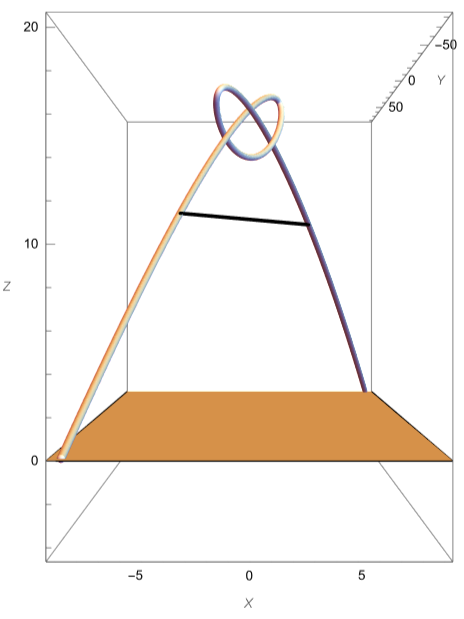
Step 3: We used Rodrigues’s Rotation formula for twisting inside .
3
R
In[]:=
Clear[t,s];L=Graphics3D[{Thickness[0.001],InfiniteLine[{{f[-2.19],g[-2.19],h[-2.19]},{f[2.19],g[2.19],h[2.19]}}]}];(*axisofrotation*)P=Graphics3D[InfinitePlane[{f[-2],g[-2],0},{{f[2],g[2],0},{f[2],g[-2],0}}]];(*xyplane*)Nr=Sqrt[g[2.19]^2+f[2.19]^2];f1[t_,s_]=(1-(1-Cos[s])g[2.19]^2/Nr^2)f[t]+(1-Cos[s])f[2.19]g[2.19]g[t]/Nr^2+(h[t]-h[2.19])Sin[s]g[2.19]/Nr;g1[t_,s_]=(1-Cos[s])f[2.19]g[2.19]f[t]/Nr^2+(1-(1-Cos[s])f[2.19]^2/Nr^2)g[t]-(h[t]-h[2.19])Sin[s]f[2.19]/Nr;h1[t_,s_]=-Sin[s]g[2.19]h[2.19]f[t]/Nr+Sin[s]f[2.19]h[2.19]g[t]/Nr+h[2.19](1-Cos[s])+Cos[s]h[t];Show[ParametricPlot3D[{f1[t,s],g1[t,s],h1[t,s]},{t,-2.54404,2.54404},{s,0,2Pi},AxesFalse,AxesLabel{X,Y,Z},ViewPointLeft,MeshStyleRed,ExclusionsNone,MaxRecursion6,PlotStyleOpacity[0.6],BoxedFalse,ImageSize->Large],L,P,PlotRange->Full]
Out[]=

Step 4: Now, to get a compact surface we used bump function which controls the rotation outside the axis of the knot .
Constructing Bump Function
F1[t_]=Piecewise[{{Exp[-1/t],t≥0},{0,t≤0}}];B[t_]=F1[4.8-t^2]/(F1[4.8-t^2]+F1[t^2-3.8]);
Using Bump function to restrict the rotation in [-2.19, 2.19]
f2[t_,s_]=f1[t,s]B[t]+f[t](1-B[t]);g2[t_,s_]=g1[t,s]B[t]+g[t](1-B[t]);h2[t_,s_]=h1[t,s]B[t]+h[t](1-B[t]);Show[ParametricPlot3D[{f2[t,s],g2[t,s],h2[t,s]},{t,-2.54404,2.54404},{s,0,2Pi},ExclusionsNone,MaxRecursion6,PlotRange->Full,Boxed->False,Axes->False],P,ViewPointRight,ImageSizeLarge]
Out[]=

Step 5: Now, we will rotate this around XY-plane in . We will call this rotation “Spinning”. Here, k is the number of twists while rotating around XY-plane in . We can plot a projection of the k-twist spun trefoil in as follows:
4
R
4
R
3
R
Projection of 2-twist spun trefoil in 3R:
Projection of 2-twist spun trefoil in :
3
R
(*Spinningaboutxyplane*)k=2;(*twistingktimes*)(*ProjectionofthetwistspunknotinR^3*)ParametricPlot3D[{f2[t,k*s],h2[t,k*s]Cos[s],h2[t,k*s]Sin[s]},{t,-2.54404,2.54404},{s,0,2Pi},ViewPointLeft,MeshStyleRed,ExclusionsNone,MaxRecursion6,PlotStyleOpacity[0.6],ImageSizeLarge,Boxed->False,Axes->False,PlotRangeFull]
Out[]=

Inside view
Inside view
Here you can see the inside along with two projections of the knotted arc of trefoil (in black ).
In[]:=
s1=0;s2=5Pi/4;(*angleofspinningfroms1tos2*)Show[ParametricPlot3D[{f2[t,k*s],h2[t,k*s]Cos[s],h2[t,k*s]Sin[s]},{t,-2.54404,2.54404},{s,s1,s2},ViewPointLeft,ExclusionsNone,MaxRecursion6,PlotStyleOpacity[0.6],ImageSizeLarge,Boxed->False,Axes->False,PlotTheme->"Minimal"],ParametricPlot3D[{f2[t,k*s1],h2[t,k*s1]Cos[s1],h2[t,k*s1]Sin[s1]},{t,-2.54404,2.54404},ViewPointLeft,ExclusionsNone,MaxRecursion6,PlotStyleOpacity[0.6],ImageSizeLarge,Boxed->False,Axes->False,PlotTheme"Monochrome"],ParametricPlot3D[{f2[t,k*s2],h2[t,k*s2]Cos[s2],h2[t,k*s2]Sin[s2]},{t,-2.54404,2.54404},ViewPointLeft,ExclusionsNone,MaxRecursion6,ImageSizeLarge,Boxed->False,Axes->False,PlotTheme"Monochrome"]]
Out[]=

10-twist spun trefoil knot
10-twist spun trefoil knot
We can give any number of twists to get different k-twist spun trefoil. Here is an example of 10-twist spun trefoil knot.
CITE THIS NOTEBOOK
CITE THIS NOTEBOOK
Polynomially knotted 2-spheres
by Rama Mishra, Tumpa Mahato
Wolfram Community, STAFF PICKS, February 14, 2024
https://community.wolfram.com/groups/-/m/t/3122742
by Rama Mishra, Tumpa Mahato
Wolfram Community, STAFF PICKS, February 14, 2024
https://community.wolfram.com/groups/-/m/t/3122742