Infographics analysis tour for thinking about the future of business and tech...
To motivate my computer science and engineering students—especially when learning computing feels tough—I always share an optimistic, grounded perspective on this exhilarating moment in history. We’re standing on the shoulders of decades of IT and tech innovations, entering a true Neo-Industrial Revolution driven by AI, advanced computation, and the unlocking of massive data potential.
I curate publicly available infographics from the web (with clear sources credited, such as Visual Capitalist charts on exponential AI compute growth, Deloitte’s 2026 software outlook visuals, or trend summaries from sites like Techstack and Dreamix), then use thoughtful AI prompt engineering to synthesize and analyze them through my own lens. These visuals highlight surging trends: explosive growth in AI-native development, agentic systems, cloud-native and edge computing, multimodal AI, and hybrid workflows that blend tools. Together, they paint a vivid picture of how software engineering is evolving—not shrinking, but expanding into higher-impact, creative roles where engineers design intelligent systems, orchestrate data insights from vast internal repositories, and build transformative products/services.
We are indeed living in fascinating times: this revolution amplifies human ingenuity rather than replacing it, creating abundant opportunities for STEM talent to innovate, collaborate globally, and shape a smarter, more efficient future. Stay curious, build relentlessly, and embrace the wave—we’re arriving at exactly the right time to lead it!
I curate publicly available infographics from the web (with clear sources credited, such as Visual Capitalist charts on exponential AI compute growth, Deloitte’s 2026 software outlook visuals, or trend summaries from sites like Techstack and Dreamix), then use thoughtful AI prompt engineering to synthesize and analyze them through my own lens. These visuals highlight surging trends: explosive growth in AI-native development, agentic systems, cloud-native and edge computing, multimodal AI, and hybrid workflows that blend tools. Together, they paint a vivid picture of how software engineering is evolving—not shrinking, but expanding into higher-impact, creative roles where engineers design intelligent systems, orchestrate data insights from vast internal repositories, and build transformative products/services.
We are indeed living in fascinating times: this revolution amplifies human ingenuity rather than replacing it, creating abundant opportunities for STEM talent to innovate, collaborate globally, and shape a smarter, more efficient future. Stay curious, build relentlessly, and embrace the wave—we’re arriving at exactly the right time to lead it!
The future of software engineering stands at the dawn of a Neo-Industrial Revolution—a transformative era powered by AI, advanced computation, and the explosive unlocking of value from vast internal company databases. We are living in truly exciting times: just as past industrial shifts amplified human capability through machinery, today’s AI tools and computational platforms are supercharging software engineers to explore rich, untapped troves of enterprise data—customer behaviors, operational metrics, transaction histories, sensor streams, and domain-specific logs—that have long sat dormant due to complexity or inaccessibility. By integrating AI-driven analytics, symbolic computation, hybrid models, and precise querying tools, engineers can now reveal hidden patterns, forecast trends, detect anomalies, and extract high-value business insights at scale, turning this “data sitting there” into engines for genuine innovation: new products, personalized services, optimized processes, predictive maintenance, risk mitigation, and entirely novel revenue streams that leverage a company’s unique internal knowledge rather than generic external sources. For businesses, this means overwhelmed IT and development teams can pivot from routine maintenance to strategic, creative work—accelerating digital transformation, boosting efficiency, and gaining a real competitive edge in an agentic AI landscape where productivity soars and software creation becomes faster, more reliable, and outcome-focused. For you, computer science and engineering students, this moment is profoundly optimistic: standing on the shoulders of giants in tech history, you enter a field not diminished by automation but elevated by it—demand remains robust with projected growth well above average (15-22% in key roles through the coming decade), AI handles the mundane so humans tackle higher-level design, ethical integration, system architecture, and interdisciplinary problem-solving. Emerging roles in machine learning engineering, MLOps, AI-native development, data science orchestration, and agentic systems offer abundant, future-proof pathways where your advanced STEM foundation enables you to build sophisticated, trustworthy solutions that drive meaningful impact. Embrace this convergence of human ingenuity, computational power, and abundant data—it’s your generation’s chance to lead the next wave of discovery, efficiency, and transformative progress in an era where software engineering evolves into the ultimate creative and innovative force.
Top 10 countries with the most engineers


The software engineers we’re talking about in this essay—computer engineers and computer scientists—are systematically trained in programming with mathematical rigor. They are prepared to deeply understand computing and all the technology involved, and also to create large and sophisticated systems using scientific principles.
It’s important to note that most programmers today are not from STEM (Science, Technology, Engineering, and Mathematics) backgrounds. They are biologists, accountants, artists, business and economics specialists, and even lawyers and doctors who program for data science, apps, WEB sites, and to create their own applications and solve valuable, specific problems in their fields, which often become important intellectual property and industrial secrets and business advantages.
Computing is a broad and welcoming field where people from different areas can get involved and are welcome, helping to enrich the field of computing with different perspectives and knowledge.
It’s important to note that most programmers today are not from STEM (Science, Technology, Engineering, and Mathematics) backgrounds. They are biologists, accountants, artists, business and economics specialists, and even lawyers and doctors who program for data science, apps, WEB sites, and to create their own applications and solve valuable, specific problems in their fields, which often become important intellectual property and industrial secrets and business advantages.
Computing is a broad and welcoming field where people from different areas can get involved and are welcome, helping to enrich the field of computing with different perspectives and knowledge.
In[]:=
Out[]=
4.85×
3
10
A Bit of Context
A Bit of Context
From time to time, a new technology rises up with promises to kill schools, professors, traditional classes, and break up the educational system. And so, here we are!!

That iconic black-and-white photo from 1986 captures a small group of math teachers—dressed in suits and ties, picketing outside the National Council of Teachers of Mathematics meeting in Washington, D.C., with handmade signs like “UNTIL UPPER GRADES” and warnings that premature calculator use would erode students’ foundational arithmetic skills and number sense—now serves as a striking historical parallel to the AI revolution unfolding today; back then, educators feared handheld calculators would turn children into button-pushers incapable of mental math or true conceptual understanding, yet today Wolfram|Alpha, powerful computational engines, and generative AI tools are freely accessible to students, professors, professionals, engineers, and virtually anyone with a smartphone in their pocket or a PC on every desk at home and work, not only accelerating complex calculations and symbolic manipulations but fundamentally shifting education and professional practice from rote computation to higher-order problem-solving, creativity, and critical interpretation of results, proving once again that initial resistance to transformative technology often gives way to widespread integration and empowerment as society adapts and redefines what it means to truly know and apply mathematics.
As we had professors protests against the calculators in 1986, Nikola Tesla, the visionary inventor, remarkably foresaw the rise of portable, pocket-sized communication devices in the early 20th century—devices that closely resemble today’s smartphones, which many describe as small computers we carry in our hands. In a famous 1926 interview with Collier’s magazine, Tesla predicted a future where “when wireless is perfectly applied the whole earth will be converted into a huge brain” (akin to the interconnected internet), allowing people “to communicate with one another instantly, irrespective of distance.” He elaborated that through advancements in television and telephony, we would “see and hear one another as perfectly as though we were face to face, despite intervening distances of thousands of miles,” with the instruments being “amazingly simple compared with our present telephone.” Crucially, he stated: “A man will be able to carry one in his vest pocket.” This description—encompassing real-time audio-visual communication via a compact, portable device—eerily anticipates modern smartphones, which serve as handheld computers for calls, video, internet access, apps, and more. Tesla’s words, from nearly a century ago, have been widely cited (and verified by sources like Snopes and historical analyses) as an astonishingly accurate prophecy of wireless, pocketable tech that fits seamlessly into daily life, transforming global connectivity long before such devices existed. While he didn’t explicitly call it a “computer,” his vision of a simple, vest-pocket instrument enabling instant worldwide interaction captures the essence of the smartphone as a powerful, miniaturized computing and communication tool we now hold in our hands.
Out[]=

Systematic Projections
Systematic Projections
Market analysis is a well-established science, and disruptive innovation can, naturally, destroy predictions. Well, we’re in the eye of the storm!
Out[]=
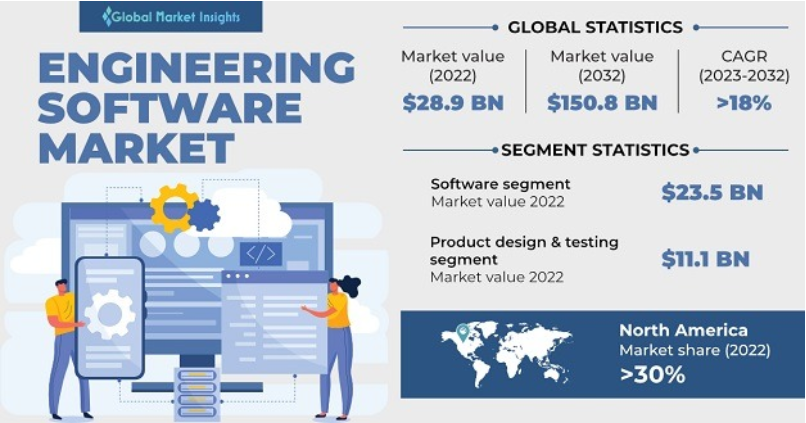
The engineering software market is booming amid the ongoing digital transformation of design, simulation, and manufacturing workflows, with demand exploding as industries grapple with increasingly complex projects under globalization pressures, stringent safety regulations, and the need for rapid innovation; valued at USD 28.9 billion in 2022, the sector is forecasted to reach USD 150.8 billion by 2032, propelled by the integration of artificial intelligence for automating repetitive tasks and optimizing vast datasets, the accelerating adoption of cloud-based platforms that deliver unmatched scalability and real-time collaboration across global teams, surging requirements for advanced 3D modeling and virtual prototyping to slash physical testing costs, and specialized advancements in product design & testing software that now dominate nearly 40% of the market share. North America currently commands over 30% of global share thanks to heavy investments by leaders like ANSYS, Autodesk, Dassault Systèmes, and Siemens, while Asia-Pacific and Europe follow closely as emerging manufacturing hubs embrace these tools to enhance productivity and product quality in automotive, aerospace, electronics, and construction sectors.Econometrics underpins such market projections through rigorous statistical modeling of historical revenue data, segment breakdowns, and macroeconomic variables via techniques like regression analysis and time-series forecasting to estimate future trajectories with quantified confidence intervals; the Compound Annual Growth Rate (CAGR) distills this into a single, comparable metric representing the steady yearly growth that would compound from the base year value to the end-year projection, formally expressed as where is the number of years (here 2023–2032), yielding the reported figure exceeding 18% for this dynamic engineering software landscape.
CAGR-1
1
n
Ending Value
Beginning Value
n
List 10 in-demand jobs for software engineers and computer scientists (STEM), and how Wolfram tech applies
Here are 10 in-demand jobs for software engineers and computer scientists, along with how Wolfram technologies can be applied:1. Machine Learning Engineer: 2. Data Scientist: 3. AI/ML Researcher: 4. DevOps Engineer: 5. Cloud Engineer: 6. Cybersecurity Analyst: 7. Full Stack Developer: 8. IoT Developer: 9. Robotics Engineer: 10. Game Developer: Wolfram technologies provide robust tools for data analysis, simulation, and deployment, enhancing productivity and innovation in these roles.
• Wolfram Tech: Use to access pre-trained models and for building machine learning workflows.
• Wolfram Tech: Utilize for data collection and for data analysis and visualization.
• Wolfram Tech: Leverage symbolic computation for developing new AI algorithms and for computer vision tasks.
• Wolfram Tech: Implement automated testing and deployment using Wolfram Workbench and for continuous integration.
• Wolfram Tech: Use Wolfram Cloud for deploying scalable applications and managing cloud-based resources.
• Wolfram Tech: Analyze network data and perform anomaly detection using and -based analytics.
• Wolfram Tech: Interface with IoT devices using and perform real-time data analysis with .
• Wolfram Tech: Create game logic and simulations using efficient symbolic computation and graphics capabilities.
Resilience
Resilience
We can observe impressive growth in the field of software engineering since 2000. What makes any innovation in engineering intelligent is the software.
The software engineering job market, after experiencing its first contraction since the Y2K era in 2023 due to widespread layoffs and a cyclical slowdown following years of explosive growth fueled by low interest rates, mobile, and cloud booms, showed clear signs of recovery and renewed growth in 2024 according to The Pragmatic Engineer’s detailed analysis; job vacancies ticked upward from early 2024 levels—though remaining roughly half of the 2022 peak and aligning closer to pre-pandemic 2019 figures—while certain companies aggressively expanded their engineering headcounts, led by standout performers like Oracle (with revenue surging from $42B to $52B in two years, massive hiring especially in senior and leadership roles, and market cap tripling), NVIDIA (riding the AI wave to briefly become the world’s most valuable company), Workday (25% headcount growth alongside strong financials), and fast-scaling AI pure-plays such as OpenAI, Anthropic, xAI, and Mistral that attracted top talent from Big Tech giants; Big Tech overall displayed mixed but stabilizing patterns—Amazon and Meta reduced overall staff in recent years, Google grew modestly by 7%, Apple by 5% without major cuts—yet recruitment upticks, particularly in AI-related disciplines, cloud infrastructure, and enterprise software, signaled a shift toward more selective, senior-focused hiring amid higher interest rates and generative AI tools boosting productivity, suggesting the discipline’s long-term trajectory may settle into steadier, less hyper-growth expansion compared to the 2010s frenzy, with pockets of rapid opportunity emerging in high-impact sectors rather than broad-based boom.
Econometrics, again, plays a crucial role in analyzing such job market dynamics by applying statistical methods—such as time-series analysis of headcount data, regression models correlating economic indicators like interest rates or VC funding with hiring trends, and comparative indices from sources like Live Data Technologies—to identify patterns, quantify shifts (e.g., the historic 2023 shrink and 2024 rebound), and forecast future trajectories; the reported trends, including vacancy levels returning toward baseline and selective company-level expansions, emerge from these rigorous data-driven insights rather than anecdotal evidence alone.
Robust Field
Robust Field
Ultimately, it will be the developers and engineers who create and implement all technological innovation.
The U.S. software engineering market remains robust and expansive, with an estimated around 4.4 million software engineers active in the country as of recent 2023 data cited in industry reports, encompassing full-time employees, contractors, and independent contributors across tech giants, startups, finance, healthcare, government, and beyond; this positions the U.S. as home to one of the world’s largest and most skilled developer talent pools, though official Bureau of Labor Statistics figures for software developers, quality assurance analysts, and testers show about 1.9 million employed in 2024, highlighting differences in scope (BLS focuses on specific occupational categories while broader estimates include self-employed and varied roles). Demand continues to surge despite past cyclical slowdowns, fueled by relentless digital transformation, AI integration, cloud adoption, cybersecurity needs, and automation across industries, with the BLS projecting a solid 15% employment growth from 2024 to 2034—much faster than the average for all occupations—translating to roughly 287,900 additional jobs over the decade and about 129,200 annual openings from growth and replacements; this outlook underscores persistent high demand for skilled talent, particularly in specialized areas like AI/ML, DevOps, and data engineering, even as entry-level roles face some pressure from productivity tools, while median annual wages hover around $131,000–$133,000, reflecting strong compensation in a competitive landscape marked by talent shortages (projected up to 1.2 million by some estimates) and elevated turnover rates around 23%.
Ups and Downs
Ups and Downs
The software industry doesn’t have a “supply chain” or “logistics”, the high cost is in people-ware! Engineers are expensive!
The software engineering job market has followed a classic boom-bust-recovery arc, as detailed in The Pragmatic Engineer’s 2025 analysis: the explosive boom of the late 2010s through 2021–2022 saw vacancies more than double amid ultra-low interest rates, abundant venture capital, and rapid scaling in mobile, cloud, and pandemic-driven digital services, creating an unprecedented hiring frenzy where companies aggressively expanded teams and offered sky-high compensation to attract talent. This hyper-growth abruptly reversed into a sharp bust starting in 2022–2023, triggered by rising interest rates, economic uncertainty, overhiring corrections, and profitability pressures, leading to widespread layoffs (notably sharp at Meta with -12% engineering headcount cuts in 2023), slower or negative growth across Big Tech, and a plunge in job openings to levels well below pre-boom baselines, making the market feel brutally competitive for many engineers with flooded applicant pools and ghosted applications. By 2025, a cautious yet unmistakable recovery has taken hold, characterized by a slow, steady upward trend in software engineering vacancies over the prior two years, driven primarily by Big Tech rebounding—Meta leading with 19% more engineers than January 2022 levels, Google up 16%, Apple 13%, while Amazon and Microsoft lag with more modest gains—alongside surging demand in AI engineering (exploding since mid-2023, concentrated in the Bay Area), aggressive hiring at select scaleups like Anduril, consulting firms, and specialized roles, though overall recruitment remains confusingly mixed: hiring managers face longer fill times amid picky, senior-focused processes, remote opportunities decline (except in AI), and the market stays “pretty weird” with persistent challenges for generalist or junior candidates despite brighter pockets for experienced talent in high-impact areas like AI, product engineering, and infrastructure.
Market View
Market View
We have many hats in the software industry, about both business and tech, and AI is creating even more new hats.
The software engineering market presents a highly positive and resilient outlook, with the global industry valued at USD 142.1 billion in 2023 and projected to surge to USD 255.2 billion by 2032, achieving a steady CAGR of over 6.5% from 2024 to 2032 according to Global Market Insights; this robust expansion is fueled by widespread digital transformation initiatives across sectors, where businesses increasingly invest in software engineering to boost operational efficiency, deliver superior customer experiences, and adapt to an ever-evolving digital landscape. Key accelerators include the rapid rise in cloud-based services for unmatched scalability and cost-effectiveness (with the cloud deployment segment already generating USD 88.5 billion in 2023 revenue), the proliferation of agile and DevOps methodologies that accelerate development cycles and foster seamless collaboration, surging demand for custom-tailored solutions that drive innovation, and the deep integration of artificial intelligence and machine learning to enhance security, automate processes, and unlock new capabilities. Testing services stand out as a powerhouse segment, poised to capture over 38% market share by 2032 due to heightened emphasis on quality, reliability, and bug-free performance, while North America dominates with more than 45% share thanks to its cutting-edge infrastructure, vibrant startup ecosystem, heavy R&D investments, and talent attraction—creating fertile ground for leaders like Accenture, TCS, Capgemini, Cognizant, and IBM to thrive through AI-powered platforms, strategic alliances, and end-to-end digital solutions. Overall, the market’s momentum underscores immense opportunities in addressing emerging needs like cybersecurity, DevSecOps, and flexible customer-centric approaches, positioning software engineering as an indispensable engine of global economic progress and technological advancement well into the next decade.
Demand
Demand
Ironically, there are jobs and unemployed people, global phenomena, complex business requires advanced knowledge and skills!!
The U.S. software engineering job market demonstrates persistent and strong demand for skilled professionals, with an average hourly rate for software developers hovering around $130—reflecting high compensation driven by a chronic talent shortage where demand significantly outstrips supply, as highlighted in Geomotiv’s analysis; this skills gap impacts business growth and the broader economy, with projections warning of up to 85 million unfilled tech-related jobs globally by 2030, potentially causing trillions in economic losses, while U.S. companies face fierce competition for local talent amid rising rates influenced by experience (seniors commanding $130–$190 or up to $350–$400 for elite experts), location (higher in tech hubs like California at $150–$200), company size, and specialization in complex stacks or AI. Factors like the shift toward remote and hybrid models, aggressive outsourcing to nearshore regions for cost savings, and non-tech industries pulling in developers further underscore the vacancy pressure, as employers turn to staff augmentation, dedicated teams, and international talent pools to bridge gaps; meanwhile, recent data points to a rebounding landscape with software job postings up 10–11% year-over-year in early 2026 (per Federal Reserve Economic Data and Indeed trends), even as overall jobs decline, signaling that AI tools are paradoxically increasing the need for human engineers to build, integrate, and maintain advanced systems. The Bureau of Labor Statistics reinforces this positive trajectory, projecting 15% employment growth for software developers, quality assurance analysts, and testers from 2024 to 2034—much faster than average—adding roughly 287,900 jobs over the decade and generating about 129,200 annual openings from expansion and replacements, cementing software engineering as a high-demand field with robust vacancy levels, competitive pay, and long-term opportunities particularly in AI, cloud, cybersecurity, and digital transformation initiatives.
Job Report Survey
Job Report Survey
New roles with high demand, business automation from possibilities to reality!
Sources:
https://www.hpcwire.com/bigdatawire/2020/02/12/demand-for-data-engineers-up-50/
Dice 2020 Tech Job Report: https://techhub.dice.com/Dice-2020-Tech-Job-Report.html
https://www.hpcwire.com/bigdatawire/2020/02/12/demand-for-data-engineers-up-50/
Dice 2020 Tech Job Report: https://techhub.dice.com/Dice-2020-Tech-Job-Report.html
The Dice 2020 Tech Job Report, released in early 2020 and spotlighted in contemporary coverage like the February 12, 2020, BigDataWire article, painted a vibrant picture of surging demand across various tech occupations, with data engineers emerging as the undisputed star—experiencing a remarkable 50% year-over-year increase in job postings, making it the fastest-growing tech role of 2019. This explosion stemmed from organizations’ growing realization that data engineers were pivotal for building and managing sprawling data infrastructures to extract real business value from massive datasets, outpacing even strong performers like back-end developers (up 38%), senior data scientists (up 32%), CRM developers (up 29%), and UI developers (up 24%). Software developers held the top spot in sheer volume, accounting for about 12% of all tech job openings, followed by network engineers and systems engineers, while emerging high-growth areas included skills like Kubernetes (up 82% YoY), Docker (42%), Microsoft Azure (41%), and DevOps (32%). The report also highlighted robust projections for related fields, such as a 38% increase in data science jobs and 37% in machine learning roles over the coming decade, alongside niche surges in areas like AR/VR engineers (dramatically up in prior years) and security engineers. Geographically, traditional hubs like San Francisco and New York dominated, but smaller cities showed explosive gains—Jacksonville, Florida, led with a 54% rise in tech openings, followed by San Diego (37%) and Columbus, Ohio (32%)—as non-tech industries and regional employers embraced data-rich roles. Data engineers commanded premium pay, averaging $160,000 annually in the San Francisco Bay Area (up 6% from the prior year), with positions taking an average of 46 days to fill—a timeline expected to lengthen amid intensifying competition from giants like Amazon, Accenture, and Capital One. Overall, the findings underscored a thriving, data-centric tech job market where specialized occupations in data engineering, analytics, and cloud infrastructure drove hiring momentum, reflecting broader digital transformation trends just before the pandemic’s disruptions reshaped the landscape.
More Opportunities for Software Engineers
More Opportunities for Software Engineers
It can be tricky to choose your software industry hat!
The software engineering field continues to offer abundant and diverse career opportunities in 2025 and beyond, as outlined in upGrad’s comprehensive guide, with software engineers playing a pivotal role in driving digital innovation across finance, healthcare, entertainment, automotive (including EVs), telecom, consulting, and emerging areas like AI, machine learning, IoT, quantum computing, and sustainable green tech. Global demand remains exceptionally strong, with the worldwide software market projected to hit approximately $741 billion in 2025 and employment for software engineering roles expected to grow by 17.9%, while The Economic Times forecasts a 22% rise in demand specifically in 2025 across key sectors; this sustained momentum through 2030 stems from relentless digital transformation, remote work flexibility, and the need for energy-efficient, secure, and AI-powered solutions. The article highlights 20 high-demand career paths building on core software engineering skills, including standout roles like Data Scientist (leveraging Python, R, SQL, Wolfram Language and ML for big data insights in healthcare and finance), DevOps Engineer (managing CI/CD pipelines and cloud automation for faster deployments), Full Stack Developer (handling end-to-end web applications with broad programming versatility), Cloud Developer (building scalable apps on AWS/Azure amid massive cloud adoption), Cybersecurity-focused roles like Information Security Analyst (safeguarding against rising threats), Mobile Software Engineer (crafting iOS/Android apps in the booming app economy), Software Architect (designing scalable systems at premium pay), and leadership positions such as Chief Technology Officer (CTO) for strategic oversight. These options span technical specialization, management, consulting, and niche integrations (e.g., Fund Manager in BFSI or Technical Writer for documentation), offering pathways from entry-level to senior/executive levels with strong growth prospects, competitive salaries (ranging widely based on experience, location, and specialization), and global/remote opportunities, making software engineering one of the most versatile and future-proof professions amid accelerating technological advancements.
At a GUI Wolfram notebook in additional to the Wolfram Language code cells, we can code in Python, R, SQL, Java, Bash and other programming language. And it can be made directly from Wolfram Language, calling other programming languages. Otherwise, other programming languages can call Wolfram Language, or integrating by Wolfram Cloud WEB APIs. Wolfram tech communicate and integrate very well with other technologies, databases RDBMS SQL and NoSQL, cloud services, web services and different platforms. And it is possible to deploy Wolfram tech on Dockers too.
IT Consulting
IT Consulting
When you get bitten by the consulting fly, you’re going to thrive in business.
The international software consulting market, a key pillar for software engineers in IT consultancy, is experiencing robust and sustained growth as enterprises worldwide accelerate digital transformation and seek expert guidance to implement, integrate, and optimize complex software solutions. According to Grand View Research, the global market was valued at USD 273.13 billion in 2022 (with an estimated USD 305.55 billion in 2023) and is projected to reach USD 678.32 billion by 2030, expanding at a strong CAGR of 12.1% from 2023 to 2030. This momentum is driven by widespread demand for digitalization across industries, the push for efficient software deployment in enterprise IT environments, rapid advancements in cloud computing, data analytics, AI, and machine learning integration, and the need for specialized services like application development, migration, maintenance, testing, design, and security consulting—areas where software engineers play central roles in custom development, system integration, and innovative implementations.Key trends highlight surging opportunities for software engineers in consultancy: the enterprise solutions segment (including application development and ERP/CRM implementations and integrations) holds the largest share (over 21% in 2022), while software security services are poised for the highest growth due to rising cyberattacks, cloud adoption, BYOD, remote work, and stringent regulations. Large enterprises dominate (over 60% share), investing heavily in AI/ML automation, IoT, big data, and blockchain, but SMEs are growing significantly through affordable cloud-based SaaS for flexibility and competitiveness.
The BFSI vertical leads in adoption (over 18% share), followed by healthcare (fastest-growing, driven by IoT, wearables, data science, and compliance needs), with strong demand in retail, manufacturing, IT/telecom, and government. Regionally, North America commands over 30% share with steady expansion, fueled by tech investments and startups, while Asia Pacific shows the most significant growth potential from e-commerce, government digital initiatives, and open-source/FOSS adoption in SaaS and mobile solutions.
For software engineers in IT consultancy, these dynamics translate to high demand for advanced skills in cloud platforms, AI/ML integration, cybersecurity, DevOps, agile methodologies, and domain-specific expertise (e.g., fintech, healthcare tech, EdTech), as firms like Accenture, Capgemini, Cognizant, Deloitte, IBM, and Oracle lead through partnerships, innovative services, and AI-enhanced offerings. The market’s emphasis on virtual consulting, hybrid models, and post-pandemic efficiency creates fertile ground for consultants to help clients unlock value from internal data, streamline operations, and build future-proof systems—positioning software engineering professionals in consultancy as essential drivers of business innovation, efficiency, and technological leadership in this evolving landscape.
The BFSI vertical leads in adoption (over 18% share), followed by healthcare (fastest-growing, driven by IoT, wearables, data science, and compliance needs), with strong demand in retail, manufacturing, IT/telecom, and government. Regionally, North America commands over 30% share with steady expansion, fueled by tech investments and startups, while Asia Pacific shows the most significant growth potential from e-commerce, government digital initiatives, and open-source/FOSS adoption in SaaS and mobile solutions.
For software engineers in IT consultancy, these dynamics translate to high demand for advanced skills in cloud platforms, AI/ML integration, cybersecurity, DevOps, agile methodologies, and domain-specific expertise (e.g., fintech, healthcare tech, EdTech), as firms like Accenture, Capgemini, Cognizant, Deloitte, IBM, and Oracle lead through partnerships, innovative services, and AI-enhanced offerings. The market’s emphasis on virtual consulting, hybrid models, and post-pandemic efficiency creates fertile ground for consultants to help clients unlock value from internal data, streamline operations, and build future-proof systems—positioning software engineering professionals in consultancy as essential drivers of business innovation, efficiency, and technological leadership in this evolving landscape.
International business and remote teams creates more global opportunities:
Software engineering and IT businesses have become profoundly international in the modern remote era, enabling highly effective, distributed teams that seamlessly span continents like Brazil, India, and the USA. With tools such as cloud platforms, collaborative IDEs, version control systems (such as Git and GitHub), and real-time communication apps (Slack, Discord, Microsoft Teams, Zoom), outstanding IT teams operate across time zones with minimal friction—leveraging India’s vast talent pool of millions of skilled developers for cost-effective, scalable expertise in AI/ML, full-stack, and enterprise solutions; Brazil’s growing nearshore ecosystem for innovative, high-quality engineers with strong English proficiency and cultural alignment for US projects; and the USA’s leadership in cutting-edge tech, strategy, and funding. This global model allows companies to assemble elite, diverse squads that combine the best of each region’s strengths—India’s depth and volume, Brazil’s creativity and timezone overlap with North America, and US innovation—while delivering tight-knit collaboration, rapid iteration, and world-class results entirely remotely, fostering innovation, 24/7 productivity, and access to top talent without geographic barriers.
New AI Roles
New AI Roles
Computational X! Here it became a reality, we can automate and make it better, bringing computational intelligence to the X thing you want!
The article “15 Most In-Demand AI Roles and Skills Needed for Success in 2024” (published on Medium in Artificial Intelligence in Plain English) highlights the explosive growth of AI-driven careers, spotlighting roles that blend advanced technical expertise with real-world problem-solving, making them particularly promising for computer science and engineering college students pursuing STEM degrees. Leading the pack is Machine Learning Engineer, described as one of the “topmost AI job winners,” where professionals develop and deploy algorithms that enable systems to learn autonomously—handling tasks like fraud detection, image recognition, recommendation engines, and anomaly detection through data collection, model selection, training, and optimization using frameworks such as Wolfram, TensorFlow or PyTorch. Closely following is Data Scientist, a hybrid role combining machine learning with statistical analysis to extract actionable insights from massive datasets, build predictive models, and collaborate with business teams to drive decisions. These emerging AI-related jobs—along with others implied in the broader 2024-2025 landscape like AI Research Scientist, NLP Engineer, Computer Vision Engineer, Generative AI Engineer, Prompt Engineer, AI Ethics Specialist, MLOps Engineer, and AI Product Manager—are rising rapidly due to widespread adoption across industries, creating net new opportunities despite automation pressures. Success in these positions demands advanced STEM education, typically a bachelor’s or master’s in computer science, engineering, mathematics, statistics, or related fields, as they require deep proficiency in programming (especially Wolfram Language, SQL, Python), machine learning/deep learning principles, data structures, algorithms, linear algebra, probability, cloud platforms, and ethical considerations. For college students, these roles represent future-proof pathways with high demand, competitive salaries, and the chance to innovate at the forefront of technology—though entry often favors those with strong foundational knowledge, hands-on projects, certifications, or internships to stand out in a competitive yet opportunity-rich market.
Good Vibes
Good Vibes
You are not alone!! Let’s make it happen together! Everybody is learning, having fun, and breaking things!
In the fast-paced landscape of software engineering, where IT and DEV teams at companies are constantly stretched thin by the demands of rapid digital transformation, complex system integrations, and the need to deliver innovative solutions under tight deadlines, Wolfram Consulting stands out as a strategic partner that drives meaningful progress amid the AI revolution. By combining symbolic computation, data-driven insights, high quality curated data, and deep technical expertise—as emphasized in their tagline, “We deliver solutions for the AI era”—Wolfram collaborates closely with customers through tailored consulting services to tackle unique challenges, from enhancing large language models (LLMs) with precise, hallucination-resistant computations via tools like Wolfram|Alpha and the Wolfram Language, to building hybrid AI frameworks and agents, custom machine learning models, predictive analytics, and scalable simulations for industries spanning engineering, finance, healthcare, and beyond. As AI technologies proliferate and evolve at breakneck speed—often creating a confusing array of options, tools, and approaches—Wolfram’s multiparadigm data science expertise and foundational integrations (such as making Wolfram tech available as a core component for LLM systems through APIs, private clouds, and agentic frameworks) help guide projects in the right direction, ensuring verifiable, traceable, and high-fidelity results that accelerate innovation, boost productivity, and enable teams to focus on high-value creativity rather than wrestling with unreliable or fragmented AI outputs. This partnership model not only addresses immediate demands for reliable computational intelligence but also empowers organizations to capture the full potential of emerging AI while maintaining control over their intellectual property and achieving faster, more dependable outcomes in an era where precision and direction are paramount.
◼
We deliver solutions for the AI era—combining symbolic computation, data-driven insights and deep technical expertise
https://www.wolframconsulting.com/
https://www.wolframconsulting.com/
◼
Data Science & AI Consulting, your data and our experts.
Multiparadigm data science from the makers of Wolfram|Alpha
https://www.wolfram.com/data-science-consulting/
Multiparadigm data science from the makers of Wolfram|Alpha
https://www.wolfram.com/data-science-consulting/
◼
Making Wolfram Tech Available as a Foundation Tool for LLM Systems
https://writings.stephenwolfram.com/2026/02/making-wolfram-tech-available-as-a-foundation-tool-for-llm-systems/
https://writings.stephenwolfram.com/2026/02/making-wolfram-tech-available-as-a-foundation-tool-for-llm-systems/
The future of software engineering looks exceptionally promising in this AI-accelerated era, offering businesses and consulting teams powerful ways to turn vast, underutilized internal databases into sources of genuine competitive advantage and innovation. Companies today sit on enormous repositories of rich, domain-specific data—customer interactions, operational logs, supply-chain metrics, financial transactions, sensor readings, and more—that often remain largely untapped due to complexity or lack of accessible analysis tools; by integrating advanced computational intelligence with AI technologies, software engineering teams can now explore these datasets at unprecedented depth to uncover hidden patterns, predict trends, optimize processes, and generate actionable business insights that drive smarter decision-making and measurable value. This capability enables organizations to move beyond generic large language models toward hybrid, precise systems that deliver reliable, verifiable results while respecting data privacy and intellectual property—accelerating everything from product development and risk management to personalized services and operational efficiency. For businesses, the payoff is clear: overwhelmed IT and development teams can shift focus from routine tasks to high-impact innovation, creating entirely new products, services, and revenue streams by leveraging the data already in-house rather than relying solely on external sources. For emerging engineers, computer scientists, and STEM graduates, the outlook is equally encouraging—the field is evolving into one of heightened creativity and opportunity, where professionals are in strong demand to design sophisticated AI-integrated architectures, build ethical and robust data pipelines, implement advanced analytics, and collaborate on cutting-edge applications; with employment growth projected well above average, rising productivity from AI tools enabling more ambitious projects, and abundant roles in machine learning, data science, MLOps, AI engineering, and beyond, the next generation has the chance to lead meaningful technological progress, turning dormant corporate data into engines of discovery, efficiency, and transformative business outcomes. In this dynamic convergence of human ingenuity, computational power, and abundant internal data, software engineering is not diminishing but expanding—empowering companies to innovate from within and equipping talented newcomers to shape a smarter, more data-rich future.
This is not about having it done! This is all about enjoying the journey, embracing changes, sharing, refining, creating, refactoring, and learning! Do it again!
Recommended additional reading to learn more:
◼
What Is ChatGPT Doing … and Why Does It Work? by Stephen Wolfram
https://writings.stephenwolfram.com/2023/02/what-is-chatgpt-doing-and-why-does-it-work/
https://writings.stephenwolfram.com/2023/02/what-is-chatgpt-doing-and-why-does-it-work/
◼
Introduction to Machine Learning by Etienne Bernard
https://www.wolfram.com/language/introduction-machine-learning/
https://www.wolfram.com/language/introduction-machine-learning/
◼
How to Think Computationally about AI, the Universe and Everything by Stephen Wolfram
https://writings.stephenwolfram.com/2023/10/how-to-think-computationally-about-ai-the-universe-and-everything/
https://writings.stephenwolfram.com/2023/10/how-to-think-computationally-about-ai-the-universe-and-everything/