Problem: Alice and Bob play a game with a string of n digits, each of which is restricted to be 0, 1, or 2. Initially all the digits are 0. A legal move is to add or subtract 1 from one digit to create a new string that has not appeared before. A player with no legal move loses, and the other player wins. Alice goes first, and the players alternate moves. For each n ≥ 1, determine which player has a strategy that guarantees winning. Both the problem and solutions are available at https://kskedlaya.org/putnam-archive/.
Game to graph
Game to graph
To avoid excessive visual clutter in the solution graph, I choose for visualization.
n=4
“... a game with a string of n digits, each of which is restricted to be 0, 1, or 2” is equivalent to using Tuples to generate all 4-element ordered sets excluding {0,0,0,0}
In[]:=
nodes=Rest@Tuples[{0,1,2},4];
Count the number of nodes:
In[]:=
len=Length[nodes]
Out[]=
80
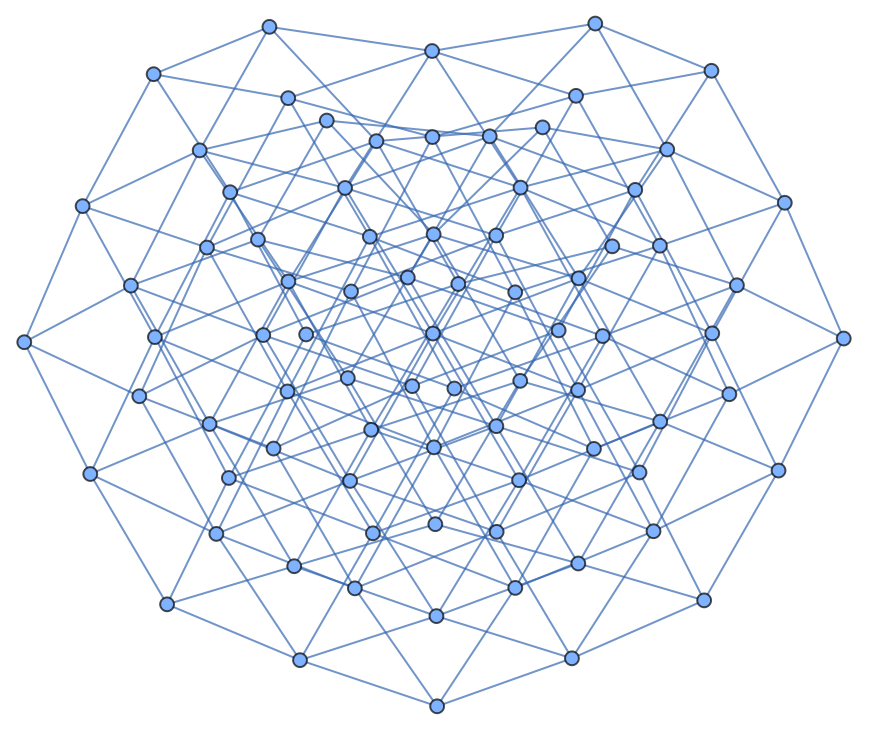
Create two dynamic array objects to store adjacent nodes. If two nodes differ by exactly one unit in exactly one position, draw an edge connecting them; for example, {1, 1, 2, 1} is linked to {2, 1, 2, 1}. By contrast, no edge is drawn between {1, 1, 1, 1} and {2, 2, 2, 2}.
In[]:=
Once[dy1=CreateDataStructure["DynamicArray"];dy2=CreateDataStructure["DynamicArray"];]
In[]:=
dy1["DropAll"];dy2["DropAll"];
In[]:=
Do[With[{res=Abs[nodes[[i]]-nodes[[j]]]},If[Total[res]==1,dy1["Append",nodes[[i]]];dy2["Append",nodes[[j]]];]],{i,1,len-1},{j,i+1,len}]
Create edge list for the graph:
In[]:=
el=Thread[dy1["Elements"]dy2["Elements"]];
Count the number of edges:
In[]:=
Length[el]
Out[]=
212
Visualize the graph:
In[]:=
g=Graph[el]
Out[]=
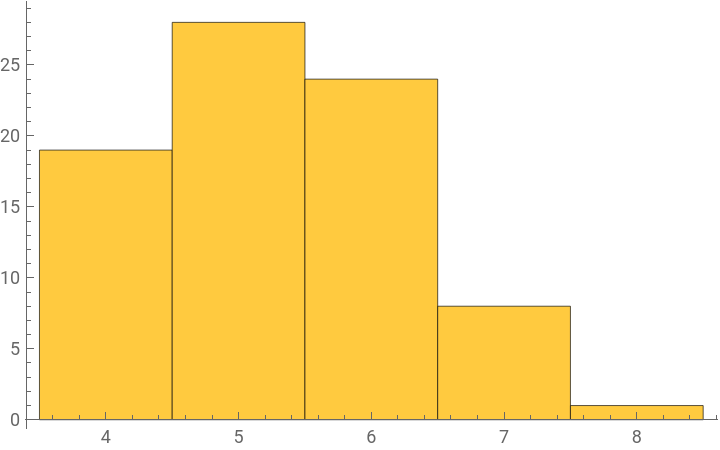
Distribution of the vertex degree:
In[]:=
Histogram[VertexDegree[g]]
Out[]=
Automorphism and its group order:
In[]:=
GraphAutomorphismGroup[g]
Out[]=
PermutationGroup[{Cycles[{{4,5},{7,8},{11,12},{14,15},{17,18},{19,20},{21,22},{23,24},{25,53},{26,54},{28,55},{30,56},{32,57},{34,58},{36,59},{38,60},{40,61},{42,62},{44,63},{45,64},{46,65},{47,66},{48,67},{49,68},{50,69},{51,70},{52,71}}],Cycles[{{3,4},{6,7},{9,25},{10,26},{12,27},{13,28},{15,29},{16,30},{18,31},{19,32},{20,44},{21,34},{22,45},{23,36},{24,46},{39,47},{41,48},{43,49},{57,63},{58,64},{59,65},{60,72},{61,73},{62,74},{69,75},{70,76},{71,77}}],Cycles[{{1,9},{2,10},{4,11},{5,12},{6,13},{7,19},{8,20},{17,21},{18,22},{28,32},{29,33},{30,38},{31,39},{36,40},{37,41},{45,47},{46,50},{49,51},{55,57},{56,60},{59,61},{64,66},{65,69},{68,70},{73,75},{74,78},{77,79}}]}]
In[]:=
GroupOrder[%]
Out[]=
24
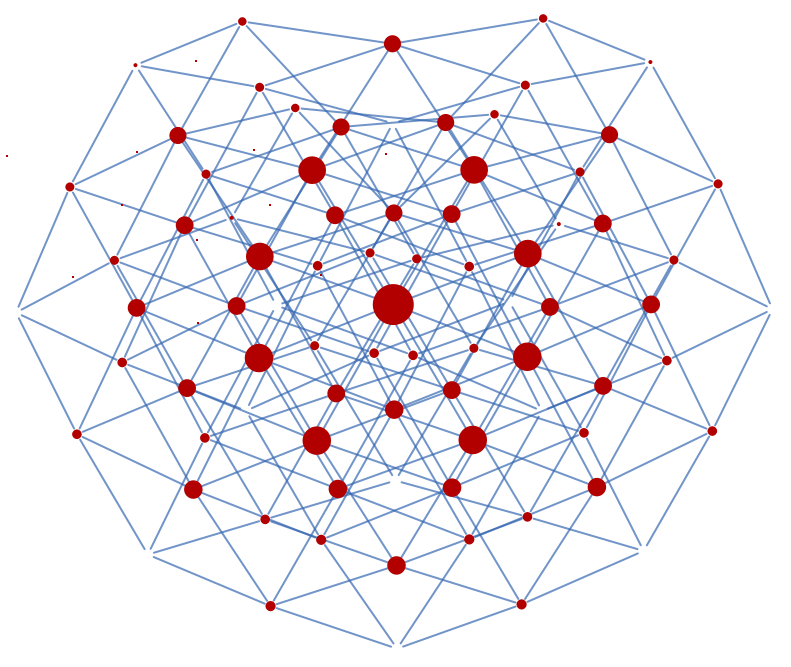
Compute closeness centralities and highlight:
In[]:=
HighlightGraph[g,VertexList[g],VertexSize->Thread[VertexList[g]->Rescale[ClosenessCentrality[g]]]]
Out[]=
Graph perfect matching
Graph perfect matching
The key step for computation is to recognize that the perfect matching set always exists for the graph. To find the proper set, use the following function:
In[]:=
inEset=FindIndependentEdgeSet[el];
Highlighting the edges from the pairs above:
In[]:=
op=Transpose[Outer[#1->#2&,inEset,{Directive[StandardOrange,Thickness[0.01]]}]][[1]];
In[]:=
Graph[el,EdgeStyle->op]
Out[]=
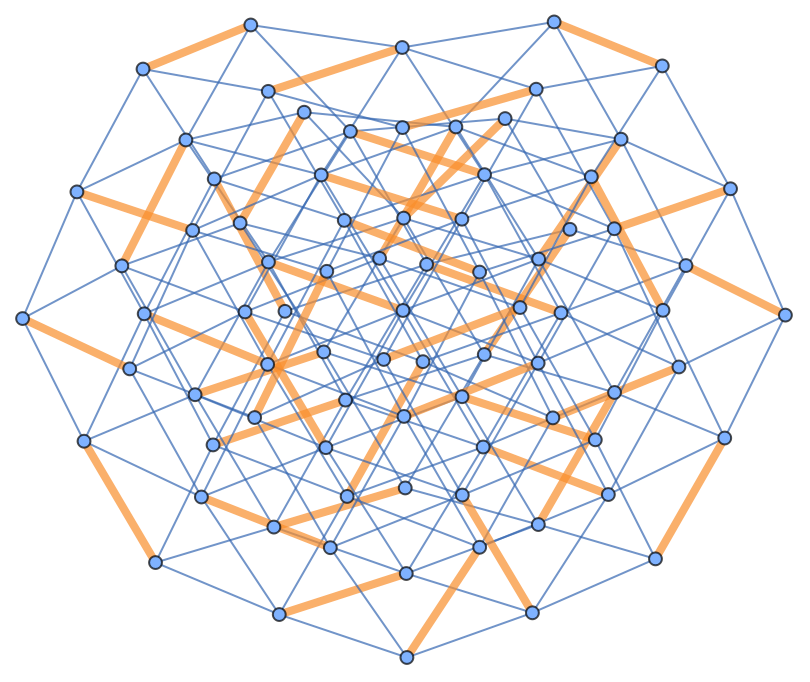
Let’s come back the original question: If Alice choose any vertex in the graph, Bob chooses the vertex linked by the orange line. So Bob has a winning strategy.
OEIS A224327
OEIS A224327
Set , the number of edges in the graph is :
n=4,5,6,7
212,805,2910,10199
In[]:=
ResourceFunction["OEISLookup"][{212,805,2910,10199}]
Out[]=
A224327OEISLookup

The closed form solution is
In[]:=
a[n_]:=n*(2*3^(n-1)-1)
In[]:=
Array[a,10]
Out[]=
{1,10,51,212,805,2910,10199,34984,118089,393650}
From the point of combinatorics the closed form formula is supported by the following argument:
◼
One has position to choose exactly one digit to flip
n
◼
Say we choose the first position there are two options {0, X, X, X,...,X} <->{1, X,X,X,...,X} and {1,X,X,X,...,X} <->{2,X,X,X,...,X}, in total and we have to remove {0,0,0,...,0} with zeros.
2·
n-1
3
n
Adjacency matrix
Adjacency matrix
Visualize the adjacency matrix of the graph
CITE THIS NOTEBOOK
CITE THIS NOTEBOOK
Visual explanation of the problem Putnam 2025 A3
by Shenghui Yang
Wolfram Community, STAFF PICKS, December 28, 2025
https://community.wolfram.com/groups/-/m/t/3598035
by Shenghui Yang
Wolfram Community, STAFF PICKS, December 28, 2025
https://community.wolfram.com/groups/-/m/t/3598035