Idea
Idea
In racing, every tenth of a second is important and race drivers need to know their car well for that. Therefore, my goal was to make a program that could calculate the highest possible speed in 3 different parts of a turn - entry, apex, and exit (more about that here).
At first, I declared initial variables necessary for the simulation and added the necessary images (see Initial Setup section).Then, I created an animation function for the 180 degree turn (hairpin) and the 90 degree turn (see Hairpin section):After this, I created functions that calculate entry, apex, and exit speeds of the selected cars and tires (see Apex Speed section). For the calculation, I needed these parameters:
1. Grip coefficient of the selected tires,
2. Inner and outer radiuses of the selected turns,
3. Speeding and braking accelerations of the selected car,
4. Area of the selected car,
5. Rear wing area of the selected car (if equipped),
6. Weight of the selected car.
Initial Setup
Initial Setup
Hairpin
Hairpin
Apex Speed
Apex Speed
How to use the GUI
How to use the GUI
Please use the following function to run the GUI
In[]:=
uifunc[]
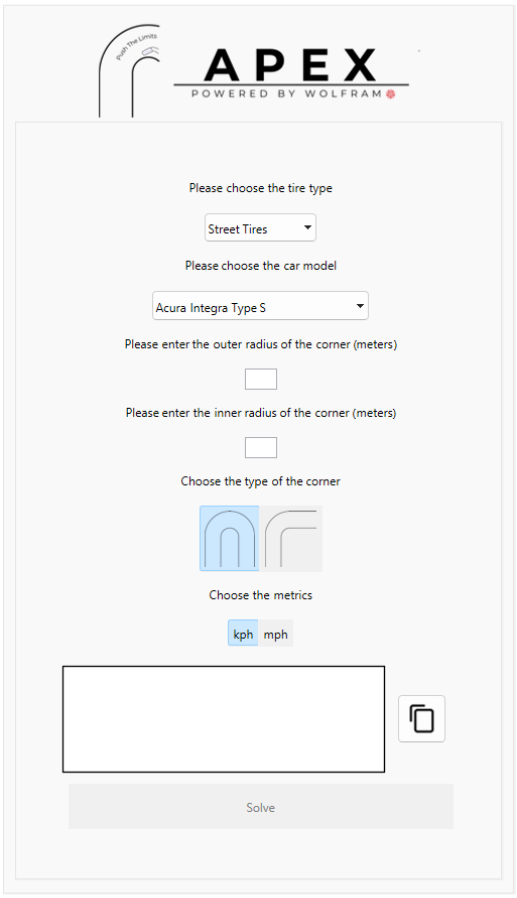
At first we need to select the tire type. It’s common knowledge that various car tires offer varying levels of grip. Therefore, I needed multiple images of those tires to explain that. Here is the result:
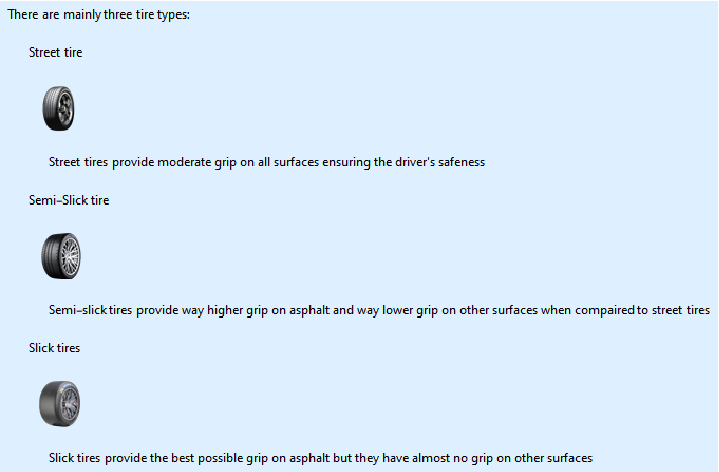
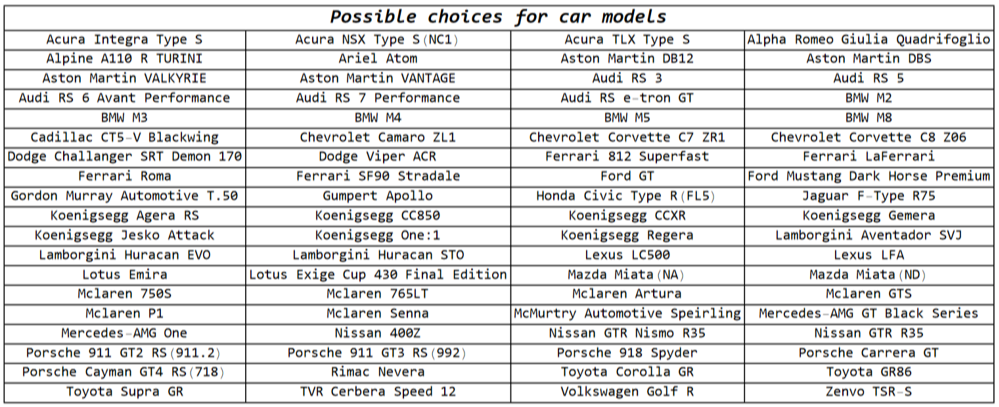
After that we choose the car model. Each car has the unique entry, apex, and exit
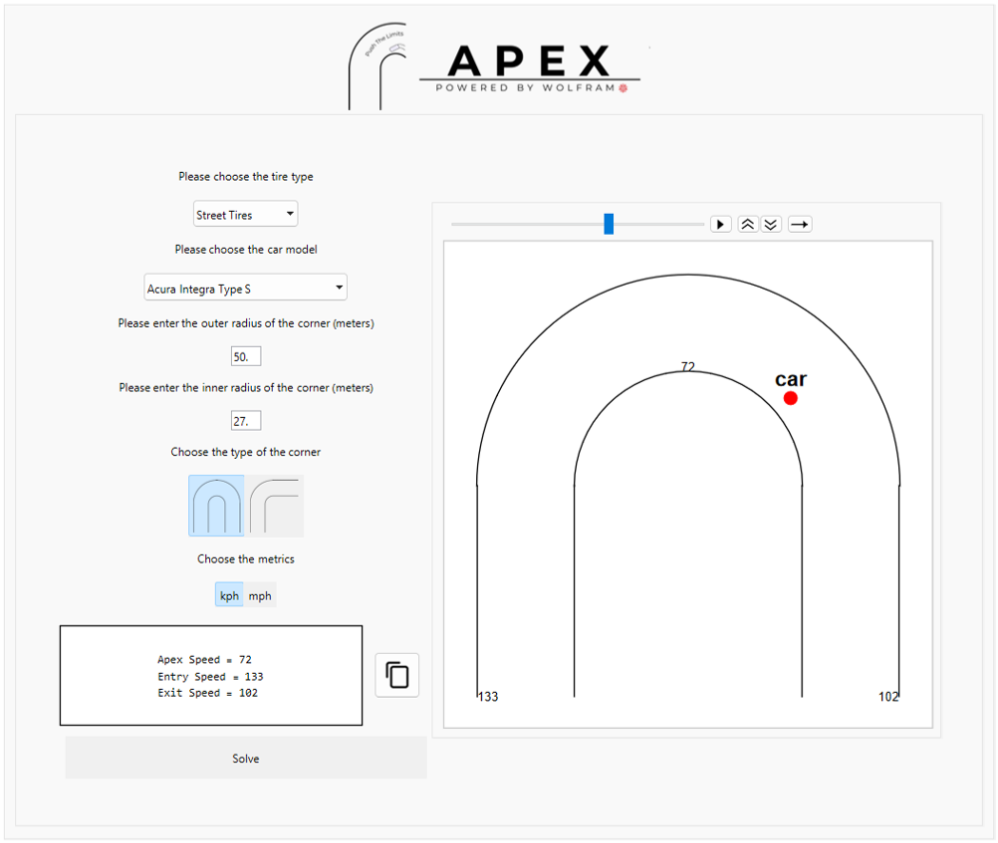
After entering all the necessary parameters (such as outer/inner radius of the corner (in meters), type of the corner, and metrics (kph or mph)) we can calculate the necessary parameters of the problem by clicking the ‘Solve’ button, which shows a simulation of the selected turn type. Here is an example below:
Conclusion
Conclusion
Finally, I managed to create a program by using different physical equations, which can help beginners to understand the ideal geometrical racing lines as well as learning the limits of their car.
Acknowledgement
Acknowledgement
I want to thank our mentor Mher Mkrtchyan for his immeasurable help and support throughout this project.
Affiliation
Affiliation
In December 2020 the Wolfram Lab opened at RAU (Russian-Armenian University, Yerevan, Armenia). The Wolfram Lab was created on the basis of the RAU research laboratory for mathematical modeling of quantum systems. This laboratory became the first laboratory in the world created by Wolfram Research on a university basis. Currently, the laboratory teaches courses for undergraduate students (major in programming and physics) and high school students (major in physical and mathematical sciences). Mher Mkrtchyan (mherm@wolfram.com) (Group: Sound & Vision, Manager: Shadi Ashnai) is responsible for the Wolfram Lab at RAU.
The project was completed by an 11th grade student.
The project was completed by an 11th grade student.
CITE THIS NOTEBOOK
CITE THIS NOTEBOOK
[WSA24] Simulation of a geometrical racing line
by Vladimir Shirkhanyan
Wolfram Community, STAFF PICKS, October 2, 2024
https://community.wolfram.com/groups/-/m/t/3289389
by Vladimir Shirkhanyan
Wolfram Community, STAFF PICKS, October 2, 2024
https://community.wolfram.com/groups/-/m/t/3289389