Sensitivity, Specificity, and Incidence
Sensitivity, Specificity, and Incidence

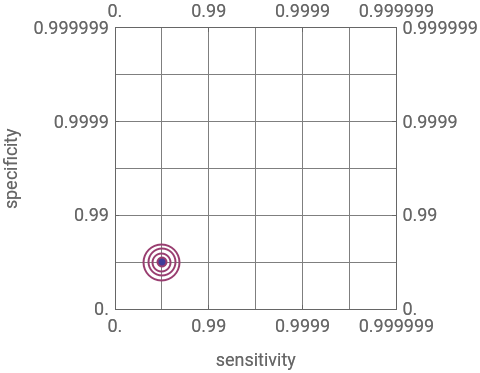
Testing, whether done in the medical field or elsewhere, generally has what is known as sensitivity and specificity. Sensitivity is the fraction of tested subjects who truly have some
characteristic that the test will say they have. Specificity is the fraction of tested subjects who truly do not have some characteristic that the test will say they do not have. This Demonstration shows how the number of true positives, false positives, false negatives, and true negatives can be calculated by using data regarding sensitivity, specificity, and the incidence in the tested population of a particular characteristic.
characteristic that the test will say they have. Specificity is the fraction of tested subjects who truly do not have some characteristic that the test will say they do not have. This Demonstration shows how the number of true positives, false positives, false negatives, and true negatives can be calculated by using data regarding sensitivity, specificity, and the incidence in the tested population of a particular characteristic.
Details
Details
If the grid is represented as
, then sensitivity is and specificity is . Incidence is .
a | b |
c | d |
a
a+c
d
b+d
a+c
a+b+c+d
The sliders do not have a linear response since it is often important to control fine levels of detail at the upper levels of sensitivity and specificity and at the lower levels of incidence.
Snapshot 1: With low incidence conditions, a positive result on even a very sensitive test does not suggest by any means that a subject is truly positive.
Snapshot 2: With high incidence conditions, a positive result on a very sensitive test strongly suggests that a subject is truly positive.
Snapshot 3: With very high incidence conditions, even not highly specific or sensitive tests are rather good predictors.
External Links
External Links
Permanent Citation
Permanent Citation
Seth J. Chandler
"Sensitivity, Specificity, and Incidence"
http://demonstrations.wolfram.com/SensitivitySpecificityAndIncidence/
Wolfram Demonstrations Project
Published: January 9, 2009