CITE THIS NOTEBOOK: A curious mass ratio by Paul Abbott. Wolfram Community FEB 2 2023.
School of Physics, Mathematics and Computing
The University of Western Australia
paul.c.abbott@uwa.edu.au
CITE THIS NOTEBOOK: A curious mass ratio by Paul Abbott. Wolfram Community FEB 2 2023.
School of Physics, Mathematics and Computing
The University of Western Australia
paul.c.abbott@uwa.edu.au
School of Physics, Mathematics and Computing
The University of Western Australia
paul.c.abbott@uwa.edu.au
me+mμ+mτ2me+mμ+mτ
m
e
m
μ
m
τ
2
++
m
e
m
μ
m
τ
In[]:=

Here is the electron mass, is the muon mass, and is the tau mass.
m
e
m
μ
m
τ
A nice problem is to check this computation.
Direct Computation
Direct Computation
Extract the masses:
In[]:=
m[e]=
Out[]=
In[]:=
m[μ]=
Out[]=
In[]:=
m[τ]=
Out[]=
Compute the expression:
In[]:=
m[e]+m[μ]+m[τ]
2
m[e]
+m[μ]
+m[τ]
Out[]=
0.66666
Uncertainty
Uncertainty
To extract the standard uncertainty for these masses, one can find the entity property via , which that leads to a very simple direct solution:

In[]:=
{m[e],m[μ],m[τ]}=Through,,
Out[]=
,,
Use to obtain the uncertainty in the result:
In[]:=
AroundReplace++,{m[e],m[μ],m[τ]}
m
e
m
μ
m
τ
2
++
m
e
m
μ
m
τ
m
e
m
μ
m
τ
Out[]=
0.66666
(
+7
1
-7
)
It looks like 2/3 is not the most probable value for this expression (although it is a possible one).
Distribution
Distribution
Michael Trott suggested looking at the distribution, which is also quite instructive:
In[]:=
{m[e],m[μ],m[τ]}=QuantityMagnitude[{m[e],m[μ],m[τ]}]
Out[]=
0.51099894
(
+33
61
-33
)
,105.65837(
+25
45
-25
)
,+0.13
1776.86
-0.13
In[]:=
td=TransformedDistribution++,{NormalDistribution[m[e]["Value"],m[e]["Uncertainty"]〚1〛],NormalDistribution[m[μ]["Value"],m[μ]["Uncertainty"]〚1〛],NormalDistribution[m[τ]["Value"],m[τ]["Uncertainty"]〚1〛]};
m
e
m
μ
m
τ
2
++
m
e
m
μ
m
τ
m
e
m
μ
m
τ
In[]:=
HistogramRandomVariate[td,],100,GridLines,None,GridLinesStyleRed
6
10
2
3
Out[]=
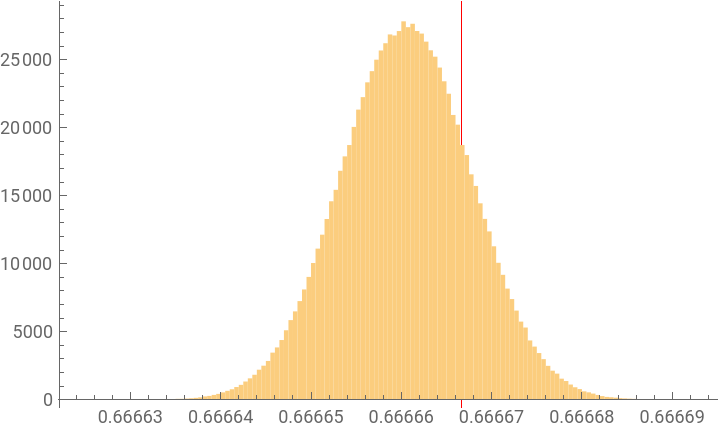
So, clearly, 2/3 is not the most likely value for this mass ratio.