Since almost exactly 5 years, I have been strength training (Powerlifting), e.g. deadlift, squat, bench press, etc. As I’m not very strong, I was very happy to learn that there are formulas for age adjustments of the weights lifted which combines weight, repetitions and age .
Together with formulas for converting the number of repetitions of a weight lifted to estimating a 1RM (estimated one repetition maximum), I use this for:
* for comparing different number of repetition for an exercise.
* how much a PR (Personal Record) corresponds to - say - a 30 years old person of the same body weight as me
Below are some different (and mostly real world) “applications” for these kind of comparisons.
The formulas for estimating 1RM are from the book Maud & Foster "Physiological Assessments of Human Fitness" (2nd ed), page 140, as well as Wikipedia page https://en.wikipedia.org/wiki/One-repetition_maximum . The age adjustment coefficients (e.g. 1.514 for age 60) are from “Meltzer-Faber Age coefficients”: http://www.mastersweightlifting.org/forms/meltzer.htm
The text that inspired all this was Brooks Kubik’s post “The Difference Between Age 30 and Age 60” (or rather a similar text in one of this books): http://dinosaurtraining.blogspot.se/2016/12/the-difference-between-age-30-and-age-60.html
“””
What’s the difference between a serious, hard charging weight trainer at age 30 and the same trainee at age 60?
And to clarify, I’m talking about someone who keeps training from age 30 to age 60 -- not someone who stops training somewhere along the road.
The difference is 1.514.
That’s the difference in the age-coefficient formula used in Masters Weightlifting to compare the relative performance of athletes of different ages.
The coefficient for a 30 year old lifter is 1.00.
“””
Notes:
* Here I compare not only with one person of different ages, but also with two persons of different ages.
* However, all these calculations assume that the person(s) in the comparison are of the same weight. See below for some sites that also includes body weight and gender in the comparisons.
Age adjustment coefficients
Age adjustment coefficients
From "Meltzer-Faber Age coefficients": http://www.mastersweightlifting.org/forms/meltzer.htm
In[]:=
coeffs={{30,1},{31,1.016},{32,1.031},{33,1.046},{34,1.059},{35,1.072},{36,1.083},{37,1.096},{38,1.109},{39,1.122},{40,1.135},{41,1.149},{42,1.162},{43,1.176},{44,1.189},{45,1.203},{46,1.218},{47,1.233},{48,1.248},{49,1.263},{50,1.279},{51,1.297},{52,1.316},{53,1.338},{54,1.361},{55,1.385},{56,1.411},{57,1.437},{58,1.462},{59,1.488},{60,1.514},{61,1.541},{62,1.568},{63,1.598},{64,1.629},{65,1.663},{66,1.699},{67,1.738},{68,1.779},{69,1.823},{70,1.867},{71,1.91},{72,1.953},{73,2.004},{74,2.06},{75,2.117},{76,2.181},{77,2.255},{78,2.336},{79,2.419},{80,2.540},{81,2.597},{82,2.702},{83,2.831},{84,2.981},{85,3.153},{86,3.352},{87,3.58},{88,3.843},{89,4.145},{90,4.493}};ListPlot[coeffs,AxesLabel{"Age","Coefficient"}]Transpose[coeffs];ageCoeffs=Thread[%[[1]]%[[2]]]//Association;
Out[]=
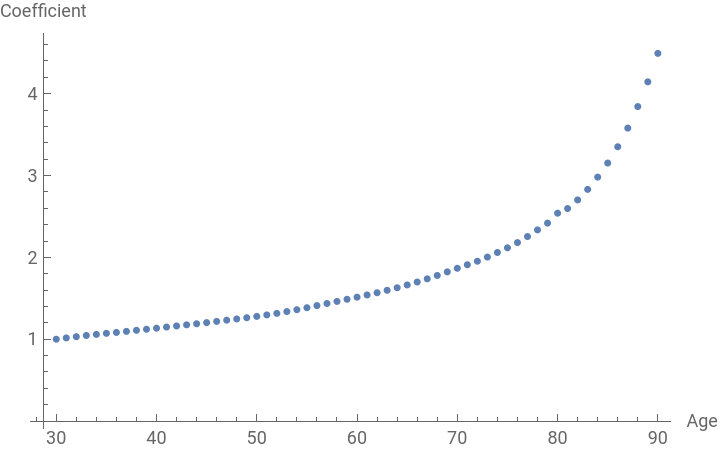
Here are some explorations of this. Though I have not pursued the model fits more.
In[]:=
myAge=64(*asofwriting,soon65*)ageCoeffs[myAge]fit1=LinearModelFit[coeffs,x,x]fit1["ANOVATable"]fit2=NonlinearModelFit[coeffs,a+Exp[xb],{a,b},x]fit2["ANOVATable"]
Out[]=
64
Out[]=
1.629
Out[]=
FittedModel
Out[]=
DF | SS | MS | F-Statistic | P-Value | |
x | 1 | 32.7233 | 32.7233 | 225.629 | 7.98292× -22 10 |
Error | 59 | 8.55685 | 0.145031 | | |
Total | 60 | 41.2802 | | | |
Out[]=
FittedModel
Out[]=
DF | SS | MS | |
Model | 2 | 235.396 | 117.698 |
Error | 59 | 5.16551 | 0.0875511 |
Uncorrected Total | 61 | 240.562 | |
Corrected Total | 60 | 41.2802 | |
1 RM formulas
1 RM formulas
The following formulas for calculating 1RM (1 repetition max) from a lifted weight and number of repetitions are from https://en.wikipedia.org/wiki/One-repetition_maximum .
Note: There are two different versions of Epley's formula, and I prefer the first one.
Note: There are two different versions of Epley's formula, and I prefer the first one.
In[]:=
brzycki[weight_,reps_]:=weight*(36./(37-reps))epley[weight_,reps_]:=0.033*weight*reps+weight;epley2[weight_,reps_]:=weight(1+reps/30.);oconner[weight_,reps_]:=weight*(1+0.025*reps);lombardi[weight_,reps_]:=weight*reps^0.10;mcglothin[weight_,reps_]:=100*weight/(101.3-2.67123*reps);wathan[weight_,reps_]:=100*weight/(48.8+53.8Exp[-0.075*reps]);
(*SetdefaulttoEpleyformulaanda30yearoldperson*)oneRM[weight_,reps_,age_:30,method_:epley]:=Module[{rm=method[weight,reps]},{rm,rm*ageCoeffs[age]}]
Some examples/applications
Some examples/applications
Here are some applications of using these formulas. It is mostly to compare some weight + repetitions either for my self to compare what a 30 years old person should take (or a friend of different age), or how many repetitions of a weight corresponds to some other number of repetitions for some other weight.
Here’s a personal record earlier this year: 117kg (deadlift) for 1 repetition, as a 64 years old.
What is the 1RM using Epley’s formula? The Age adjusted weight is about 197kg, i.e. what a 30 years old would have to lift be “as strong as” I am.
As mentioned above, all these calculations assume that the two persons have the same body weight.
What is the 1RM using Epley’s formula? The Age adjusted weight is about 197kg, i.e. what a 30 years old would have to lift be “as strong as” I am.
As mentioned above, all these calculations assume that the two persons have the same body weight.
In[]:=
oneRM[117,1,myAge][[2]]
Out[]=
196.883
Here we test some different PR’s from the last year (also in deadlift), and use shows other 1RM methods as well. As can be seen, the methods might give quite different results. Epley’s method seems to be one of the most used formulas.
For example, 5 repetitions of 102kg for a 64 years old corresponds to 183kg using Brzycki’s formula.
For example, 5 repetitions of 102kg for a 64 years old corresponds to 183kg using Brzycki’s formula.
In[]:=
methods={brzycki,epley,epley2,oconner,lombardi,mcglothin,wathan};"112 kg for 1 repetition:"{#,oneRM[112,1,63,#][[2]]}&/@methods//Column"102 kg for 5 repetition:"{#,oneRM[102,5,63,#][[2]]}&/@methods//Column"107 kg for 3 repetition:"{#,oneRM[107,3,63,#][[2]]}&/@methods//Column
Out[]=
112 kg for 1 repetition:
Out[]=
{brzycki,178.976} |
{epley,184.882} |
{epley2,184.942} |
{oconner,183.45} |
{lombardi,178.976} |
{mcglothin,181.464} |
{wathan,181.31} |
Out[]=
102 kg for 5 repetition:
Out[]=
{brzycki,183.371} |
{epley,189.89} |
{epley2,190.162} |
{oconner,183.371} |
{lombardi,191.458} |
{mcglothin,185.341} |
{wathan,190.025} |
Out[]=
107 kg for 3 repetition:
Out[]=
{brzycki,181.044} |
{epley,187.914} |
{epley2,188.085} |
{oconner,183.81} |
{lombardi,190.841} |
{mcglothin,183.292} |
{wathan,186.34} |
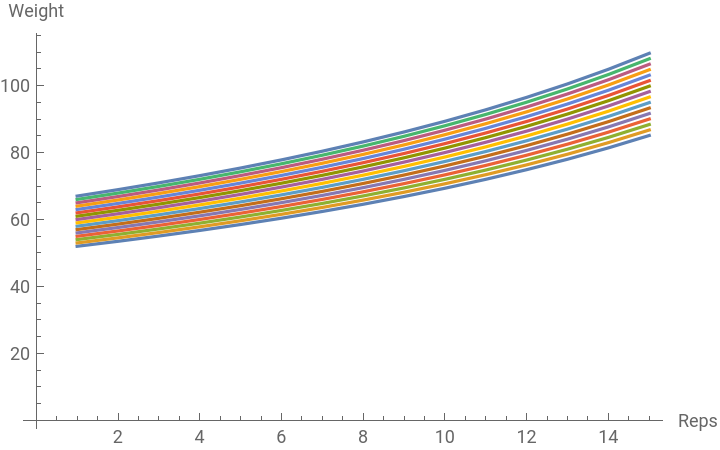
Below is a plot showing Brzycki’s 1RM formula for 1..15 repetitions for 52kg..67kg.
In[]:=
Table[brzycki[weight,reps],{weight,52,67},{reps,1,15}];ListLinePlot[%,AxesLabel{"Reps","Weight"}]
Out[]=
How much must I (at age 64) bench press with 10 repetition to be “as strong” as a 30 years old person bench pressing 70kg x 5: 37.6kg .
Note: a 30 years old has the age coefficient 1, so 30 can be seen as the “baseline age”.
Note: a 30 years old has the age coefficient 1, so 30 can be seen as the “baseline age”.
In[]:=
Solve[epley[x,10]*ageCoeffs[myAge]epley[70,5]*ageCoeffs[30],x]
Out[]=
{{x37.6401}}
But let' s take a real case . 77 x 5 was actually the record of my (now former) colleague S who was then 37 yo. This corresponds to 49.3kg for me, then 60 years old. (Due to my shoulder problem I cannot lift 46kg in bench press, and my physio therapist has forbidden me to do any bench press at all.)
In[]:=
Solve[epley[x,6]*ageCoeffs[60]==epley[70,5]*ageCoeffs[37],x]
Out[]=
{{x49.2779}}
What is the coefficient for 10 vs 5 repetitions? 10 repetitions corresponds to 1.14163 x 5 repetitions (using Epley’s formula)
In[]:=
Reduce[epley[x,10]==epley[y,5],{x,y}]
Out[]=
y0.+1.14163x
What would S (then aged 37) take in deadlift for 5 repetitions to match my 52kg x 10 at age 60? He would have to lift 82.0kg x 5.
What would S (now 41 yo) lift in deadlift for 1 repetitions to match my 117kg x 1 from earlier this year (age 64)? He would have to lift one repetition of 165.9kg (which he don’t since he is not doing any deadlifts at all).
What would S (now 41 yo) lift in deadlift for 1 repetitions to match my 117kg x 1 from earlier this year (age 64)? He would have to lift one repetition of 165.9kg (which he don’t since he is not doing any deadlifts at all).
In[]:=
Solve[epley[52,10]*ageCoeffs[60]==epley[x,5]*ageCoeffs[37],x]Solve[epley[117,1]*ageCoeffs[myAge]==epley[x,1]*ageCoeffs[41],x]
What should S (aged 37) take in Dumbbell row x 5 to match my 22.5 kg x 12? : 40.1kg
What is my age adjusted value of 22.5kg x 10 (in biceps curl)? 48.7kg
What is my age adjusted value of 37.5kg x 5 (in dumbbell row)? 71.2kg
What is my age adjusted value of 37.5kg x 5 (in dumbbell row)? 71.2kg
What corresponds to 37.5kg x 10 (dumbbell row) in 5 repetitions? 42.8kg
Age adjusted: 69.7kg
Age adjusted: 69.7kg
How much should I (age adjusted) take x 10 to correspond to a 1 RM of 100kg (of a 30 yo)? 46.2kg
Not age adjusted: 75.2kg
Not age adjusted: 75.2kg
How much should I (age adjusted and not age adjusted) take x 12 to correspond to a 1 RM on 100 kg?
Age adjusted: 44.0kg
Not age adjusted : 71.6kg
Age adjusted: 44.0kg
Not age adjusted : 71.6kg
What is 1RM for 30kg x 10? 39.9kg
Age adjusted? 65.0kg
Age adjusted? 65.0kg
How much should I (age adjusted) lift in 1 repetition that correspond to a 1 RM on 200 kg? 118.9kg
(Almost there!)
(Almost there!)
What corresponds to 47 kg with 10 reps if doing 6 reps? 52.2kg
What corresponds to 52 kg with 10 reps if doing 6 reps? 57.8kg
What corresponds to 52 kg with 10 reps if doing 6 reps? 57.8kg
Person P (age 30) lift 30 kg in bench press x 10. How much does that corresponds to 1RM and for a 60 yo?
Person P (still age 30) lifted 77kg in deadlift x 6. What does that corresponds to in 1RM (one repetition) and age adjusted (40 yo)?
Person P took 77kg in deadlift x 6. What does that correspond to x 12?
How much should I take x 6 to correspond to 67kg x 12 ?
What is the relation between X x 6 reps and Y x 12 reps?
What is the relation between weight and repetitions: What does the weight xw x xr corresponds to for yr reps?
1 RM vs reps and weight
1 RM vs reps and weight
Here are some relations between weight lifted, number of repetitions, and 1RM. Basically it's just the 1RM formula (Epley's) in different forms.
Wolfram | Alpha
Wolfram | Alpha
Here is an example of Wolfram|Alpha for 1RM conversion . It uses Epley’s 1RM formula.
It would be really great if these queries would also include age adjustments and perhaps also some assessment. Here’s the above query to the Wolfram|Alpha site: https://www.wolframalpha.com/input/?i=weight+lifting+102+kg+for+5+repetitions+male+64+yo
Interestingly, it has support for showing the energy expenditure: https://www.wolframalpha.com/input/?i=weight+lifting+102+kg+for+5+repetitions+male+64+yo&assumption=%7B%22F%22%2C+%22WeightLiftingRepetitions%22%2C+%22H%22%7D+-%3E%22182+cm%22&assumption=%7B%22F%22%2C+%22WeightLiftingRepetitions%22%2C+%22W%22%7D+-%3E%2276+kg%22&assumption=%22FSelect%22+-%3E+%7B%7B%22WeightLiftingRepetitions%22%7D%7D&assumption=%7B%22FP%22%2C+%22WeightLiftingRepetitions%22%2C+%22exercise%22%7D+-%3E+%22Deadlift%22
Interestingly, it has support for showing the energy expenditure: https://www.wolframalpha.com/input/?i=weight+lifting+102+kg+for+5+repetitions+male+64+yo&assumption=%7B%22F%22%2C+%22WeightLiftingRepetitions%22%2C+%22H%22%7D+-%3E%22182+cm%22&assumption=%7B%22F%22%2C+%22WeightLiftingRepetitions%22%2C+%22W%22%7D+-%3E%2276+kg%22&assumption=%22FSelect%22+-%3E+%7B%7B%22WeightLiftingRepetitions%22%7D%7D&assumption=%7B%22FP%22%2C+%22WeightLiftingRepetitions%22%2C+%22exercise%22%7D+-%3E+%22Deadlift%22