How many order-3 rep-tiles and irreptiles are there?
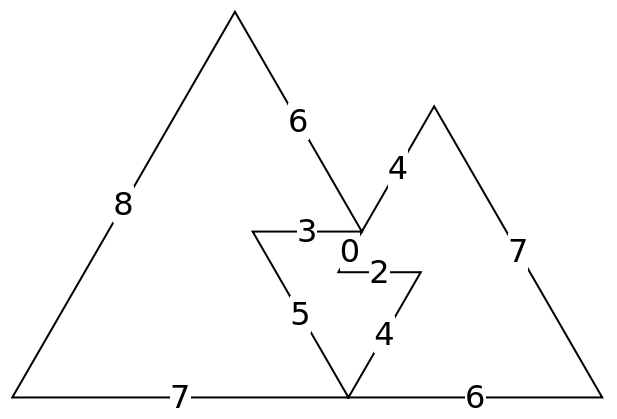
In the Vesa Timonen irregular pentagon, the sides are powers of the plastic constant ρ, where =ρ+1.
3
ρ
In[]:=
ρ = Root[-1 - #1 + #1^3 & , 1, 0];
vesa = ρ^{{9,8,6,4,7},{8,7,5,3,6},{7,6,4,2,5},{5,4,2,0,3}};
N[ρ]
vesa = ρ^{{9,8,6,4,7},{8,7,5,3,6},{7,6,4,2,5},{5,4,2,0,3}};
N[ρ]
Out[]=
1.32472
In[]:=
path=RootReduce[With[{r=Root[-1-#1+#1^3&,1,0]},AnglePath[{{r^6,0°},{r^7,120°},{r^4,120°},{r^6,-120°},{r^8,120°},{r^7,120°},{r^4,60°},{r^2,120°},{r^0,-120°},{r^3,120°},{r^5,120°}}]]];Graphics[{Line[path],Style[Text[ResourceFunction["IntegerChop"][Quiet@N[Log[Root[-1-#1+#1^3&,1,0],EuclideanDistance@@#]]],Mean[#],BackgroundWhite],16]&/@Partition[path,2,1]}]
Out[]=
In[]:=
vesapic=Graphics[{Line[path]}];
But wait, there’s more!
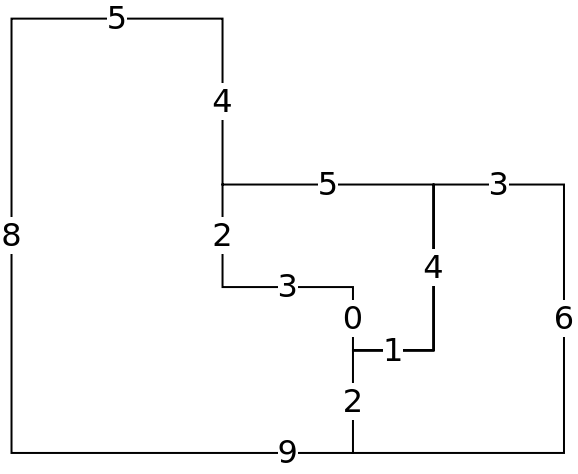
I’ve since learned of a chair hexagon found by Mineyuki Uyematsu in March 2020, based on the square root of the golden ratio:
In[]:=
ϕ=Root[-1-#1+#1^3&,1,0];mine=ϕ^{{9,8,5,4,7,6},{8,7,4,3,6,5},{6,5,2,1,4,3},{5,4,1,0,3,2}};N[ϕ]
Out[]=
1.32472
Here’s a picture:
In[]:=
path=RootReduceWith{r=RootReduce[Sqrt[GoldenRatio]]},AnglePath[{{,0°},{,-90°},{r,-90°},{1,-90°},{,90°},{,-90°},{,0°},{,90°},{,90°},{,90°},{,90°},{,90°},{,90°},{,-90°},{,90°}}];Graphics[{Line[path],Style[Text[ResourceFunction["IntegerChop"][Quiet@N[Log[Sqrt[GoldenRatio],EuclideanDistance@@#]]],Mean[#],BackgroundWhite],16]&/@Partition[path,2,1]}]
5
r
4
r
3
r
2
r
4
r
5
r
8
r
9
r
6
r
3
r
4
r
1
r
2
r
Out[]=
In[]:=
minepic=Graphics[{Line[path]}];
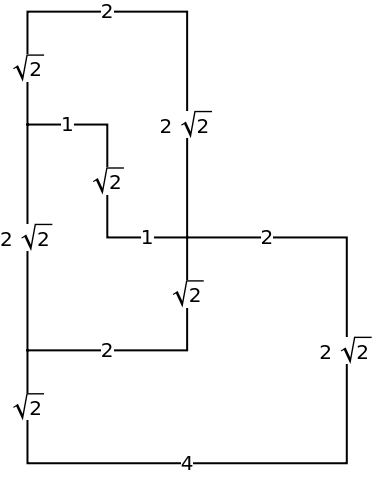
Also, another chair was found by Jun-ichi Miyoshi:
In[]:=
path=RootReduceWith{r=RootReduce[Sqrt[GoldenRatio]]},AnglePath2
2
,-90°,{2,90°},2
,90°,{1,90°},2
,-90°,{1,90°},2
,-90°,{2,-90°},22
,-90°,{2,90°},22
,-90°,{4,-90°},2
,-90°;Graphics[{Line[path],Style[Text[EuclideanDistance@@#,Mean[#],BackgroundWhite],10]&/@Partition[path,2,1]}]Out[]=
In[]:=
miyoshi=Graphics[{Line[path]}];
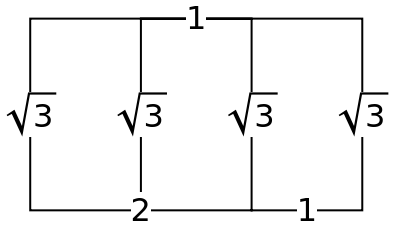
Here’s a simple rep-tile that can be skewed into a parallelogram:
In[]:=
path=AnglePath{1,0°},
3
,90°,{3,90°},3
,90°,{2,90°},3
,90°,{1,90°},3
,90°;Graphics[{Line[path],Style[Text[EuclideanDistance@@#,Mean[#],BackgroundWhite],16]&/@Partition[path,2,1]}]Out[]=
In[]:=
thirds=Graphics[{Line[path]}];
Another rectangle dissection into similar copies:
In[]:=
sqrt2=GraphicsEdgeForm[Black],White,Rectangle{0,0},1,1
2
,Rectangle0,12
,1,2
,Rectangle{-1,0},0,2
Out[]=
Another rectangle dissection into similar copies:
In[]:=
twothirds=GraphicsEdgeForm[Black],White,Rectangle{0,0},,1,Rectangle{0,1},,2,Rectangle-2,0,{0,2}
2
3
2
3
2
3
Out[]=
And a similar rectangle dissection based on the square root of the golden ratio:
In[]:=
golden=Graphics[{EdgeForm[Black],White,Rectangle[{0,0},{Sqrt[GoldenRatio],1}],Rectangle[{0,1},{Sqrt[GoldenRatio],GoldenRatio+1}],Rectangle[{-Sqrt[GoldenRatio]^3,0},{0,GoldenRatio+1}]}]
Out[]=
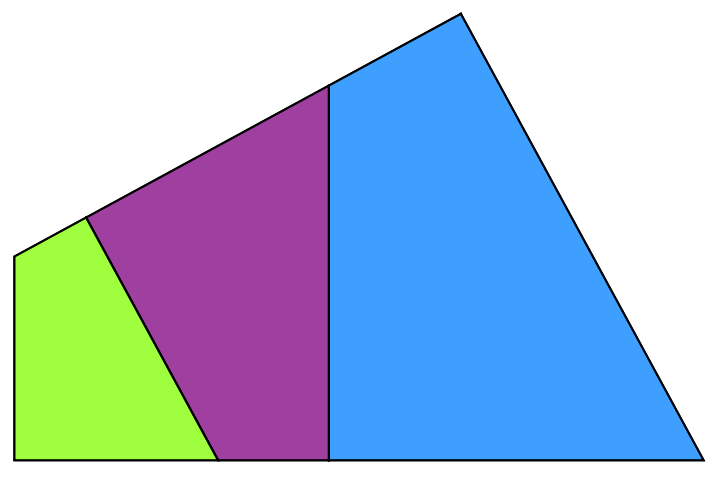
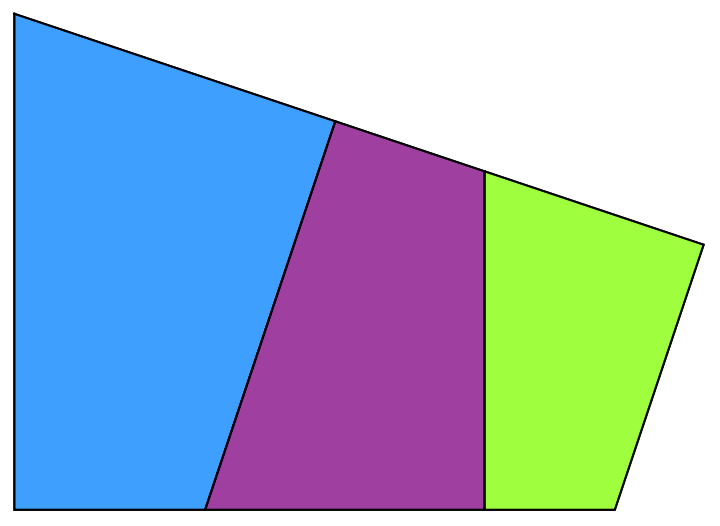
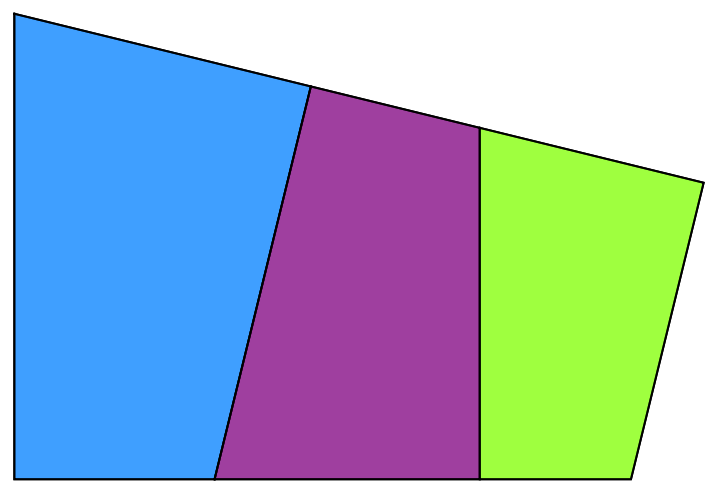
In addition to another chair, there are an infinite number of quadrangles that work. I need to come up with the generalized form.
In[]:=
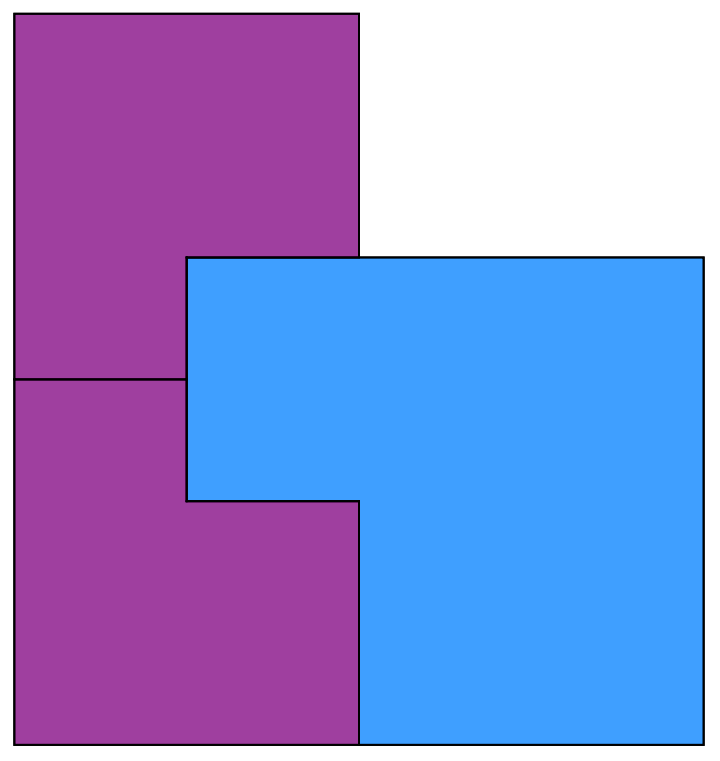
Column[{Text@#,ResourceFunction["AlgebraicSubstitutionTiling"][#,1,{"N"}]},Alignment->Center]&/@{"Tritan3","WaltonChair","TribonacciChordQuadrangle","PsiChordQuadrangle","RhoChordQuadrangle"}
Out[]=
,
,
,
,
Tritan3 |
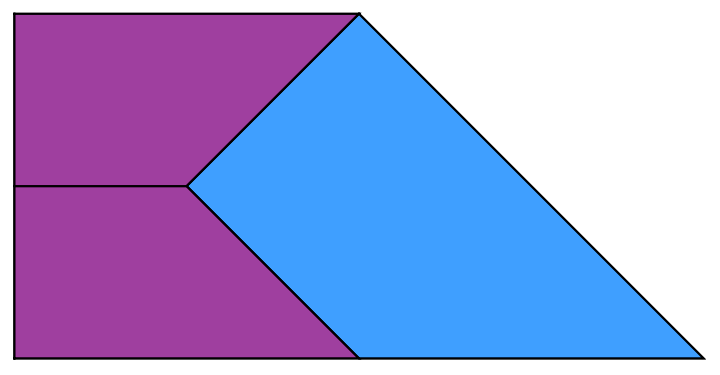
WaltonChair |
TribonacciChordQuadrangle |
PsiChordQuadrangle |
RhoChordQuadrangle |
In[]:=
{Tritan3,WaltonChair,TribonacciChordQuadrangle,PsiChordQuadrangle,RhoChordQuadrangle}=(ResourceFunction["AlgebraicSubstitutionTiling"][#,1,{"N"}]&/@{"Tritan3","WaltonChair","TribonacciChordQuadrangle","PsiChordQuadrangle","RhoChordQuadrangle"});
A closer look at the Walton Chair:
In[]:=
waltonpts=2
2
,4,22
,6,{0,6},{0,0},42
,0,42
,4,2
,4,2
,3,2
,2,22
,2,22
,0,{0,3};waltonpoly={{10,9,7,6,5,11},{9,8,12,4,11,10},{7,8,12,3,2,1}};Graphics[{EdgeForm[Black],Cyan,Polygon[waltonpts[[#]]]&/@waltonpoly}]The second stage of the Ammann chair is an order-3 irreptile, and we could have divided the smaller chair instead for a second way:
A unique triangle can be divided into three similar copies of itself:
However, any scalene right triangle can be divided into three similar triangles in two ways:
Then there are the fractal polygons. Here are a few order-3 fractal polygons:
Many of these fractal polygons likely corresponds to a simpler “almost” irreptile that could be extended into fractal polygons.
However, as one drifts further away, the fractal dimension increases.
Still, it would be nice to find simplest forms for various fractal polygons. Also, I need to come up with a good way for representing fractal polygons. For example, the 1-2-2 triangle below can used to make a fractal irreptile, but I currently can’t extract the three shape form.
Let me pull everything together for order-3 non-fractal irreptiles. I know about
1. Right triangles (infinite) and drafter3.
2. Four rectangles, which can be skewed to parallelograms.
3. An infinite set of quadrangles with two right angles and the tritan2.
4. The Vesa Timonen irregular pentagon.
5. Chairs by Mineyuki Uyematsu, Jun-ichi Miyoshi, Robert Ammann (and Karl Scherer) and Dale Walton.
Have I missed any order-3 irreptiles?
CITE THIS NOTEBOOK
CITE THIS NOTEBOOK
Order-3 non-fractal irreptiles: from triangles to Vesa Timonen pentagon and Mineyuki Uyematsu chair
by Ed Pegg
Wolfram Community, STAFF PICKS, June 28, 2024
https://community.wolfram.com/groups/-/m/t/3201522
by Ed Pegg
Wolfram Community, STAFF PICKS, June 28, 2024
https://community.wolfram.com/groups/-/m/t/3201522