Part-Whole Relations
Part-Whole Relations

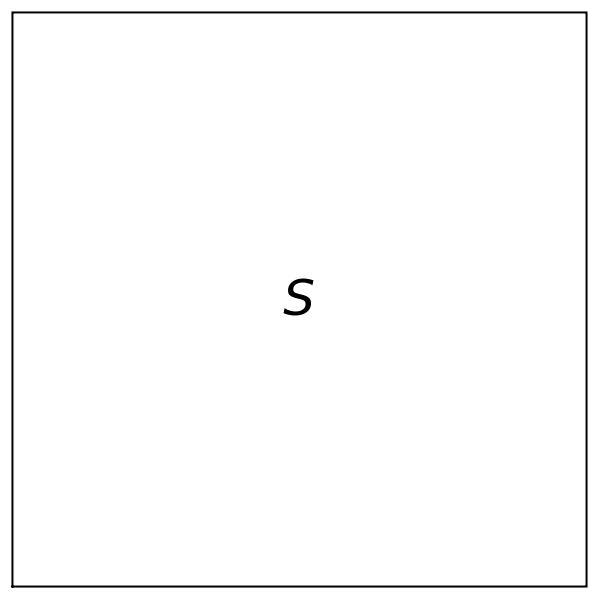
This Demonstration introduces the basic notions of Leśniewski's mereology (a theory of part-whole relations). A 2×2 square is divided into four 1×1 squares , , , and . The same object also consists of two 2×1 rectangles and , or alternatively, two 1×2 rectangles and . Then, for example, is a part of , is a part of , and is a part of . In symbols, ∈pt(S), ∈pt(), and ∈pt(S). Let be the general name for a 1×1 square; then is the class of these squares. In symbols, . If is the general (unshared) name of 2×1 rectangles, then . Also, is not part of itself. Squares are shown in yellow, while rectangles are colored light gray.
S
S
1
S
2
S
3
S
4
S
R
1
R
2
R
3
R
4
S
1
S
S
1
R
1
R
1
S
S
1
S
1
R
1
R
1
S
1×1
S
S∈Kl()
S
1×1
R
2×1
S∈Kl()
R
2×1
S
The notion of ingredient (element) is defined by —that is, is an ingredient of object if and only if is the same object as or is a part of . So .
A∈el(B)≡A=BorAϵpt(B)
A
B
A
B
A
B
S∈el(S)
It is possible to define class in terms of ingredient.
P
a
1. is an object;
P
2. every is an ingredient of the object ;
a
P
3. for any , if is an ingredient of the object , then some ingredient of the object is an ingredient of some .
Q
Q
P
Q
a
You can use the diagrams to illustrate the following truth relations: , , ∈pt(), ….
S∈Kl()
S
1×1
S∈Kl()
R
2×1
S
1
R
1
Details
Details
The following description of Leśniewski's system for the foundation of mathematics is given in[5, pp. xiv]. It consists of three parts: protothetic, ontology, and mereology. These can be described, in general terms, as follows.
Mereology is a theory of part-whole relations.
Ontology is a theory of the copula (linkage) "is". It comprises the theory of predicates, of classes, and of relations, including the theory of identity.
Protothetic is the logic of propositional forms with quantifiers binding propositional and functional variables.
Three definitions of the notion of class were discovered by Kuratowski and Tarski[5, pp. 327].
In[6], Lejewski studied atomistic and atomless mereology using two notions:
The expression ( is an atom) means that is an object that has no proper parts.
A∈atm
A
A
The expression means that is an atom of .
A∈atm(B)
A
B
In this Demonstration, 1×1 squares could be considered as atoms. The set of all open disks in the plane is an example of an atomless mereology.
References
References
[1] C. Lejewski, "On Leśniewsi's Ontology," in Leśniewski's Systems: Ontology and Mereology, The Hague: Martinus Nijhoff Publishers, 1984 pp. 123–148.
[2] E. J. Borowski and J. M. Borwein, Collins Dictionary of Mathematics, New York: HarperCollins Publishers, 1991 pp. 203.
[4] Wikipedia, "Stanisław Leśniewski." (Apr 4, 2016) en.wikipedia.org/wiki/Stanis% C5 %82 aw_Le % C5 %9 Bniewski.
[5] S. J. Surma, J. J. T. Srzednicki, D. I. Barnett, and V. F. Rickey, eds., Stanisław Leśniewski Collected Works, Volume I, New York: Springer, 1991.
[6] C. Lejewski, "A Contribution to the Study of Extended Mereologies," Notre Dame Journal of Formal Logic, 14(1), 1973 pp. 55–67.
External Links
External Links
Permanent Citation
Permanent Citation
Izidor Hafner
"Part-Whole Relations"
http://demonstrations.wolfram.com/PartWholeRelations/
Wolfram Demonstrations Project
Published: April 5, 2016