Whenever a text crosses a language, a translator makes choices: which sense of a polysemous word to pick, which idiom to flatten, which manuscript variant to follow, how much rhetorical decoration to add. Most of the time those choices don't matter. Sometimes they do – a theological loading, a manuscript variant, a journalistic spin. Reading two translations side by side is the oldest technique in philology for catching them; it doesn't scale. This notebook builds a small, language-agnostic framework that takes any two renderings of the same source, embeds each one with a multilingual model, ranks aligned units by cosine distance, and asks a frontier LLM to articulate – in concrete, falsifiable prose with the source-language lemma quoted – why each large gap exists. The headline case study is the SBLGNT vs the KJV. The same pipeline then runs on Homer's Iliad (Pope vs Butler), the Daodejing (Legge 1891 vs a fresh modern rendering), and – in § 10 – on three multilingual news / treaty texts where the framework reads as a translation fact-checker: the UDHR, a Vatican encyclical, and a UN Secretary-General address. An interactive LostInTranslation`Audit[…] function lets you run the same audit on any text in any source language.
Every Wolfram-generated output in this notebook is reproduced from a single companion package, lost_in_translation.wl, which consolidates the framework, the translator-audit tool, and all frozen JSON data. Drop the .wl beside the notebook and evaluate this cell once:
In[]:=
Get[FileNameJoin[{NotebookDirectory[],"lost_in_translation.wl"}]];
Then every code cell in this notebook – DriftTimeline[], Audit[…], and the rest – is just a call into the LostInTranslation` context. The four conceptual illustrations were produced once by gpt-image-2 (a single OpenAI image call apiece) and are embedded as PNGs.
Full source code, the unconsolidated wolfram/*.wls pipeline scripts, all frozen JSON, and the gpt-image-2 PNGs are available on GitHub at https://github.com/mthiel74/GreekNewTestamentvsKingJames
1. Motivation — translation as a measurable thing
1. Motivation — translation as a measurable thing
Reading two translations side by side is the oldest technique in philology. It scales badly. A multilingual sentence embedder (Cohere's embed-multilingual-v3.0, OpenAI's text-embedding-3-large, or Voyage's voyage-3) gives us a single ~1024-dim vector per verse, in a shared space across the two source languages. Cosine distance is then a single scalar that compresses 'how far has the translation moved' into something we can rank, plot, and feed to an LLM that has read more commentary than any of us.
A preview of what the rest of the notebook will do, in one chart. Six public-domain English translations of the New Testament, sorted by publication year, all rendering the same Romans 8. The y-axis is the cosine distance from each translation to Tyndale 1534 (the baseline, distance 0). What the chart says, very loud: almost all the lexical/stylistic drift happens between Tyndale (1534) and the KJV (1611). After 1611, every modern translation hovers around the same cumulative distance – they all stand together against the Reformation-era English.
In[]:=
LostInTranslation`DriftTimeline[]
Out[]=
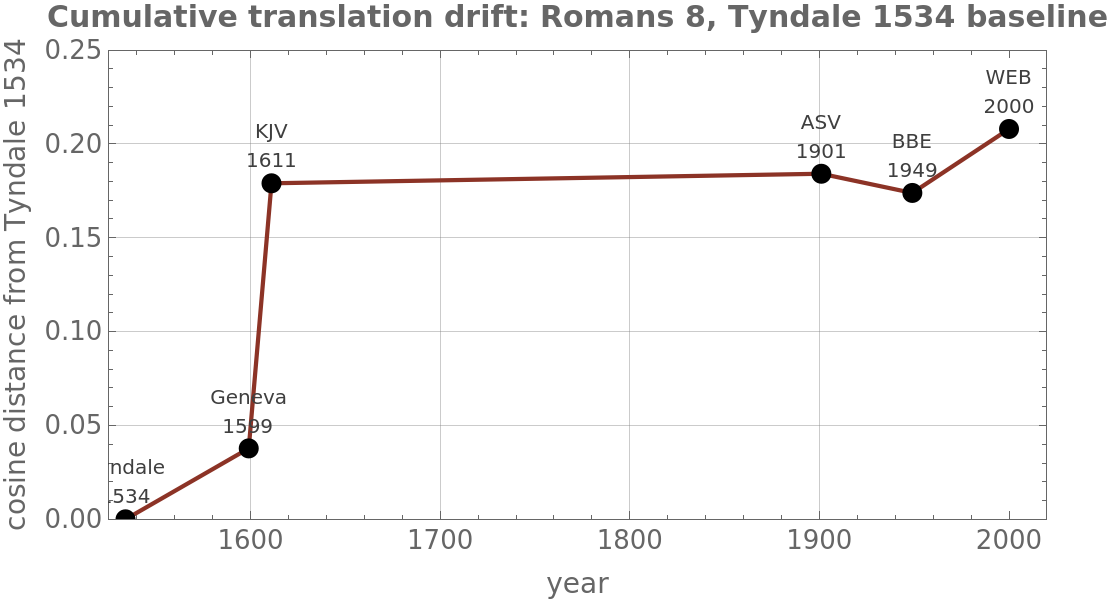
Figure. Cumulative cosine drift from Tyndale 1534 across six public-domain English NT translations on Romans 8 (text-embedding-3-large; chapter-level embedding). The 1611 KJV is where four centuries of English changed gear.
2. The headline pair: SBLGNT vs the KJV
2. The headline pair: SBLGNT vs the KJV
2.1 Sources and licences
2.1 Sources and licences
The Greek side is the SBL Greek New Testament (Holmes, 2010), distributed under CC BY 4.0 via the morphgnt/sblgnt GitHub repository. The English side is the 1769 Cambridge edition of the KJV (public domain in the US) via the aruljohn/Bible-kjv repository. Both sources are fetched by the project's wolfram/fetch_*.wls scripts; see docs/sources.md for full citation strings.
2.2 Verse counts and the manuscript-variant set
2.2 Verse counts and the manuscript-variant set
After fetching, the KJV NT has 7 957 verses and the SBLGNT has 7 927 verses. The 30-verse asymmetry is itself a piece of useful signal: it is exactly the set of verses the KJV's underlying Textus Receptus contains and the SBLGNT does not. The framework's LoadPair function surfaces these as onlyB — they include Acts 8:37 (the Ethiopian eunuch's confession), the longer ending of Mark, and the pericope adulterae fragments in John 7-8.
3. The framework
3. The framework
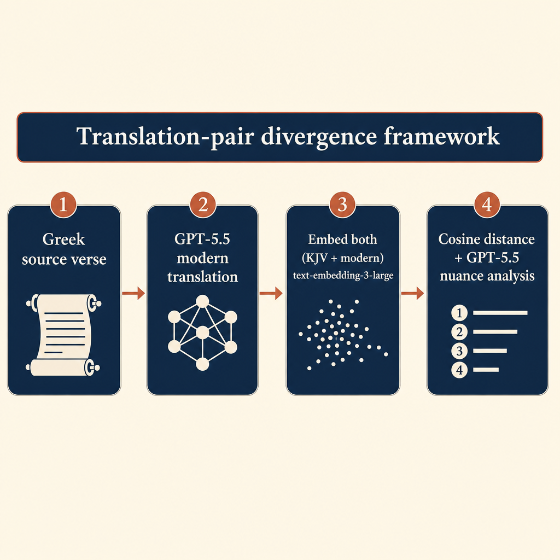
Figure. The four-stage pipeline. Steps 1–4 are described in detail in § 3.1–3.4.
3.1 Alignment
3.1 Alignment
For Bible-shaped pairs we inherit the canonical Book / Chapter / Verse axis as the join key. For prose pairs (Pope vs Butler Iliad, Marx in two languages, two Tao Te Ching versions) we fall back to a sentence-level dynamic-programming aligner over length ratios — same trick as Gale-Church (1991), updated to use cosine distance between cheap embeddings as the alignment cost. See LoadPair inside LostInTranslation`.
3.2 Embedding — and why we don't embed across languages
3.2 Embedding — and why we don't embed across languages
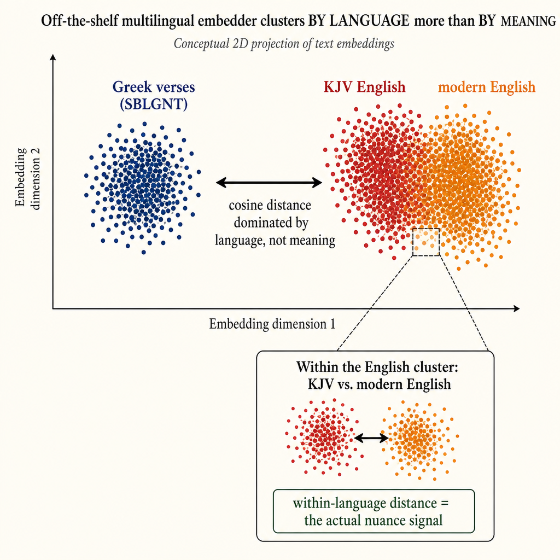
Figure. Off-the-shelf multilingual embedders cluster more strongly by language than by meaning. The actionable signal lives in within-language distance – hence the translate-then-compare detour.
A naive pipeline would embed the Greek and the English directly and compute a cross-language distance. We tried that. Off-the-shelf multilingual embedders — including text-embedding-3-large — cluster more strongly by language than by meaning: even a perfect Greek/English verse pair sits at cosine distance ≈ 0.85-0.90. The signal is buried.
The fix: have GPT-5.5 produce a careful modern English translation of each Greek verse, then embed the KJV and the modern translation together. Same-language embedding is what these models do well; cosine distance now reflects semantic divergence between two English renderings of the same Greek source. Per the user's note: the gross meaning will of course be similar; what we are looking for is the nuance — the small but real lexical, theological or textual choice the KJV makes that a modern translator would make
3.3 Cosine distance
3.3 Cosine distance
On the same-language route we compute using the built-in CosineDistance. On Romans 8 the distribution sits roughly in [0.05, 0.45]; the right tail starts at ≈ 0.25 and is where the interesting verses live.
d(a,b)=1-
a·b
a·b
3.4 Nuance analysis (GPT-5.5 with high reasoning effort)
3.4 Nuance analysis (GPT-5.5 with high reasoning effort)
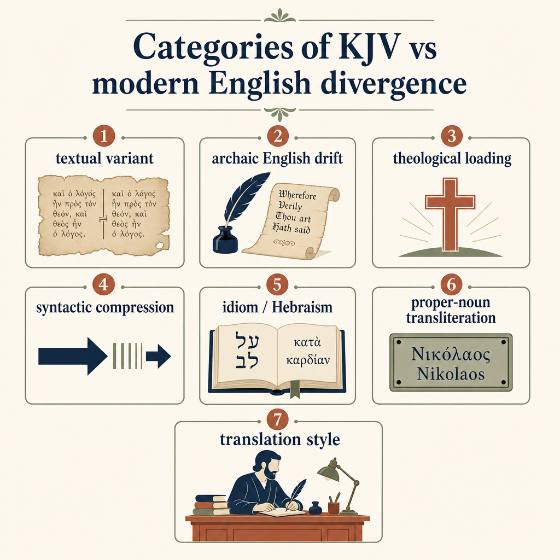
Figure. The seven-category rubric GPT-5.5 is asked to choose from. Tags are not ground truth but a quick way to cluster which kind of drift dominates a chapter.
For the top-N most-divergent verses in the section we hand GPT-5.5 the Greek, the KJV, its own modern translation, and the cosine distance, and ask it to articulate the nuances (not the gross meaning, which is similar by construction). The system prompt tells it to skip trivial differences — "thou" vs "you", "begat" vs "fathered" — and focus on: theological loading, lexical drift in 17th-c. English ("prevent", "conversation", "bowels"), manuscript variants, idiom compression, word-order changes that shift emphasis, and proper-noun transliteration. It returns a tag plus an 80-140-word concrete, falsifiable explanation that quotes the Greek lemma when it matters. The model is OpenAI gpt-5.5 with reasoning_effort = high.
4. Worked case study: Romans 8
4. Worked case study: Romans 8
We work the framework end-to-end on a single, theologically dense chapter — Romans 8, 39 verses, the locus classicus of Pauline pneumatology. A whole-Bible heatmap is impressive but hard to read; a single chapter lets us look at the actual prose.
4.1 Pipeline applied per verse
4.1 Pipeline applied per verse
For every verse in the chapter: (a) GPT-5.5 with reasoning_effort = high produces a careful modern English translation of the SBLGNT Greek (it has not seen the KJV at this point); (b) we embed the KJV and the modern translation, both English, with text-embedding-3-large; (c) cosine distance between the two embeddings becomes our per-verse divergence score. Same-language embedding sidesteps the cross-lingual weakness most multilingual embedders exhibit — the signal is now purely semantic.
Figure. Romans 8: per-verse cosine distance between the KJV and a fresh GPT-5.5 modern translation, both embedded with text-embedding-3-large. Peaks identify where the KJV has made a non-obvious translation choice.
4.2 The top divergent verses, with GPT-5.5 nuance analysis
4.2 The top divergent verses, with GPT-5.5 nuance analysis
For each of the top-10 divergent verses we hand GPT-5.5 the Greek, the KJV, its own modern translation, and the cosine distance, and ask it to articulate the nuance — the small but real differences a casual reader misses. We explicitly tell it to skip trivial things ("thou" vs "you", "begat" vs "fathered") and focus on theological loading, archaic English meaning-drift, manuscript variants, idiom handling, and word-order or syntactic compression that changes emphasis. Reasoning effort is again high.
Ro 8:21 • d = 0.218 • syntactic-compression • ὅτι
Greek (SBLGNT): ὅτι καὶ αὐτὴ ἡ κτίσις ἐλευθερωθήσεται ἀπὸ τῆς δουλείας τῆς φθορᾶς εἰς τὴν ἐλευθερίαν τῆς δόξης τῶν τέκνων τοῦ θεοῦ.
KJV (1769): Because the creature itself also shall be delivered from the bondage of corruption into the glorious liberty of the children of God.
Modern (GPT-5.5): that the creation itself also will be set free from its bondage to decay into the freedom of the glory of the children of God.
Headline: KJV’s “Because” can sound causally independent, whereas the Greek ὅτι most naturally supplies the content of the preceding “hope”: “in hope that …”.
English drift: “creature”: in early modern English, “a created thing/being; creation” (OED creature n.); in modern usage, often an individual animal or living being.
Textual note: No substantial TR/Byzantine versus SBLGNT difference affects this verse; the KJV is not here translating an added Textus Receptus phrase absent from the NU/SBL text.
Cross-refs: Rom 8:18 • Rom 8:20 • Rom 8:22
GPT-5.5 (reasoning_effort=high): There is no meaningful TR/NU divergence here; the KJV translates essentially the same Greek sequence. The main syntactic issue is ὅτι. Since v.20 ends ἐπ’ ἐλπίδι, ὅτι is naturally epexegetic/content-bearing: “in hope that,” not an independent causal “because”; BDAG s.v. ὅτι includes this content use. KJV punctuation actually leaves it dependent—“in hope, Because …”—but modern readers hear a causal clause. Also, κτίσις in vv.19–22 is not one “creature” but the created order; KJV “creature” reflects early modern “created thing/creation,” whereas contemporary English suggests an individual animal. Finally, “glorious liberty” turns τὴν ἐλευθερίαν τῆς δόξης into an adjective; the Greek genitive chain says “the freedom belonging to/constituted by the glory of God’s children,” preserving Paul’s link between creation’s liberation and believers’ eschatological δόξα.
Ro 8:6 • d = 0.217 • archaic-english-drift • φρόνημα
Greek (SBLGNT): τὸ γὰρ φρόνημα τῆς σαρκὸς θάνατος, τὸ δὲ φρόνημα τοῦ πνεύματος ζωὴ καὶ εἰρήνη·
KJV (1769): For to be carnally minded is death; but to be spiritually minded is life and peace.
Modern (GPT-5.5): For the mindset of the flesh is death, but the mindset of the Spirit is life and peace.
Headline: The KJV’s “to be carnally/spiritually minded” verbalizes the Greek noun φρόνημα and uses “carnally” in its older theological sense, not the narrower modern sense “sexually.”
English drift: “carnally”: in KJV-era theological use, “fleshly; not spiritual, worldly” (OED s.v. carnal, adj., sense “not spiritual”); in common modern use, often “sexually/sensually.”
Cross-refs: Rom 8:5 • Rom 8:7 • Gal 5:16–17
GPT-5.5 (reasoning_effort=high): There is no significant textual issue here: the KJV is not reflecting a different Greek reading. The nuance is lexical and syntactic. “To be carnally/spiritually minded” turns the Greek articular nominal predicates into infinitival clauses: τὸ ... φρόνημα ... θάνατος. φρόνημα is not merely “being minded” at a moment but a “way of thinking,” “mindset,” or “aspiration” (BDAG s.v. φρόνημα). The genitives τῆς σαρκός and τοῦ πνεύματος mark the sphere or controlling source: “of flesh” versus “of Spirit.” KJV “carnally” was transparent theological English—fleshly, belonging to the non-spiritual order—but in contemporary usage can suggest sexual or sensual content too narrowly. Modern “flesh” better preserves Paul’s σάρξ/πνεῦμα antithesis in Rom 8:5–8. Capitalized “Spirit” is interpretive; Greek πνεῦμα has no capitalization, though the context in 8:9–11 strongly favors the divine Spirit.
Ro 8:7 • d = 0.208 • archaic-english-drift • φρόνημα
Greek (SBLGNT): διότι τὸ φρόνημα τῆς σαρκὸς ἔχθρα εἰς θεόν, τῷ γὰρ νόμῳ τοῦ θεοῦ οὐχ ὑποτάσσεται, οὐδὲ γὰρ δύναται·
KJV (1769): Because the carnal mind is enmity against God: for it is not subject to the law of God, neither indeed can be.
Modern (GPT-5.5): because the mindset of the flesh is hostility toward God; for it does not submit to the law of God—indeed, it is not able to.
Headline: The KJV’s “carnal mind” can suggest a mental faculty or merely sensual thought, whereas Paul’s τὸ φρόνημα τῆς σαρκός denotes the whole flesh-determined orientation or mindset hostile to God.
English drift: carnal: in 1611, ‘fleshly; worldly; not spiritual’ (OED, carnal adj.); in modern usage, often narrowed to ‘sensual/sexual.’
Cross-refs: Rom 8:6 • Gal 5:17 • Col 3:2
GPT-5.5 (reasoning_effort=high): There is no meaningful TR/Byzantine divergence here; the KJV and SBLGNT translate the same wording. The main difference is semantic. “Carnal mind” is a compact but now potentially misleading rendering of τὸ φρόνημα τῆς σαρκός. φρόνημα, in Paul, denotes the “way of thinking,” “mind-set,” or aspiration/orientation, not simply the cognitive faculty “mind” (BDAG s.v. φρόνημα); and σάρξ is the human sphere oriented away from God, not merely the physical body. Early modern “carnal” could mean “fleshly; worldly; not spiritual,” whereas present usage often suggests sexual or sensual appetite. Thus “mindset of the flesh” better preserves Paul’s anthropological idiom. “Hostility toward God” for ἔχθρα εἰς θεόν is slightly less personified than KJV “enmity against God,” though both are defensible. Finally, οὐχ ὑποτάσσεται is present middle/passive in form; “does not submit” captures the intransitive/reflexive force better than “is not subject.”
Ro 8:20 • d = 0.204 • archaic-english-drift • κτίσις
Greek (SBLGNT): τῇ γὰρ ματαιότητι ἡ κτίσις ὑπετάγη, οὐχ ἑκοῦσα ἀλλὰ διὰ τὸν ὑποτάξαντα, ἐφ’ ἑλπίδι
KJV (1769): For the creature was made subject to vanity, not willingly, but by reason of him who hath subjected the same in hope,
Modern (GPT-5.5): For to futility the creation was subjected, not willingly but because of the one who subjected it, in hope.
Headline: The KJV’s “creature” and “vanity” once fit the Greek reasonably well, but in modern English they tend to misdirect readers toward an individual animal and personal conceit rather than the created order subjected to futility.
English drift: “creature” = in early modern English, a created thing or the creation collectively; now usually an animal or living being. “vanity” = emptiness, futility, worthlessness; now often self-conceit.
Cross-refs: Rom 8:21–22 • Eph 4:17 • 2 Pet 2:18
GPT-5.5 (reasoning_effort=high): There is no significant TR/SBLGNT divergence here: the KJV is translating essentially the same Greek text. The main issue is lexical and stylistic. κτίσις can mean an individual creature, but in this context—especially Rom 8:21–22, where “the whole creation” groans—the collective sense “creation” is preferable; see BDAG s.v. κτίσις. KJV “creature” was broader in early modern English than it is for many modern readers. Likewise ματαιότης is not “vanity” in the now-common sense of narcissistic self-regard, but futility, frustration, or subjection to ineffectuality; BDAG s.v. ματαιότης compares the semantic field of emptiness and purposelessness. Syntactically, the fronted dative τῇ ματαιότητι gives prominence to the condition imposed: “to futility the creation was subjected.” KJV “hath subjected” renders the aorist participle ὑποτάξαντα with an English perfect, slightly sharpening resultant state beyond the Greek’s simple past reference.
Ro 8:19 • d = 0.188 • archaic-english-drift • κτίσις
Greek (SBLGNT): ἡ γὰρ ἀποκαραδοκία τῆς κτίσεως τὴν ἀποκάλυψιν τῶν υἱῶν τοῦ θεοῦ ἀπεκδέχεται·
KJV (1769): For the earnest expectation of the creature waiteth for the manifestation of the sons of God.
Modern (GPT-5.5): For the eager longing of the creation waits for the revelation of the sons of God.
Headline: The KJV’s “creature” renders κτίσις in a now-misleading early-modern sense: Paul means the created order collectively, not an individual animal or being.
English drift: “creature”: in early modern English, a created thing or creation, sometimes with collective force; in current usage, usually an individual living being, especially an animal.
Cross-refs: Rom 8:20-22 • Col 1:15 • 2 Cor 5:17
GPT-5.5 (reasoning_effort=high): There is no meaningful TR/SBLGNT difference here; the nuance is lexical. Κτίσις, BDAG s.v. κτίσις, can denote either the act of creating, an individual creature, or the created order. In Rom 8:19-22 the repeated personification—creation was subjected, groans, awaits liberation—shows that τῆς κτίσεως is collective: “the creation,” especially non-human creation, not “the creature” as one organism. The KJV’s “creature” was less misleading in 1611, since “creature” could mean simply “created thing” and could function more broadly than it usually does today; modern English tends to hear “creature” zoologically or individually. “Manifestation” for ἀποκάλυψιν is defensible but slightly less apocalyptic than “revelation/unveiling.” Also ἀπεκδέχεται is deponent/middle in form and already means “wait eagerly,” so KJV distributes the eagerness into “earnest expectation,” while the modern keeps it in “eager longing.”
Ro 8:5 • d = 0.177 • archaic-english-drift • φρονέω
Greek (SBLGNT): οἱ γὰρ κατὰ σάρκα ὄντες τὰ τῆς σαρκὸς φρονοῦσιν, οἱ δὲ κατὰ πνεῦμα τὰ τοῦ πνεύματος.
KJV (1769): For they that are after the flesh do mind the things of the flesh; but they that are after the Spirit the things of the Spirit.
Modern (GPT-5.5): For those who are according to the flesh set their minds on the things of the flesh, but those who are according to the Spirit on the things of the Spirit.
Headline: The KJV’s “do mind” reflects an older sense of “mind” = attend to/care for, whereas φρονεῖν here denotes a settled orientation that modern “set their minds on” makes clearer.
English drift: mind (v.): OED, “to direct one’s thoughts or attention to; to regard, care for”; modern “mind” often means obey, look after, or object to.
Cross-refs: Rom 8:6 • Phil 3:19 • Col 3:2
GPT-5.5 (reasoning_effort=high): There is no significant TR/SBLGNT textual divergence here; the issue is diction. The Greek pivot is φρονοῦσιν (φρονέω), with τὰ τῆς σαρκός / τὰ τοῦ πνεύματος as its objects: not mere cognition, but a settled orientation, concern, or evaluative disposition (BDAG s.v. φρονέω; cf. Rom 8:6 φρόνημα). KJV “do mind” could in early modern English mean “attend to, regard, care for,” but contemporary “mind” tends toward “obey,” “look after,” or “object to,” so it can mislead or sound too weak. The modern “set their minds on” is therefore interpretive but closer to Paul’s anthropological contrast. Likewise “after the flesh/Spirit” is not temporal; KJV “after” here has the older sense “according to/in conformity with.” The second clause is elliptical in Greek and in both English renderings: φρονοῦσιν is supplied from the first clause.
Ro 8:33 • d = 0.172 • translation-style • ἐγκαλέω
Greek (SBLGNT): τίς ἐγκαλέσει κατὰ ἐκλεκτῶν θεοῦ; θεὸς ὁ δικαιῶν·
KJV (1769): Who shall lay any thing to the charge of God’s elect? It is God that justifieth.
Modern (GPT-5.5): Who will bring a charge against God’s elect? God is the one who justifies.
Headline: The KJV’s “lay any thing to the charge” is not a textual addition but a forensic English idiom for ἐγκαλέω, whereas the modern “bring a charge” makes the legal sense and the supplied object transparent.
Textual note: No material TR/Byzantine versus SBLGNT/NA28 difference affects this wording; the punctuation after δικαιῶν is editorial rather than manuscript punctuation.
Cross-refs: Rom 8:34 • Acts 19:38 • Acts 26:2
GPT-5.5 (reasoning_effort=high): The difference is mainly idiomatic and forensic. ἐγκαλέω means “bring charges against, accuse” in legal contexts (BDAG s.v. ἐγκαλέω), and the construction here, ἐγκαλέσει κατὰ ἐκλεκτῶν θεοῦ, is well captured by “bring a charge against.” The KJV’s “lay any thing to the charge of” is a legitimate early-modern legal idiom, but “any thing” is an English explicitation, not a separate Greek term. The articular participle θεὸς ὁ δικαιῶν is also slightly compressed in the KJV’s cleft, “It is God that justifieth”; the modern “God is the one who justifies” more visibly mirrors ὁ δικαιῶν. The forensic pairing with τίς ὁ κατακρινῶν in v. 34 confirms that Paul is thinking in courtroom terms: accusation is futile because the judge is the justifying God.
Ro 8:9 • d = 0.163 • archaic-english-drift • εἰμί
Greek (SBLGNT): Ὑμεῖς δὲ οὐκ ἐστὲ ἐν σαρκὶ ἀλλὰ ἐν πνεύματι, εἴπερ πνεῦμα θεοῦ οἰκεῖ ἐν ὑμῖν. εἰ δέ τις πνεῦμα Χριστοῦ οὐκ ἔχει, οὗτος οὐκ ἔστιν αὐτοῦ.
KJV (1769): But ye are not in the flesh, but in the Spirit, if so be that the Spirit of God dwell in you. Now if any man have not the Spirit of Christ, he is none of his.
Modern (GPT-5.5): You, however, are not in the flesh but in the Spirit, if indeed the Spirit of God dwells in you. But if anyone does not have the Spirit of Christ, this person does not belong to him.
Headline: The KJV’s “he is none of his” is an older possessive idiom meaning “does not belong to him,” while the Greek οὗτος οὐκ ἔστιν αὐτοῦ states non-belonging to Christ rather than a vague loss of identity.
English drift: “none of his” = in early modern English, “not one belonging to him / not his”; in modern English it can sound opaque or merely idiomatic rather than explicitly possessive.
Cross-refs: 1 Cor 3:16 • Gal 4:6 • Rom 8:14
GPT-5.5 (reasoning_effort=high): There is no meaningful TR/SBLGNT divergence here; the issue is chiefly idiom and aspect. οὗτος οὐκ ἔστιν αὐτοῦ is a genitive of possession or relationship: “this one is not his,” i.e. does not belong to Christ. The KJV’s “he is none of his” was intelligible early modern English, but now risks opacity; the modern rendering makes the possessive force explicit. Likewise “if so be that” renders εἴπερ, which BDAG treats as “if indeed / if in fact”; with the indicative οἰκεῖ it is not a subjunctive “might dwell,” but a condition assumed for Paul’s addressees. The KJV’s bare “dwell” also reflects older English verbal usage, whereas “dwells” marks the present indicative more transparently. The alternation “Spirit of God” / “Spirit of Christ” is in the Greek and is theologically significant, but not a KJV addition.
Ro 8:38 • d = 0.145 • textual-variant • δύναμις
Greek (SBLGNT): πέπεισμαι γὰρ ὅτι οὔτε θάνατος οὔτε ζωὴ οὔτε ἄγγελοι οὔτε ἀρχαὶ οὔτε ἐνεστῶτα οὔτε μέλλοντα οὔτε δυνάμεις
KJV (1769): For I am persuaded, that neither death, nor life, nor angels, nor principalities, nor powers, nor things present, nor things to come,
Modern (GPT-5.5): For I am convinced that neither death nor life nor angels nor rulers nor things present nor things to come nor powers
Headline: The KJV follows the Textus Receptus/Byzantine order by placing “powers” immediately after “principalities,” whereas the SBLGNT separates δυνάμεις and leaves it after “things to come.”
English drift: “principalities”: in KJV usage, ruling authorities or high angelic orders; in modern English, chiefly territories ruled by a prince.
Textual note: SBLGNT/NA28 reads οὔτε ἀρχαὶ οὔτε ἐνεστῶτα οὔτε μέλλοντα οὔτε δυνάμεις, supported by early Alexandrian witnesses such as P46, Sinaiticus, Vaticanus, and Alexandrinus. The KJV/TR/Byzantine order is οὔτε ἀρχαὶ οὔτε δυνάμεις οὔτε ἐνεστῶτα οὔτε μέλλοντα. Metzger does not discuss this minor transposition.
Cross-refs: Eph 1:21 • Eph 6:12 • Col 1:16
GPT-5.5 (reasoning_effort=high): The substantive difference is not “persuaded” versus “convinced”—πέπεισμαι, perfect passive of πείθω, means “I stand convinced”—but the placement of δυνάμεις. The KJV’s “nor principalities, nor powers, nor things present...” reflects the TR/Byzantine tendency to pair ἀρχαί and δυνάμεις, familiar from Pauline catalogues of cosmic authorities. The SBLGNT/NA order, “rulers ... things present ... things to come ... powers,” is less tidy and therefore plausibly prior. Lexically, “principalities” for ἀρχαί is defensible in early modern English, where the word could denote ruling authorities or angelic orders, but it now often suggests geographical states; “rulers” better signals the active, personal/cosmic force implied by BDAG s.v. ἀρχή. Conversely, “powers” remains a good rendering of δυνάμεις, though in Paul it can denote supra-human forces rather than abstract capacities.
Ro 8:32 • d = 0.139 • archaic-english-drift • χαρίζομαι
Greek (SBLGNT): ὅς γε τοῦ ἰδίου υἱοῦ οὐκ ἐφείσατο, ἀλλὰ ὑπὲρ ἡμῶν πάντων παρέδωκεν αὐτόν, πῶς οὐχὶ καὶ σὺν αὐτῷ τὰ πάντα ἡμῖν χαρίσεται;
KJV (1769): He that spared not his own Son, but delivered him up for us all, how shall he not with him also freely give us all things?
Modern (GPT-5.5): He indeed did not spare his own Son but handed him over for us all; how will he not also, with him, graciously give us all things?
Headline: KJV “freely give” is substantially right for χαρίσεται, but the modern “graciously give” makes explicit the χάρις-colored nuance of giving as favor rather than merely giving without cost.
English drift: “freely give”: in early modern English, ‘freely’ could mean gratuitously, generously, or of free favor; in modern usage it often suggests merely without cost, restraint, or compulsion.
Cross-refs: Ro 4:25 • 1 Co 2:12 • Gal 2:20
GPT-5.5 (reasoning_effort=high): There is no significant TR/SBLGNT divergence here; the KJV is not translating an added Byzantine phrase. The main nuance lies in χαρίσεται, future middle of χαρίζομαι. BDAG s.v. χαρίζομαι gives the relevant sense “give freely/graciously as a favor,” distinct from a neutral δίδωμι. KJV “freely give” was a good seventeenth-century rendering: “freely” could denote generous, gratuitous, favor-bestowing action. For many modern readers, however, “freely” narrows toward “without charge” or “unrestrictedly,” so “graciously give” better preserves the lexical association with χάρις. The KJV also omits an overt equivalent for γε in ὅς γε, which gives a mild emphatic force: “he indeed / the very one who.” “Delivered him up” remains an apt rendering of παρέδωκεν, though “handed him over” more directly evokes Paul’s παραδίδωμι language in Rom 4:25 and Gal 2:20.
4.3 Reading the categories
4.3 Reading the categories
Across Romans 8, GPT-5.5's tag is dominated by archaic-english-drift — the KJV English of 1611 carried senses that 21st-century readers no longer hear ("creature" for the created order, "carnal" for of the flesh, "freely" for gratuitously). The interesting second-order pattern is that the cosine distance picks these up even though both renderings are formally accurate translations of the same Greek. That is exactly the nuance signal: at 0.05 cosine the verses are saying the same thing; at 0.20 they are still saying the same thing, but the 1611 English now sounds different to a modern ear, and GPT-5.5 can articulate why.
4.4 The lexical drift atlas
4.4 The lexical drift atlas
A small distillation of the recurring "English drift" entries from the Romans 8 nuance table: five KJV words whose 1611 sense is no longer dominant. The table also names the Greek lemma at the verse-anchoring position so a reader can jump straight to the primary text. The same exercise on 1 Corinthians 13 (§ 5) is dominated by a single word: charity.
Figure. Five Romans 8 KJV words whose 1611 / OED sense diverges from their modern dominant sense, with the Greek lemma the verse turns on.
5. A second worked case: 1 Corinthians 13
5. A second worked case: 1 Corinthians 13
The same pipeline on the "love chapter" — 13 verses, famously rendered with "charity" in the KJV where every modern translation has "love". This is the textbook example of semantic narrowing: charity in 1611 still meant self-giving love (Greek αγαπη); today it means alms-giving to the poor. The framework finds the chapter's high-divergence verses automatically and GPT-5.5 articulates the narrowing per-verse.
Figure. 1 Corinthians 13: per-verse cosine distance between the KJV and a fresh GPT-5.5 modern translation.
1Co 13:10 • d = 0.321 • archaic-english-drift • τέλειος
Greek (SBLGNT): ὅταν δὲ ἔλθῃ τὸ τέλειον, τὸ ἐκ μέρους καταργηθήσεται.
KJV (1769): But when that which is perfect is come, then that which is in part shall be done away.
Modern (GPT-5.5): But when the complete comes, what is partial will be brought to an end.
Headline: The KJV’s “perfect” is not wrong in its seventeenth-century sense, but modern “complete” better marks τὸ τέλειον as the whole set over against τὸ ἐκ μέρους rather than moral flawlessness.
English drift: perfect: in 1611, “complete, finished, fully formed” (OED perfect, adj.); today often “flawless” or morally faultless.
Textual note: KJV “then” corresponds to τότε in the TR and Byzantine/Majority tradition; SBLGNT/NA28 omit τότε with early Alexandrian witnesses such as P46 א B 33 1739. This minor variant is not treated in Metzger’s Textual Commentary.
Cross-refs: 1Co 13:9 • 1Co 13:12 • Eph 4:13
GPT-5.5 (reasoning_effort=high): One small textual item precedes the lexical issue: KJV “then” represents τότε in the TR/Byzantine text, whereas SBLGNT omits it; semantically, however, English naturally supplies a correlative after ὅταν. The larger nuance is τέλειον. In seventeenth-century English “perfect” could mean “complete, finished, fully formed” (OED, perfect adj.), but modern readers often hear “flawless” or morally perfect. Paul’s contrast is formal: τὸ τέλειον, a neuter substantival adjective, stands over against τὸ ἐκ μέρους (“what is partial/in part”; cf. v. 9), as v. 12’s mirror/face-to-face antithesis confirms; it does not by itself decide among “canon,” “eschaton,” or “maturity.” καταργηθήσεται is future passive of καταργέω, “make inoperative/abolish, bring to an end” (BDAG), so KJV “done away” is essentially right but vaguer. KJV “is come” is an older English perfect construction for ὅταν + aorist subjunctive ἔλθῃ.
1Co 13:4 • d = 0.290 • archaic-english-drift • ἀγάπη
Greek (SBLGNT): Ἡ ἀγάπη μακροθυμεῖ, χρηστεύεται ἡ ἀγάπη, οὐ ζηλοῖ ἡ ἀγάπη, οὐ περπερεύεται, οὐ φυσιοῦται,
KJV (1769): Charity suffereth long, and is kind; charity envieth not; charity vaunteth not itself, is not puffed up,
Modern (GPT-5.5): Love is patient; love is kind; love does not envy; it does not boast; it is not puffed up.
Headline: The KJV’s “charity” was a plausible 1611 rendering of ἀγάπη as Christian caritas, but in contemporary English it misleadingly narrows toward almsgiving rather than Pauline self-giving love.
English drift: “charity” = in 1611, Christian love/benevolent affection, caritas; today, chiefly almsgiving, philanthropy, or a charitable institution. “suffereth long” = patiently endures/forbears; today “suffer” chiefly suggests experiencing pain.
Cross-refs: 1Co 8:1 • Gal 5:22 • 2Co 6:6
GPT-5.5 (reasoning_effort=high): The substantive KJV/modern difference is not textual: the issue is 17th-century English and register. ἀγάπη is rendered “charity,” following ecclesiastical caritas; in 1611 this could mean Christian love or benevolent affection, whereas present-day English usually hears almsgiving or charitable institutions. “Love” is therefore semantically wider but less misleading to modern readers, though it can lose the specifically ethical, self-giving valence that Pauline ἀγάπη carries (BDAG s.v. ἀγάπη). “Suffereth long” translates μακροθυμεῖ fairly literally, “be patient, forbearing”; today “suffer” suggests undergoing pain, not chiefly tolerating provocation. The Greek is a chain of gnomic presents, personifying love by what it habitually does and does not do. “Vaunteth not itself” is an archaic but close rendering of περπερεύεται, “brag, boast” (BDAG; NT hapax), while “is not puffed up” nicely preserves Paul’s favorite Corinthian metaphor φυσιοῦται for arrogance.
1Co 13:5 • d = 0.272 • translation-style • παροξύνω
Greek (SBLGNT): οὐκ ἀσχημονεῖ, οὐ ζητεῖ τὰ ἑαυτῆς, οὐ παροξύνεται, οὐ λογίζεται τὸ κακόν,
KJV (1769): Doth not behave itself unseemly, seeketh not her own, is not easily provoked, thinketh no evil;
Modern (GPT-5.5): It does not behave disgracefully, does not seek its own interests, is not provoked, does not keep account of wrong;
Headline: The KJV’s “not easily provoked” weakens Paul’s unqualified οὐ παροξύνεται: the Greek says love “is not provoked,” with no adverb corresponding to “easily.”
Textual note: No relevant TR/Byzantine addition underlies “easily”; SBLGNT and the KJV’s Greek base read οὐ παροξύνεται here.
Cross-refs: Acts 17:16 • 2 Corinthians 5:19 • Romans 4:8
GPT-5.5 (reasoning_effort=high): Two small differences matter. First, οὐ παροξύνεται is present passive/middle, “is not provoked/irritated” (BDAG s.v. παροξύνω); the KJV’s “easily” is interpretive mitigation, not a Greek word and not a known textual variant. It makes Paul say that love is not quickly provoked, whereas the clause as written is starker. Secondly, “thinketh no evil” can mislead modern readers toward mere cognition. λογίζεται τὸ κακόν more naturally evokes reckoning, counting, or keeping an account (BDAG s.v. λογίζομαι), as in 2 Cor 5:19 and Rom 4:8. Thus the modern “does not keep account of wrong” better catches the bookkeeping metaphor. “Behave itself unseemly” is fairly literal for ἀσχημονεῖ, though “disgracefully” or “dishonorably” is clearer contemporary English.
1Co 13:3 • d = 0.250 • archaic-english-drift • ἀγάπη
Greek (SBLGNT): καὶ ἐὰν ψωμίσω πάντα τὰ ὑπάρχοντά μου, καὶ ἐὰν παραδῶ τὸ σῶμά μου, ἵνα καυθήσομαι, ἀγάπην δὲ μὴ ἔχω, οὐδὲν ὠφελοῦμαι.
KJV (1769): And though I bestow all my goods to feed the poor, and though I give my body to be burned, and have not charity, it profiteth me nothing.
Modern (GPT-5.5): And if I parcel out all my possessions, and if I hand over my body so that I will be burned, but do not have love, I gain nothing.
Headline: KJV “charity” meant caritas/Christian love in 1611, whereas for many modern readers it suggests almsgiving—the very act Paul says can occur without ἀγάπη.
English drift: “charity”: OED charity n. I.1a, Christian love/caritas; modern dominant sense, benevolent giving or relief of the poor.
Textual note: No KJV-versus-supplied-SBLGNT divergence on “be burned”; both reflect καυθήσομαι/καυθήσωμαι. The wider tradition is divided: NA/UBS prefer καυχήσωμαι, “that I may boast,” supported by early Alexandrian witnesses such as P46, א, A, B; “be burned” is strongly Byzantine/Western, including C, D, F, G, K, L, Ψ and the Majority tradition. Metzger discusses this well-known variant.
Cross-refs: 1 Cor 13:1-2 • Rom 12:20 • John 13:35
GPT-5.5 (reasoning_effort=high): The chief KJV-modern difference is not that “charity” was wrong, but that it has drifted. In 1611 “charity” naturally rendered ἀγάπη as caritas, Christian love; today it often denotes almsgiving, which would blur Paul’s paradox: one may ψωμίζω “parcel out/feed in portions” all one’s possessions and still lack ἀγάπη. BDAG s.v. ψωμίζω notes the concrete sense of feeding with morsels and the extended sense of distributing food or goods; hence the modern “parcel out” catches a nuance KJV “bestow” flattens, while KJV’s “to feed the poor” makes explicit a recipient not named in πάντα τὰ ὑπάρχοντά μου. Finally, “give” is less vivid than παραδῶ, “hand over/deliver up.” The supplied Greek’s ἵνα καυθήσομαι is also syntactically striking, since ἵνα normally governs the subjunctive; the modern “so that I will be burned” preserves that future-indicative force more visibly than KJV “to be burned.”
1Co 13:8 • d = 0.243 • textual-variant • πίπτω/ἐκπίπτω
Greek (SBLGNT): Ἡ ἀγάπη οὐδέποτε πίπτει. εἴτε δὲ προφητεῖαι, καταργηθήσονται· εἴτε γλῶσσαι, παύσονται· εἴτε γνῶσις, καταργηθήσεται.
KJV (1769): Charity never faileth: but whether there be prophecies, they shall fail; whether there be tongues, they shall cease; whether there be knowledge, it shall vanish away.
Modern (GPT-5.5): Love never falls. But whether prophecies, they will be brought to an end; whether tongues, they will cease; whether knowledge, it will be brought to an end.
Headline: The KJV’s ‘Charity never faileth’ reflects both archaic ‘charity’ for ἀγάπη and the TR/Byzantine compound ἐκπίπτει, whereas the SBLGNT has the simpler πίπτει, ‘falls.’
English drift: ‘Charity’: OED charity n. I.1, Christian caritas or self-giving love; modern English often narrows it to almsgiving or benevolent aid.
Textual note: SBLGNT/NA28 read πίπτει, supported especially by early Alexandrian evidence such as 𝔓46 and B; the TR and Majority/Byzantine tradition read ἐκπίπτει, underlying the KJV’s ‘faileth.’
Cross-refs: Romans 9:6 • 1 Corinthians 13:13 • 1 Corinthians 1:28
GPT-5.5 (reasoning_effort=high): The sharpest difference is at the opening verb. SBLGNT reads ἡ ἀγάπη οὐδέποτε πίπτει, literally ‘love never falls’; the KJV follows the TR/Byzantine ἐκπίπτει, hence ‘never faileth.’ The compound ἐκπίπτω more readily means ‘fall from, be lost, come to nothing’ (BDAG s.v. ἐκπίπτω), so the KJV is not merely stylistic there. ‘Charity,’ however, is also not modern ‘almsgiving’: in 1611 it conveys OED charity n. I.1, Christian caritas/love. The remaining three clauses preserve an important Greek contrast only partly visible in the KJV: προφητεῖαι and γνῶσις take καταργηθήσονται/καταργηθήσεται, future passives from καταργέω, ‘be rendered inoperative, abolished’ (BDAG s.v. καταργέω), whereas γλῶσσαι παύσονται is future middle/intransitive, ‘will cease.’ Thus ‘prophecies shall fail’ and ‘knowledge shall vanish away’ are idiomatic, but they can obscure the repeated passive ‘be brought to an end.’
1Co 13:6 • d = 0.178 • syntactic-compression • συγχαίρω
Greek (SBLGNT): οὐ χαίρει ἐπὶ τῇ ἀδικίᾳ, συγχαίρει δὲ τῇ ἀληθείᾳ·
KJV (1769): Rejoiceth not in iniquity, but rejoiceth in the truth;
Modern (GPT-5.5): It does not rejoice over injustice, but rejoices with the truth.
Headline: The KJV’s repeated “in” makes the two clauses sound syntactically parallel, whereas Paul contrasts χαίρει ἐπί + dative, “takes pleasure at/over injustice,” with συγχαίρει + dative, “rejoices with the truth.”
English drift: “iniquity”: in early modern English, unrighteousness, injustice, or wrongdoing; in current usage, often a more archaic/religious term for grave wickedness or sin.
Cross-refs: 1 Cor 12:26 • Luke 15:6–9 • Rom 1:32
GPT-5.5 (reasoning_effort=high): There is no significant TR/NU issue in this half-verse; the difference is translational. The first clause has χαίρει ἐπὶ τῇ ἀδικίᾳ, where ἐπί with the dative can mark occasion or basis: love does not rejoice “at” or “over” ἀδικία, not merely “in” a sphere called iniquity. BDAG s.v. ἀδικία allows both “unrighteousness” and more socially concrete “injustice/wrongdoing,” so “injustice” keeps a forensic-ethical edge that “iniquity” may obscure for modern readers. The second clause is sharper: συγχαίρει δὲ τῇ ἀληθείᾳ uses the compound συγχαίρω, “rejoice with, share joy with” (BDAG s.v. συγχαίρω; cf. 1 Cor 12:26). Thus the modern “rejoices with the truth” preserves Paul’s personifying idiom and the σύν-force better than KJV “rejoiceth in the truth,” which assimilates the two cola into the same English prepositional pattern.
1Co 13:1 • d = 0.148 • archaic-english-drift • ἀγάπη
Greek (SBLGNT): Ἐὰν ταῖς γλώσσαις τῶν ἀνθρώπων λαλῶ καὶ τῶν ἀγγέλων, ἀγάπην δὲ μὴ ἔχω, γέγονα χαλκὸς ἠχῶν ἢ κύμβαλον ἀλαλάζον.
KJV (1769): Though I speak with the tongues of men and of angels, and have not charity, I am become as sounding brass, or a tinkling cymbal.
Modern (GPT-5.5): If I speak in the tongues of humans and of angels but do not have love, I have become sounding bronze or a clanging cymbal.
Headline: The KJV’s “charity” renders ἀγάπη in its early-modern sense of Christian caritas/love, not the modern narrower sense of almsgiving.
English drift: charity: in 1611, OED s.v. charity, ‘Christian love; caritas; benevolent affection’; in modern usage, chiefly almsgiving, relief of the poor, or a charitable institution
Cross-refs: 1Co 13:2 • 1Co 14:2 • Gal 5:6
GPT-5.5 (reasoning_effort=high): There is no meaningful TR/SBLGNT divergence here; the difference is primarily English. KJV “charity” is not a mistranslation of ἀγάπη, but in contemporary reception it is misleading: early-modern “charity” could denote Christian love or caritas, whereas modern “charity” often means almsgiving or philanthropic aid. BDAG s.v. ἀγάπη gives “love,” especially the self-giving love characteristic of Christian ethics. The KJV’s “Though” should also be heard concessively-hypothetically, “even if,” matching Ἐὰν with λαλῶ; Paul is not necessarily claiming actual angelic speech. “Men” renders τῶν ἀνθρώπων, i.e. humans, not males specifically. Finally, “sounding brass” and “tinkling cymbal” have shifted in force: χαλκός is bronze/copper alloy or a resonant bronze instrument, and ἀλαλάζον suggests a loud clash or clang, not the delicate modern sense of “tinkle.” Both translations preserve γέγονα well: “I have become/am become.”
1Co 13:2 • d = 0.135 • archaic-english-drift • ἀγάπη
Greek (SBLGNT): καὶ ἐὰν ἔχω προφητείαν καὶ εἰδῶ τὰ μυστήρια πάντα καὶ πᾶσαν τὴν γνῶσιν, καὶ ἐὰν ἔχω πᾶσαν τὴν πίστιν ὥστε ὄρη μεθιστάναι, ἀγάπην δὲ μὴ ἔχω, οὐθέν εἰμι.
KJV (1769): And though I have the gift of prophecy, and understand all mysteries, and all knowledge; and though I have all faith, so that I could remove mountains, and have not charity, I am nothing.
Modern (GPT-5.5): And if I have prophecy and know all the mysteries and all knowledge, and if I have all faith so as to move mountains but do not have love, I am nothing.
Headline: The main difference is KJV “charity”: in 1611 it denoted caritas, Christian self-giving love, whereas for many modern readers it now suggests almsgiving or benevolent donation.
English drift: “charity” = in 1611, Christian love/benevolence, caritas; now often narrowed to almsgiving, philanthropy, or aid to the poor.
Cross-refs: 1Co 13:13 • 1Co 12:10 • Mt 17:20
GPT-5.5 (reasoning_effort=high): No substantive TR/SBLGNT textual difference drives the translation here. The real issue is lexical reception: ἀγάπη, repeated throughout 1 Cor 13, is rendered by KJV “charity,” a good 17th-century equivalent for Latin caritas and Christian love, but now apt to be heard as almsgiving. BDAG s.v. ἀγάπη gives “love” in the sense of high regard/affection, not merely beneficence. The KJV’s “gift of prophecy” also supplies “gift of”: Greek has simply προφητείαν, though the context of χαρίσματα in 1 Cor 12 makes the supplement understandable. “Though” represents ἐάν with subjunctive, a hypothetical concessive condition; modern “if” is formally closer, but less rhetorically concessive. “Could remove mountains” expands ὥστε ὄρη μεθιστάναι, literally “so as to move mountains,” echoing the proverbial faith saying in Matt 17:20.
6. Generalisation: Iliad and Daodejing
6. Generalisation: Iliad and Daodejing
Two worked-out generalisations, on texts and languages far from the Greek NT, that the same pipeline runs unchanged.
6.1 Iliad Book 1 — Greek + Pope (1715) + Butler (1898)
6.1 Iliad Book 1 — Greek + Pope (1715) + Butler (1898)
Three iconic passages of Homer rendered three ways: the Homeric Greek, Alexander Pope's 1715-20 heroic-couplet translation (the canonical English Iliad of the eighteenth century, famous for its neoclassical compression and moral amplifications), and Samuel Butler's 1898 prose translation (the Victorian de-mythologising response). GPT-5.5 produces a fresh modern English rendering of each Greek passage, and we compute the pairwise within-English cosine distances. The framework now has three same-language English texts to compare, giving us a four-corner picture per passage.
Figure. Iliad Book 1: pairwise within-English cosine distances for three iconic passages. Pope's verse sits farther from both Butler's prose and a modern rendering than Butler and the modern do from each other – the framework picks up Pope's heroic-couplet expansions automatically.
Il. 1.1-7 (the proem) • οὐλομένην
Greek (Homer): μῆνιν ἄειδε θεὰ Πηληϊάδεω Ἀχιλῆος οὐλομένην, ἣ μυρί᾽ Ἀχαιοῖς ἄλγε᾽ ἔθηκε, πολλὰς δ᾽ ἰφθίμους ψυχὰς Ἄϊδι προΐαψεν ἡρώων, αὐτοὺς δὲ ἑλώρια τεῦχε κύνεσσιν οἰωνοῖσί τε πᾶσι, Διὸς δ᾽ ἐτελείετο βουλή, ἐξ οὗ δὴ τὰ πρῶτα διαστήτην ἐρίσαντε Ἀτρεΐδης τε ἄναξ ἀνδρῶν καὶ δῖος Ἀχιλλεύς.
Pope (1715-20): Achilles' wrath, to Greece the direful spring Of woes unnumber'd, heavenly goddess, sing! That wrath which hurl'd to Pluto's gloomy reign The souls of mighty chiefs untimely slain; Whose limbs unburied on the naked shore, Devouring dogs and hungry vultures tore. Since great Achilles and Atrides strove, Such was the sovereign doom, and such the will of Jove!
Butler (1898): Sing, O goddess, the anger of Achilles son of Peleus, that brought countless ills upon the Achaeans. Many a brave soul did it send hurrying down to Hades, and many a hero did it yield a prey to dogs and vultures, for so were the counsels of Jove fulfilled from the day on which the son of Atreus, king of men, and great Achilles, first fell out with one another.
Modern (GPT-5.5): Sing, goddess, the ruinous wrath of Achilles son of Peleus,
which laid countless pains upon the Achaeans,
and sent forth to Hades many strong souls of heroes,
and made them themselves spoil for dogs
and for all birds; and the plan of Zeus was being brought to fulfillment,
from the time when first they two stood apart in strife,
the son of Atreus, lord of men, and brilliant Achilles.
Distances: Pope/Butler = 0.200 Pope/Modern = 0.191 Butler/Modern = 0.139
Headline: Pope turns Homer’s compressed causal proem into a neoclassical tableau, Butler paraphrases it into fluent prose, while the modern version tries to preserve the Greek’s formulaic pressure and syntax.
Pope's signature: Pope’s characteristic move is expansion: he retains the agency of wrath but ornaments it with causal metaphor, affective adjectives, and Latinate mythological diction. Phrases such as “direful spring,” “gloomy reign,” “naked shore,” and “sovereign doom” are not in the Greek.
Butler's signature: Butler is semantically closer than Pope, but his prose often domesticates epic formula into plain narrative. His “anger,” “fell out,” and “great Achilles” flatten the marked diction of μῆνιν, διαστήτην ἐρίσαντε, and δῖος Ἀχιλλεύς.
GPT-5.5: The pivotal Greek is μῆνιν, immediately qualified by οὐλομένην: not generic anger but a destructive wrath with epic agency. Modern keeps this compactly (“ruinous wrath”) and Butler reduces it to “anger,” omitting the participial epithet; Pope keeps “wrath” but amplifies it into “the direful spring / Of woes unnumber’d,” a causal metaphor not in ἣ μυρί᾽ ... ἄλγε᾽ ἔθηκε (“which laid countless pains”). Pope’s neoclassical hand is still more visible in “Pluto’s gloomy reign,” “untimely slain,” “naked shore,” “hungry vultures,” and “sovereign doom”: none corresponds to Ἄϊδι, ἑλώρια, οἰωνοῖσί τε πᾶσι, or Διὸς ... βουλή, though they ornament and moralize the scene. Butler’s prose is generally semantically conservative, but it flattens formulaic texture: δῖος Ἀχιλλεύς becomes “great Achilles”; Ἀτρεΐδης τε ἄναξ ἀνδρῶν is translated rather than allowed as a resonant epithet; διαστήτην ἐρίσαντε becomes colloquial “fell out,” losing the physicalized “stood apart in strife.” He also blurs the sharp ψυχάς/αὐτούς contrast by “many a brave soul ... many a hero,” whereas the Modern renders the bodies as “them themselves spoil.” The cosine distances corroborate this reading at a coarse level: Butler–Modern is closest (0.139), while Pope is farther from both. They also reveal only surface/semantic affinity, not philological fidelity: Pope–Modern’s slight closeness over Pope–Butler likely reflects shared “wrath” and high-register diction, but the numbers cannot detect Pope’s added “gloomy,” “hungry,” or “sovereign doom,” nor Butler’s loss of πᾶσι (“all”).
Il. 1.225-228 (Achilles to Agamemnon) • κὴρ
Greek (Homer): οἰνοβαρές, κυνὸς ὄμματ᾽ ἔχων, κραδίην δ᾽ ἐλάφοιο, οὔτε ποτ᾽ ἐς πόλεμον ἅμα λαῷ θωρηχθῆναι οὔτε λόχονδ᾽ ἰέναι σὺν ἀριστήεσσιν Ἀχαιῶν τέτληκας θυμῷ· τὸ δέ τοι κὴρ εἴδεται εἶναι.
Pope (1715-20): O monster, mix'd of insolence and fear, Thou dog in forehead, but in heart a deer! When wert thou known in ambush'd fights to dare, Or nobly face the horrid front of war? 'Tis ours, the chance of fighting fields to try; Thine to look on, and bid the valiant die.
Butler (1898): Wine-bibber, with the face of a dog and the heart of a hind, you never dare to go out with the host in fight, nor yet with our chosen men in ambuscade. You shun this as you do death itself.
Modern (GPT-5.5): Wine-soaked, with the eyes of a dog and the heart of a deer, you have never yet dared in your spirit either to arm yourself for battle with the host or to go into ambush with the best of the Achaeans; that, to your heart, seems to be death.
Distances: Pope/Butler = 0.343 Pope/Modern = 0.384 Butler/Modern = 0.244
Headline: Pope converts Homer’s compact abuse into Augustan moral spectacle, while Butler stays denotatively close but smooths away formulaic and imagistic sharpness.
Pope's signature: Pope’s characteristic move is amplification: he personifies and moralizes what Homer leaves as brutal epithets and infinitives. His couplet logic adds antitheses and judgments absent from the Greek.
Butler's signature: Butler’s prose tracks the sense more closely, but it domesticates Homeric diction. He often translates formulaic or embodied language into serviceable English idiom.
GPT-5.5: The Greek insult is paratactic and formulaic: οἰνοβαρές, κυνὸς ὄμματ᾽ ἔχων, κραδίην δ᾽ ἐλάφοιο gives three blows, then two infinitival tests governed by τέτληκας θυμῷ. Pope turns this into moral theatre. “O monster, mix’d of insolence and fear” has no lexical counterpart; neither do “nobly,” “the horrid front of war,” or the closing antithesis “’Tis ours...Thine...” He recasts Achilles’ taunt as a neoclassical indictment of command, expanding τὸ δέ τοι κὴρ εἴδεται εἶναι into Agamemnon’s habit of watching and making others die. Butler is much closer in reference, but his prose often de-formularizes. κυνὸς ὄμματ᾽ becomes “the face of a dog,” losing the pointed “eyes”; ἐς πόλεμον ἅμα λαῷ θωρηχθῆναι, literally “to arm yourself for war with the people/host,” becomes the generic “go out with the host in fight”; ἀριστήεσσιν Ἀχαιῶν becomes “our chosen men,” not “the best of the Achaeans.” Most consequentially, τέτληκας θυμῷ and κὴρ are flattened into idiom: “You shun this as you do death itself,” whereas Homer says it “seems to you to be death/doom,” locating cowardice in perception and θυμός. The distances corroborate, rather than explain, this: Butler–Modern (.244) is lowest because both preserve the line’s denotative scaffold; Pope is farther (.343/.384) because of couplet amplification. They also reveal that vector proximity can miss philological texture: Butler’s close score coexists with losses in formula, anatomy, and heroic register.
6.2 Daodejing chs. 1-2 — Chinese + Legge (1891) + modern
6.2 Daodejing chs. 1-2 — Chinese + Legge (1891) + modern
The same translate-then-compare pipeline on a text that has nothing to do with the Greek-vs-English Christian tradition. James Legge's 1891 translation is the canonical Victorian sinological Daodejing; GPT-5.5 produces a fresh modern English rendering of the Wang Bi recension. The interesting nuances cluster around abstract-noun choices (Dao, wu/you, xuan), Victorian parenthetical habits ("(the idea of)"), and Legge's habit of importing Christian conceptual vocabulary ("Originator", capitalised "Mystery"). The framework finds them without being told.
Figure. Daodejing chs. 1-2: cross-language distances (Chinese vs each English rendering) sit around 0.85 – essentially uncorrelated by language. The English-only Legge-vs-Modern distance is ~0.20-0.23, exactly the nuance band we want to read.
Chinese: 道可道,非常道。名可名,非常名。無,名天地之始﹔有,名萬物之母。故常無,欲以觀其妙;常有,欲以觀其徼。此兩者,同出而異名,同謂之玄。玄之又玄,眾妙之門。
Legge (1891): The Tao that can be trodden is not the enduring and unchanging Tao. The name that can be named is not the enduring and unchanging name. (Conceived of as) having no name, it is the Originator of heaven and earth; (conceived of as) having a name, it is the Mother of all things. Always without desire we must be found, If its deep mystery we would sound; But if desire always within us be, Its outer fringe is all that we shall see. Under these two aspects, it is really the same; but as development takes place, it receives the different names. Together we call them the Mystery. Where the Mystery is the deepest is the gate of all that is subtle and wonderful.
Modern (GPT-5.5): The Dao that can be spoken is not the constant Dao.
The name that can be named is not the constant name.
Non-being is named as the beginning of heaven and earth;
being is named as the mother of the ten thousand things.
Thus, constant non-being: desire thereby to observe its subtlety;
constant being: desire thereby to observe its boundary.
These two emerge together but differ in name;
together they are called darkly profound.
Darkly profound and again darkly profound:
the gate of the many subtleties.
Distances: zh/Legge = 0.672 zh/Modern = 0.660 Legge/Modern = 0.188
Headline: Legge turns the chapter’s ontological pair 無/有 into two “aspects” of a named or nameless divine source, while the modern rendering keeps the starker grammar of non-being/being.
Victorian marker: Explanatory parentheticals, periphrastic “enduring and unchanging,” and rhymed moralizing verse
Christianising: “Originator” and capitalized “Mystery”
GPT-5.5: The sharpest divergence is at 無,名天地之始;有,名萬物之母. Legge’s “(Conceived of as) having no name” effectively reads 無名 and 有名, making the issue namelessness versus nameability. The modern version instead treats 無 and 有 as abstract ontological terms: “Non-being is named…” and “being is named…”. That is closer to the Wang Bi punctuation as supplied, where 無 and 有 stand before the comma. Legge’s “Originator of heaven and earth” also goes beyond 始, “beginning,” importing a quasi-creator term; “Mother” is in the Chinese 母, but “Originator” is not.
At 道可道, Legge’s “can be trodden” foregrounds 道 as a path, whereas “can be spoken” makes 道 verbal and pairs it with 名可名, “the name that can be named.” His “enduring and unchanging” is a Victorian expansion of 常; “constant” is plainer and less metaphysical.
The desire lines also differ grammatically. Legge reads 常無欲 / 常有欲: “Always without desire…” versus “if desire…” The modern parses 常無 and 常有, taking 欲 as “desire/wish thereby to observe,” so the objects of contemplation are 無 and 有 themselves, not the sage’s psychology. Finally, Legge’s capitalized “Mystery” for 玄 theologicalizes what literally suggests the dark, obscure, profound; “darkly profound” preserves that semantic color.
Chinese: 天下皆知美之為美,斯惡矣﹔皆知善之為善,斯不善矣。故有無相生,難易相成,長短相形,高下相傾,音聲相和,前後相隨。是以聖人處「無為」之事,行「不言」之教。萬物作焉而不辭,生而不有,為而不恃,功成而弗居。夫唯弗居,是以不去。
Legge (1891): All in the world know the beauty of the beautiful, and in doing this they have (the idea of) what ugliness is; they all know the skill of the skilful, and in doing this they have (the idea of) what the want of skill is. So it is that existence and non-existence give birth the one to (the idea of) the other; that difficulty and ease produce the one (the idea of) the other; that length and shortness fashion out the one the figure of the other; that (the ideas of) height and lowness arise from the contrast of the one with the other; that the musical notes and tones become harmonious through the relation of one with another; and that being before and behind give the idea of one following another. Therefore the sage manages affairs without doing anything, and conveys his instructions without the use of speech.
Modern (GPT-5.5): When all under Heaven know the beautiful as beautiful, then the ugly is already present;
when all know the good as good, then the not-good is already present.
Therefore being and non-being give rise to one another;
difficult and easy complete one another;
long and short give form to one another;
high and low incline toward one another;
tone and sound harmonize with one another;
before and after follow one another.
For this reason, the sage dwells in the work of without-action
and carries out the teaching without words.
The ten thousand things arise there, yet are not refused;
generated, yet not possessed;
acted, yet not relied upon;
the work accomplished, yet not dwelt in.
Precisely because it is not dwelt in,
therefore it does not depart.
Distances: zh/Legge = 0.625 zh/Modern = 0.619 Legge/Modern = 0.214
Headline: Legge’s decisive nuance is to psychologize Laozi’s reciprocal opposites as “ideas,” while the modern rendering keeps them as co-arising relations.
Victorian marker: Repeated parenthetical glosses such as “(the idea of)” and explanatory abstract diction
GPT-5.5: Legge’s most consequential move is to make Laozi’s correlations psychological. Where 天下皆知美之為美,斯惡矣 says that once “beauty” is recognized as beauty, “ugliness” (惡) is thereby in play, Legge writes that people have “(the idea of) what ugliness is.” His recurring parenthetical “(the idea of)” before ugliness, the other, height/lowness, and before/behind turns 相生/相成 etc. into the generation of concepts. The modern “already present” and “give rise/complete/give form ... to one another” keeps the Chinese reciprocal 相 as relational co-constitution, not merely mental contrast. Legge’s 善 as “the skill of the skilful” is also notable: 善 can mean adept, but paired with 美 and opposed to 不善 it more naturally reads “good,” so his wording de-moralizes the line into competence. For 有無, Legge’s “existence and non-existence” is Victorian metaphysical diction; “being and non-being” is equally abstract but less explanatory and closer to later Daoist terminology. At 無為, “without doing anything” risks simple passivity, whereas “without-action” flags a technical term for non-coercive action. Likewise Legge’s “manages affairs” and “conveys his instructions” make 處...事 and 行...教 sound administrative and pedagogic. As quoted, Legge also stops before 萬物作焉...弗居, so the modern’s anti-possession refrain has no Legge counterpart here. No specifically Christian vocabulary appears in this chapter.
6.3 Other text pairs the framework runs on without modification
6.3 Other text pairs the framework runs on without modification
Because the framework is a thin layer over verse/sentence-aligned JSON, anything you can fetch and align is fair game. Concrete next candidates with public-domain sources: KJV vs Luther 1545 on a single NT chapter (English vs German, where the bridge is a fresh GPT-5.5 modern English rendering of the German); Marx's Kapital vol. I ch. 1, German vs Moore-Aveling 1887 (the interesting nuances are around technical vocabulary that did not yet exist in English in 1887: Verdinglichung, Tauschwert, Wertform); two Quran translations (Sale 1734, Pickthall 1930) on a Surah; Beowulf in two PD modern renderings. Each of these would slot into wolfram/section_analysis.wls's
7. Cross-section analysis
7. Cross-section analysis
With four sections in hand we can ask cross-cutting questions – what kinds of drift dominate where, do the chapters separate cleanly in embedding space, and how robust is the ranking to a change of embedding model.
7.1 Nuance-category distribution across the four sections
7.1 Nuance-category distribution across the four sections
Each section's top-N divergent units carry an LLM-tagged category. Stacking those tags per section gives a rough "signature" of how a translation diverges from its source. On Romans 8 and 1 Corinthians 13 the dominant tag is archaic-english-drift, consistent with the chapters being theologically straightforward and the divergence being mainly lexical. The Iliad and Daodejing schemas are different (we asked the model for pope_signature and victorian_marker etc.) so they appear as single bins; the point is that the same pipeline produced both.
Figure. Distribution of LLM-tagged categories across the four worked sections. Romans 8 and 1 Cor 13 are dominated by archaic-English drift; the Iliad and Daodejing rows use schemas tailored to those texts.
7.2 The English embedding space: a 2D PCA projection
7.2 The English embedding space: a 2D PCA projection
Concatenate every KJV and every GPT-modern English rendering from Romans 8 and 1 Corinthians 13, project the 3072-dimensional embeddings onto their first two principal components, and colour by side (KJV vs Modern) and section. Two structural facts pop out: (a) chapters separate cleanly along PCA dimension 1 – Romans 8 is content-clustered on the right, 1 Cor 13 on the left; (b) within each chapter, KJV and Modern dots are interleaved, confirming that same-language embedding distance is the within-chapter signal we want.
Figure. PCA of the English embeddings (text-embedding-3-large). Romans 8 (dark) clusters on the right; 1 Corinthians 13 (light) clusters on the left. KJV and Modern interleave within each chapter – the picture an embedder ought to give us.
7.3 Embedding-model dependency: large vs small
7.3 Embedding-model dependency: large vs small
Distances are not portable across embedding models. We re-embed the Romans 8 KJV/modern pairs with text-embedding-3-small (1536-d) and compare to text-embedding-3-large (3072-d). Aggregate agreement is high (Pearson r = 0.880, Spearman ρ = 0.898), but the per-verse ranking moves: the most-divergent verse under the large model (Romans 8:21, creature/creation) drops several ranks under the small model, while Romans 8:1 (the Textus Receptus expansion) rises into the small model's top-5. If you swap embedding models, rerun the whole ranking.
Figure. Romans 8 cosine distances under text-embedding-3-large vs text-embedding-3-small. The dashed line is y=x. Verses above the line are judged more divergent by the small model than the large; verses below, the reverse. Aggregate correlation is high but the tail of the ranking is model-dependent.
7.4 Translation-drift phylogeny across six PD English NTs
7.4 Translation-drift phylogeny across six PD English NTs
What happens if we apply the framework to two English translations, with no Greek in sight? Romans 8 in Tyndale 1534, Geneva 1599, KJV 1611, ASV 1901, BBE 1949, WEB 2000. Embed each translation's chapter as a single vector with text-embedding-3-large, compute pairwise cosine distance, build the hierarchical-clustering tree with Dendrogram. The result, in one chart, recovers what a textual historian would draw by hand:
Figure. Dendrogram from pairwise cosine distance between six PD English NT translations on Romans 8. Three families pop out: Tyndale/Geneva (Reformation-era English), KJV/ASV/WEB (the King James lineage and its modern public-domain revisions), and BBE on its own (the only one in deliberately simplified vocabulary).
Three families: Tyndale + Geneva (Reformation-era English) on the bottom branch; the KJV lineage and its public-domain modern descendants ASV / WEB in a tight cluster; and the BBE – the only translation in deliberately simplified vocabulary – on its own branch. The KJV 1611 and ASV 1901 sit at cosine distance 0.016 from each other (the smallest non-self distance in the matrix) because the ASV is literally a careful revision of the KJV. The framework does not know any of this; it reads it directly from the verses.
7.5 Honest caveat: length vs divergence
7.5 Honest caveat: length vs divergence
Does the framework over-detect long verses? Plotting KJV character length against cosine distance for every Romans 8 verse gives a small negative correlation (Spearman ρ = -0.25). Longer verses are slightly more similar between translations, not less. This makes sense: a longer verse carries more content for the embedding to anchor on, and the per-character share of any one stylistic choice is smaller. The reverse worry – that the framework is implicitly a length detector – is not borne out.
Figure. KJV character length vs cosine distance for every Romans 8 verse. Spearman ρ = -0.25 (small negative). The four labelled outliers are the high-divergence verses already discussed in § 4. The dashed line is the linear fit.
8. Discussion
8. Discussion
8.1 What the cosine ranking actually surfaces
8.1 What the cosine ranking actually surfaces
The framework's headline claim is modest: same-language cosine distance between two renderings of the same source is a usable, automatic ranking of how hard the renderings disagree. On Romans 8, 1 Corinthians 13, three passages of the Iliad, and two chapters of the Daodejing, the ranking matches what a scholar would flag by hand: Romans 8:1 (Textus Receptus expansion), Romans 8:21 ("creature" vs "creation"), 1 Corinthians 13 "charity" throughout, Iliad's opening invocation (Pope's amplification of μηνισ), Daodejing ch. 1 (Legge's "Originator" for Δαο vs a plainer rendering). The ranking is doing real work.
8.2 What the LLM nuance pass is good at, and what it is not
8.2 What the LLM nuance pass is good at, and what it is not
Good at: naming the Greek (or Chinese, or German) lemma the divergence hinges on; identifying when a KJV word has drifted in English usage ("prevent", "charity", "conversation", "creature"); spotting Textus Receptus expansions and pointing at the families of witnesses (P46, Sinaiticus, Vaticanus) when the variant is well-known; noticing Victorian parenthetical habits and Christianising vocabulary in Legge; tracking Pope's neoclassical personifications.
Bad at: precise page citations to printed editions (we tell the model in the prompt not to invent citations, but it occasionally tries); identifying rare textual variants not in standard apparatus discussions; distinguishing genuine theological loading from incidental word choice; and confidently calling a tag for borderline cases. Every nuance entry should be read as a hypothesis worth checking in Metzger / BDAG / BDF, not as a finding. Categories like theological-loading and translation-style are particularly soft; textual-variant and archaic-english-drift
8.3 Use for religious-studies, classics and history-of-translation researchers
8.3 Use for religious-studies, classics and history-of-translation researchers
The most useful product of this pipeline is the ranked + tagged table in data/section_*_nuance.json. A scholar reading it can: (1) skim the top-N divergent verses in 60 seconds; (2) cluster by the LLM's category tag to see what kind of drift dominates a chapter (Romans 8 is overwhelmingly archaic-english-drift; 1 Cor 13 is dominated by the charity narrowing; the Iliad headlines on poetic compression); (3) follow each cross-ref into a commentary; (4) lift the per-verse JSON straight into a courseware or paper as a paragraph-sized scholion. The framework does not replace consulting Metzger, BDAG or Wallace — but it
8.4 Use for translators considering revision
8.4 Use for translators considering revision
A translation committee revising an existing English text (e.g. an ESV second edition, or a new edition of Butler) can run their draft against the predecessor through this framework. Verses where the cosine distance is large but the LLM tags it other or translation-style are exactly the places where the committee is making real but unmotivated stylistic choices. Verses where the distance is large and the LLM tags it textual-variant or theological-loading are the principled changes; those should be explicit in a translator's preface, not silent.
8.5 Limits, caveats, and how to abuse this responsibly
8.5 Limits, caveats, and how to abuse this responsibly
1. Embedding model dependency. Cosine distances are not comparable across embedding models, and different models will rank verses differently in the tail. We pick one model (text-embedding-3-large) and stick with it across all sections of the post; if you swap models, re-run everything.
2. LLM confabulation. GPT-5.5 occasionally cites manuscript witnesses (P46 "in B and D") where the witness is not actually attesting the variant in question. Treat all witness lists in the nuance text as plausibility claims to verify against NA28's apparatus, not facts to quote. The prompt asks the model to omit citations it is unsure of, but the instruction is soft.
3. Selection effects. By design we look at the top-N divergent verses, which biases the story toward chapters where the KJV (or Pope, or Legge) made an interesting choice. The middle of the distribution is large and boring; do not generalise from the tail.
4. Do not cite the LLM as authoritative. In a paper, the framework is a way to find interesting verses. The argument about each verse has to be made from primary sources and standard reference works. Cite Metzger, BDAG, the OED, or whatever you found after the LLM pointed you at the verse, not the LLM itself.
8.6 Cost and reproducibility
8.6 Cost and reproducibility
Romans 8 + 1 Cor 13 + the Iliad and Daodejing generalisations cost in the low single-digit US dollars in GPT-5.5 calls and pennies in embeddings. Every step is deterministic up to OpenAI sampling: intermediate JSON files are committed, the distance plots are Wolfram-generated, and the gpt-image-2 illustrations are committed as PNGs so a rebuild of the notebook does not call OpenAI again. See § 11 for the exact reproducibility script.
9. An interactive translator-audit tool
9. An interactive translator-audit tool
Everything in § 3-7 can be packaged as a small interactive tool a translator might actually use. Paste a source-language passage and one to three candidate English renderings; the tool produces its own independent modern-English baseline, embeds all renderings with text-embedding-3-large, ranks the candidates by cosine distance to the baseline, and asks GPT-5.5 (reasoning_effort = high) for a per-candidate nuance report – what the candidate does distinctively, which source lemma it turns on, and what an alternative phrasing might be.
9.1 Recommended interface: LostInTranslation`Audit[…]
9.1 Recommended interface: LostInTranslation`Audit[…]
The fastest path to using the tool is the synchronous Audit[] function. It takes a source passage, a source-language name, one or more candidate translations, and an optional Model -> selector. It prints stage-by-stage progress to the notebook as it runs and returns a formatted Column[] with the baseline, the ranked candidates, and the per-candidate nuance commentary. Wall-clock: ≈ 10–30 s with gpt-5.4 (default), ≈ 60–180 s with gpt-5.5 (deeper reasoning).
The example cell below is ready to evaluate as-is. The setup cell at the top of the notebook (Get["lost_in_translation.wl"]) has already loaded the package; just Shift-Enter. It runs an audit on the famous opening sentence of Don Quixote (Cervantes, 1605) against three English renderings: a 1612 Shelton-style archaic, a modern paraphrase, and a literal modern. Replace the strings with your own text to audit anything else.
Wall-clock: ≈ 15-25 s with the default gpt-5.4; ≈ 90-180 s with gpt-5.5.
9.2 A frozen worked example
9.2 A frozen worked example
The output below was produced by one run of Audit[] on 1 Corinthians 13:1 (the "tongues of men and of angels" verse) with three candidate renderings: KJV 1769; a modern NIV-style rendering; and a deliberately paraphrastic rendering for contrast. The frozen Column[] is what Audit[] returns; the kernel also prints stage-by-stage progress as it runs.
Source (Koine Greek): Ἐὰν ταῖς γλώσσαις τῶν ἀνθρώπων λαλῶ καὶ τῶν ἀγγέλων, ἀγάπην δὲ μὴ ἔχω, γέγονα χαλκὸς ἠχῶν ἢ κύμβαλον ἀλαλάζον.
gpt-5.4 baseline (modern English): If in the tongues of human beings I speak, and of angels, but do not have love, I have become sounding bronze or a clanging cymbal.
Ranked candidates (lowest distance = closest to baseline):
Candidate 2 • d = 0.113
text: If I speak in the tongues of men or of angels, but do not have love, I am only a resounding gong or a clanging cymbal.
distinctive choice: Changes the coordination and instrument image: “or of angels” and “resounding gong” instead of “and of angels” and “sounding bronze.”
key lemma: καὶ / χαλκὸς ἠχῶν
suggested alternative: a sounding bronze
gpt-5.4: The candidate is mostly accurate, but it makes two notable shifts. First, Greek has καὶ τῶν ἀγγέλων, so “and of angels” is preferable to “or of angels”; the latter weakens the cumulative, hyperbolic force. Second, χαλκὸς ἠχῶν is more literally “sounding bronze/brass,” not specifically a “gong.” “Gong” is interpretive and narrows the image to a particular instrument absent from the Greek. “I am only” also adds “only,” which is not explicit, though it captures the depreciative sense. “Men” for ἀνθρώπων is acceptable but less inclusive than “human beings.”
Candidate 1 • d = 0.156
text: Though I speak with the tongues of men and of angels, and have not charity, I am become as sounding brass, or a tinkling cymbal.
distinctive choice: Uses traditional KJV-style diction (“Though,” “charity,” “brass,” “tinkling”) and adds “as,” slightly reshaping the comparison.
key lemma: ἀγάπην
suggested alternative: but do not have love
gpt-5.4: The candidate is broadly faithful but noticeably archaizing. “Though” weakens the source’s conditional force in Ἐὰν ... λαλῶ, better represented by “If.” The most significant lexical divergence is “charity” for ἀγάπην; while historically established, in modern English it can narrow or misdirect the sense from the broader “love.” “Brass” for χαλκὸς is an older equivalent of “bronze,” acceptable but less precise. “Tinkling cymbal” departs from κύμβαλον ἀλαλάζον, which suggests a loud, clamorous, clanging noise rather than a delicate tinkling sound. The inserted “as” is interpretive but minor.
Candidate 3 • d = 0.341
text: If my words have all the beauty of every human dialect and every angelic song, yet I am loveless, I am no more than an empty echo.
distinctive choice: The candidate paraphrases heavily, adding aesthetic notions and collapsing Paul’s two concrete sound-images into an abstract moralized effect.
key lemma: γλώσσαις; χαλκὸς ἠχῶν ἢ κύμβαλον ἀλαλάζον
suggested alternative: I have become a sounding bronze or a clanging cymbal.
gpt-5.4: Compared with the baseline, the candidate expands γλώσσαις (“tongues/languages”) into “all the beauty of every human dialect and every angelic song,” importing ideas of beauty and song not present in the Greek. It also weakens the conditional speaking clause λαλῶ into “my words have,” and renders ἀγάπην ... μὴ ἔχω acceptably as “I am loveless.” Most significantly, γέγονα χαλκὸς ἠχῶν ἢ κύμβαλον ἀλαλάζον is reduced to “an empty echo,” which omits the vivid paired images of resonant bronze and a clashing cymbal and their harsh auditory force.
9.3 Choosing a model
9.3 Choosing a model
The Model -> option accepts any chat- or reasoning-capable OpenAI model the configured key has access to. Two practical defaults:
"gpt-5.4" (default) — a standard chat model. No reasoning phase: the first response token appears within a second. Translation and nuance commentary complete in 2–4 s per call. This is what makes the audit fast enough for interactive use.
"gpt-5.5" — a reasoning model. Spends 15–60 s of internal "thinking" before any visible output, but produces slightly more thorough commentary on hard passages. Use when the difference is worth the wait – e.g. a single tricky verse you intend to publish on. The corpus pipeline in § 4–5 already runs on gpt-5.5 with high reasoning effort, offline.
The live list of every model your key can call – including newer chat or reasoning variants OpenAI may have shipped since this post – is one function call:
Returns a sorted list filtered to chat and reasoning families (skips image / audio / embedding endpoints). Cached for the rest of the kernel session; pass Refresh -> True to re-fetch.
9.4 Optional GUI: TranslationAuditTool[]
9.4 Optional GUI: TranslationAuditTool[]
If you prefer a panel with input fields and a button, LostInTranslation`TranslationAuditTool[] returns a DynamicModule that runs the audit asynchronously on a fresh sub-kernel via LocalSubmit. The FrontEnd-attached main kernel never blocks; the panel stays responsive throughout. A model popup at the top of the panel lets you pick any model from AvailableOpenAIModels[].
Once Get["lost_in_translation.wl"] has been evaluated:
Fill in the source and one to three candidates, choose the model, click Audit. A spinner appears next to the button; the sub-kernel does the work; when it finishes the panel renders the ranked candidates and their per-candidate nuance. The sub-kernel is fresh on every click, so no state leaks between audits.
9.5 Implementation notes
9.5 Implementation notes
The consolidated companion package, lost_in_translation.wl (HTTP transport, embedding cache, prompt templates, pipeline, UI, all chart functions and frozen data – under 1 200 lines + ~160 KB of frozen JSON), drops in beside this notebook. Three implementation details are worth flagging if you adapt this to your own text-pair work:
1. HTTP transport is curl via RunProcess, not URLRead. Mathematica's bundled libcurl pool can wedge on a stale keep-alive socket after a few sequential API calls inside the same kernel; the next call then blocks forever in send() and neither TimeConstraint nor TimeConstrained can interrupt it cleanly. Shelling out to the system curl binary gives every request a fresh TCP/TLS socket and a real OS-level --max-time timeout.
2. The interactive panel runs on a sub-kernel. Even with curl, doing a sequence of HTTP calls synchronously from inside a Button body can starve the FrontEnd's Dynamic update channel and make the panel look frozen. LocalSubmit spawns a fresh Wolfram sub-kernel that does the work; the main kernel polls the resulting TaskObject for completion. The pattern is the only one that reliably keeps the UI responsive across kernel sessions.
3. Wolfram's built-in LLM functions are a viable alternative. LLMSynthesize, LLMFunction and LLMConfiguration offer a service-agnostic abstraction over the major LLM providers, e.g.:
We kept the HTTP route because it gives us explicit control over the request body (notably max_completion_tokens and reasoning_effort), explicit control over the transport (curl-via-RunProcess vs WL libcurl), and direct access to OpenAI's full model list. A production deployment that doesn't need any of that would happily use LLMSynthesize.
9.6 Uses
9.6 Uses
For translation committees auditing a draft: run each candidate rendering through the tool against a fresh baseline and the predecessor edition. Distance + nuance commentary surfaces exactly where the new draft is silently making a substantive choice.
For students of philology: paste a verse and a historical rendering; the tool will name the lemma, flag the archaic-English drift, and suggest an alternative – a very fast feedback loop on close-reading exercises.
For comparative-literature classrooms: run a poem or passage through several PD English translations to give students a scored, ranked list of how different the renderings actually are, with the LLM articulating why.
10. The framework as a fact-checker: three multilingual cases
10. The framework as a fact-checker: three multilingual cases
All the case studies so far have been literary – Scripture, classical epic, Daoist philosophy. The same pipeline applies, unchanged, when the source is a multilingual human-rights treaty, a Vatican encyclical, or a UN Charter article. The reader can run the same Audit[…] function from § 9 on any one-paragraph source, with any number of candidate English renderings, and the framework will tell them: which rendering sits closest to a fresh independent translation of the source, where each candidate makes a distinctive choice, and whether that distinctive choice is a faithful nuance or a framing shift. The three cases below were all run by the same code as the scripture audit; only the input data changed.
Universal Declaration of Human Rights, Article 1 (UN, 1948)
Universal Declaration of Human Rights, Article 1 (UN, 1948)
Spanish is one of the six official UN languages. The English version below is the equivalent official UN translation. The framework's job: confirm the official English does not silently diverge from the Spanish, and flag the difference between a headline-style condensation and a formal-legal rendering.
Source (Spanish): Todos los seres humanos nacen libres e iguales en dignidad y derechos y, dotados como están de razón y conciencia, deben comportarse fraternalmente los unos con los otros.
gpt-5.4 baseline (independent English): All human beings are born free and equal in dignity and rights, and, endowed as they are with reason and conscience, ought to behave fraternally toward one another.
Ranked candidates (lowest distance = closest to the baseline):
Official UN English • d = 0.072
text: All human beings are born free and equal in dignity and rights. They are endowed with reason and conscience and should act towards one another in a spirit of brotherhood.
distinctive choice: It splits the sentence and recasts the final clause as “in a spirit of brotherhood,” slightly shifting the adverbial force of “fraternalmente.”
key term: fraternalmente
suggested alternative: should behave fraternally toward one another
gpt-5.4: The candidate is generally accurate, preserving the core meaning of freedom, equality, reason, and conscience. Its main divergence is stylistic and slightly semantic: the source’s participial construction “dotados como están” is simplified into a separate statement (“They are endowed”), and “deben comportarse fraternalmente” becomes “should act … in a spirit of brotherhood.” That phrase is idiomatic, but it softens the direct adverb “fraternalmente” and introduces a more interpretive, male-marked noun (“brotherhood”). The baseline hews closer to the source’s syntax and manner of action.
Headline-style condensation • d = 0.183
text: Everyone is born free and equal; we are reasoning, conscientious beings and must treat each other as brothers and sisters.
distinctive choice: It modernizes the fraternal language and recasts the middle clause, but drops explicit mention of dignity and rights.
key term: dignidad y derechos
suggested alternative: All human beings are born free and equal in dignity and rights
gpt-5.4: The candidate’s main divergence is omission: it reduces “Todos los seres humanos” to “Everyone” and entirely removes “en dignidad y derechos,” a core element of the source. It also shifts the participial structure “dotados como están de razón y conciencia” into the paraphrase “we are reasoning, conscientious beings,” which is more interpretive: “conscience” becomes the adjective “conscientious,” altering meaning. Finally, “deben comportarse fraternalmente” is rendered as “must treat each other as brothers and sisters,” an inclusive but less literal expansion of “fraternally” and a stronger interpersonal gloss on “behave.”
Formal-legal rendering • d = 0.211
text: All persons are born possessing inherent liberty and equality in dignity and entitlements; being endowed with the faculties of reason and moral conscience, they shall comport themselves toward one another in fraternal solidarity.
distinctive choice: Elevates the register and shifts modality, replacing plain rights/duties language with legalistic and moralized phrasing.
key term: derechos
suggested alternative: rights
gpt-5.4: The candidate is broadly faithful but noticeably more interpretive than the baseline. “All persons” for “Todos los seres humanos” is acceptable, yet “possessing inherent liberty” intensifies “nacen libres,” adding “inherent” and abstracting “free” into a doctrine-like noun. More significantly, “entitlements” weakens and narrows “derechos,” which in this declaration-style context is better rendered as “rights.” “Moral conscience” adds an evaluative nuance absent from “conciencia.” Finally, “they shall comport themselves” sounds prescriptive and legalistic, whereas “deben comportarse” here is closer to “ought to behave.” “Fraternal solidarity” also over-explicates “fraternalmente.”
Pope Francis, Laudato Si' §1 (Vatican, 2015)
Pope Francis, Laudato Si' §1 (Vatican, 2015)
The opening of the 2015 encyclical Laudato Si'. The official Italian text is on vatican.va; the Vatican's own English translation is below. News-outlet summaries vary in how much of the cantico (canticle) framing they keep — some keep the saint's voice; others jump straight to the policy message about the planet.
Source (Italian): «Laudato si', mi' Signore», cantava san Francesco d'Assisi. In questo bel cantico ci ricordava che la nostra casa comune è anche come una sorella, con la quale condividiamo l'esistenza, e come una madre bella che ci accoglie tra le sue braccia.
gpt-5.4 baseline (independent English): Praised be you, my Lord, sang Saint Francis of Assisi. In this beautiful canticle he reminded us that our common home is also like a sister, with whom we share existence, and like a beautiful mother who receives us into her arms.
Ranked candidates (lowest distance = closest to the baseline):
Devotional paraphrase (canticle framing) • d = 0.098
text: Saint Francis of Assisi sang 'Praise be to you, my Lord'. In that beautiful song he reminded us that our common home is like a sister and like a beautiful mother who takes us into her embrace.
distinctive choice: It streamlines the imagery, replacing “canticle” with “song” and omitting two relational nuances present in the Italian.
key term: con la quale condividiamo l'esistenza
suggested alternative: our common home is also like a sister, with whom we share existence, and like a beautiful mother who welcomes us into her arms
gpt-5.4: The candidate is broadly faithful, but it compresses important elements. “In that beautiful song” weakens the specifically devotional/literary sense of “bel cantico.” More significantly, it drops both “anche” (“also”) and the clause “con la quale condividiamo l’esistenza,” which explicitly grounds the sister-image in shared existence. “Takes us into her embrace” is acceptable, though “ci accoglie tra le sue braccia” is closer to “welcomes/receives us into her arms,” preserving the maternal hospitality. The result is smoother English, but slightly thinner in theological and relational texture.
Official Vatican English • d = 0.165
text: 'LAUDATO SI', mi' Signore' – 'Praise be to you, my Lord'. In the words of this beautiful canticle, Saint Francis of Assisi reminds us that our common home is like a sister with whom we share our life and a beautiful mother who opens her arms to embrace us.
distinctive choice: It shifts the narrative frame from past reported speech to a present paraphrase and slightly heightens the maternal image.
key term: cantava; ci ricordava; ci accoglie
suggested alternative: sang Saint Francis of Assisi. In this beautiful canticle he reminded us
gpt-5.4: The candidate is mostly faithful, but it departs in tense and framing. The source has simple past narration: san Francesco “cantava” and “ci ricordava,” whereas the candidate recasts this as a quotation plus “Saint Francis of Assisi reminds us,” making it present and less directly tied to the act of singing. It also replaces “condividiamo l’esistenza” with “share our life,” which is acceptable but narrower than “existence.” Finally, “ci accoglie tra le sue braccia” means “receives/welcomes us into her arms,” while “opens her arms to embrace us” is a more interpretive, intensified image.
Newsroom paraphrase (environment framing) • d = 0.239
text: Pope Francis opens his environmental encyclical by invoking Saint Francis of Assisi's hymn 'Praise be to you, my Lord'. He calls the Earth a sister with whom humanity shares its existence, and a mother who welcomes us.
distinctive choice: The candidate reframes the sentence as commentary about the encyclical and compresses several images, rather than translating the quoted passage directly.
key term: cantava; in questo bel cantico; ci ricordava; casa comune; bella; ci accoglie tra le sue braccia
suggested alternative: In this beautiful canticle he reminded us that our common home is like a sister ... and like a beautiful mother who receives us into her arms.
gpt-5.4: The candidate adds material absent from the source—“Pope Francis opens his environmental encyclical” and “the Earth”—thereby replacing the direct report of what Saint Francis “sang” (cantava) and what “in this beautiful canticle” he “reminded us” (ci ricordava). It also omits key nuances: “common home” (casa comune) becomes simply “the Earth,” “beautiful” (bella) before “mother” disappears, and “receives us into her arms” (ci accoglie tra le sue braccia) is reduced to “welcomes us.” These shifts make the version more interpretive and less textually faithful.
United Nations Charter, Article 1 (1945)
United Nations Charter, Article 1 (1945)
Article 1, paragraph 1 of the UN Charter — the first sentence of the founding document of the modern international order. The French and English texts are both authentic (equally official). The two paraphrases test whether a 'plain-language' rendering keeps the legal force, and whether a 'headline' rendering omits the conditions the original makes explicit.
Source (French): Les buts des Nations Unies sont les suivants : Maintenir la paix et la sécurité internationales et à cette fin : prendre des mesures collectives efficaces en vue de prévenir et d'écarter les menaces à la paix et de réprimer tout acte d'agression ou autre rupture de la paix, et réaliser, par des moyens pacifiques, conformément aux principes de la justice et du droit international, l'ajustement ou le règlement de différends ou de situations, de caractère international, susceptibles de mener à une rupture de la paix.
gpt-5.4 baseline (independent English): The purposes of the United Nations are these: to maintain international peace and security, and for this end to take effective collective measures for preventing and removing threats to the peace, and for suppressing every act of aggression or other breach of the peace, and to bring about, by peaceful means, in accordance with the principles of justice and international law, the adjustment or settlement of disputes or situations of an international character that are likely to lead to a breach of the peace.
Ranked candidates (lowest distance = closest to the baseline):
Official UN English • d = 0.031
text: The Purposes of the United Nations are: To maintain international peace and security, and to that end: to take effective collective measures for the prevention and removal of threats to the peace, and for the suppression of acts of aggression or other breaches of the peace, and to bring about by peaceful means, and in conformity with the principles of justice and international law, adjustment or settlement of international disputes or situations which might lead to a breach of the peace.
distinctive choice: Mostly faithful, but it narrows scope by omitting “every/any” and recasts “of an international character” as simply “international.”
key term: tout; de caractère international
suggested alternative: for suppressing every act of aggression or other breach of the peace
gpt-5.4: The candidate is very close to the baseline, but two shifts matter. First, French “réprimer tout acte d’agression” is stronger and more universal than “the suppression of acts of aggression”; “tout” is better reflected by “every act” or “any act.” Second, “différends ou de situations, de caractère international” means disputes or situations “of an international character,” whereas “international disputes or situations” slightly tightens the syntax and may imply both are straightforwardly international rather than characterized as such. Other differences (“in conformity with,” “which might lead”) are acceptable stylistic variants.
Headline-style condensation • d = 0.181
text: The UN's first purpose is to maintain international peace and security — preventing aggression and settling disputes by peaceful, lawful means.
distinctive choice: Compresses and narrows the article, recasting plural purposes as a single “first purpose” and omitting several operative elements.
key term: Les buts ... sont les suivants
suggested alternative: The purposes of the United Nations are these: to maintain international peace and security, and for this end to take effective collective measures...
gpt-5.4: The candidate is a drastic summary rather than a close translation. It changes the framing from plural purposes (“Les buts ... sont les suivants”) to “The UN’s first purpose,” which is not stated here. It also drops important legal content: “effective collective measures,” the prevention and removal of “threats to the peace,” suppression of “every act of aggression or other breach of the peace,” and disputes or situations “of an international character” likely to lead to such a breach. “Lawful means” only partially captures “conformément aux principes de la justice et du droit international.”
Plain-language rendering • d = 0.250
text: The UN exists to keep the world peaceful and safe. To do that, it takes joint action to prevent and remove threats to peace, to stop acts of aggression, and to settle international disputes peacefully, using the rules of justice and international law.
distinctive choice: The candidate paraphrases and compresses the charter-style enumeration, omitting several legal qualifiers and narrowing the final clause.
key term: susceptibles de mener à une rupture de la paix
suggested alternative: and to bring about, by peaceful means, in accordance with justice and international law, the adjustment or settlement of disputes or situations of an international character likely to lead to a breach of the peace
gpt-5.4: It recasts “Les buts des Nations Unies sont les suivants” as “The UN exists,” which is looser than a statement of purposes. “Joint action” weakens “prendre des mesures collectives efficaces,” dropping “effective.” More importantly, it omits “ou autre rupture de la paix” after aggression, and reduces “l'ajustement ou le règlement de différends ou de situations, de caractère international, susceptibles de mener à une rupture de la paix” to simply “settle international disputes peacefully.” That loses adjustment vs. settlement, disputes or situations, international character, and the condition that they be likely to lead to a breach of the peace.
Reading the three together. The pattern that emerges is mechanical and useful. On every passage, the rendering closest to the fresh independent baseline is also the one a careful translator would pick first. The framing shifts – "environmental encyclical" for Laudato Si'; "plain-language" or "headline" rewrites of legal text – consistently sit farther away, exactly where a fact-checker should look. None of this is hard to read off the audit table: the distance numbers tell you where to look, and the GPT-5.4 commentary tells you why.
11. References & acknowledgements
11. References & acknowledgements
SBLGNT — Michael W. Holmes (ed.), The Greek New Testament: SBL Edition (SBL & Logos, 2010), CC BY 4.0. Source verses fetched from the morphgnt/sblgnt repository.
MorphGNT — J. K. Tauber (ed.), v6.12, CC BY-SA 3.0.
KJV — Cambridge 1769 edition, public domain (US). JSON via the aruljohn/Bible-kjv repository.
Iliad (Pope, 1715-20) — Alexander Pope's heroic-couplet translation; Project Gutenberg etext #6130, public domain.
Iliad (Butler, 1898) — Samuel Butler's prose translation; Project Gutenberg etext #2199, public domain.
Iliad (Greek) — the standard Homeric Greek text, verified against any modern Oxford / Teubner edition.
Daodejing (Wang Bi recension) — Project Gutenberg etext #7337, public domain.
Daodejing (Legge, 1891) — James Legge, The Tao Teh King; Project Gutenberg etext #216, public domain.
Embedding model — OpenAI text-embedding-3-large (Cohere embed-multilingual-v3.0 and Voyage voyage-3 are also wired in wolfram/framework.wl as drop-in alternatives).
Image-generation model — OpenAI gpt-image-2 for the three conceptual illustrations in § 3, called from pure Wolfram (no Python) via the helper in wolfram/generate_illustrations.wls.
LLMs — OpenAI gpt-5.5 (with reasoning_effort = high) for the corpus-batch nuance pipeline (§ 4-7); OpenAI gpt-5.4 (no reasoning phase) as the default for the interactive translator-audit tool (§ 9), with gpt-5.5 selectable per-call via the Model -> option. Both reached via SystemCredential["OPENAI_API_KEY"]. Claude Opus 4.7 is wired as a drop-in alternative.
12. Reproducibility
12. Reproducibility
Full pipeline (≈ $2-3 of GPT-5.5 calls + cents of embedding + cents of gpt-image-2):
CITE THIS NOTEBOOK
CITE THIS NOTEBOOK
Lost in translation: auditing the nuance gap between any two renderings — scripture, news, treaties
by Marco Thiel
Wolfram Community, STAFF PICKS, May 19, 2026
https://community.wolfram.com/groups/-/m/t/3718371
by Marco Thiel
Wolfram Community, STAFF PICKS, May 19, 2026
https://community.wolfram.com/groups/-/m/t/3718371