We explore graph properties of the Ruliad by changing parameters of modular arithmetic functions. We explored simple rules applying the Modulo operation on linear, quadratic and cubic functions. We found Isomorphic Graphs and Cycles of many sizes for every function tried. A general framework to study the isomorphisms and cycle size needs to be built to further study and properly classify the structure of these rules.
Linear Functions
Linear Functions
We begin by exploring the graphs formed by the rules derived from applying a simple linear function, such as x -> Mod[10 x + 1, i], {x, 0, 9}, {i, 1, 10}
Isomorphisms
Isomorphisms
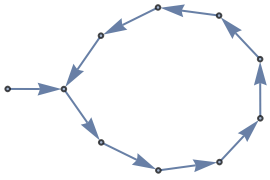
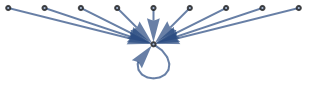
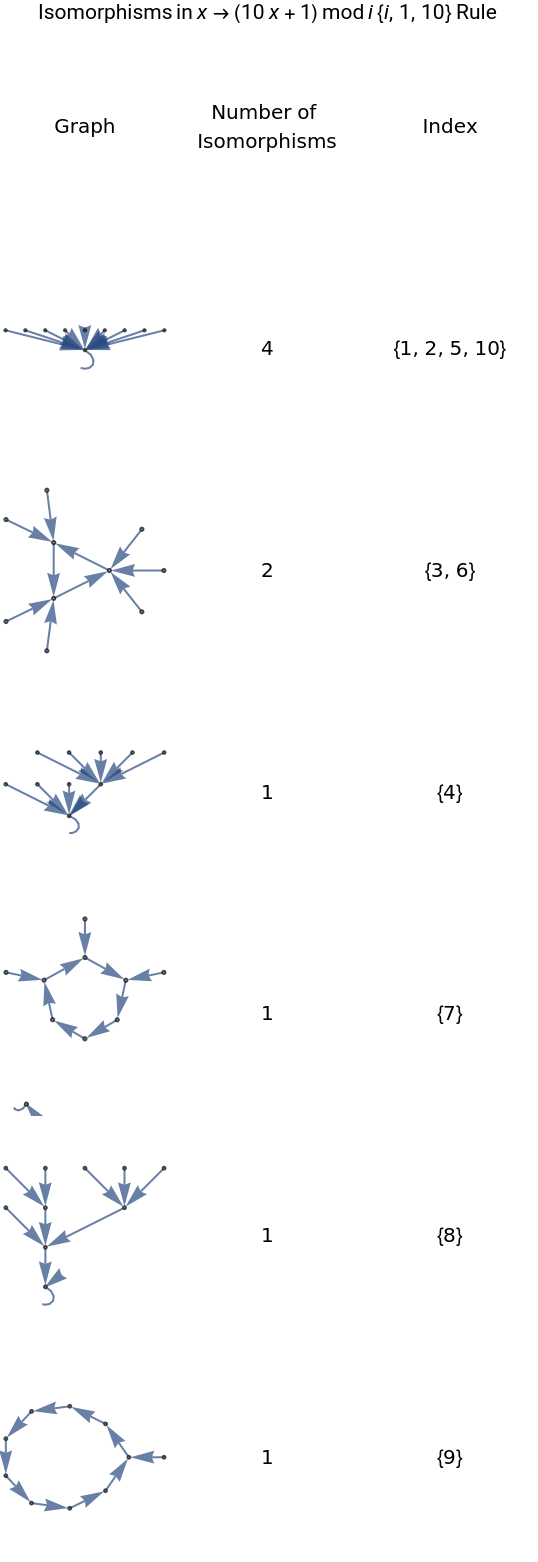
The first feature we explore is the isomorphic nature of the graphs generated by this simple rule.
First, we generate the graphs by applying the rule
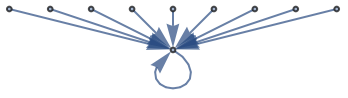
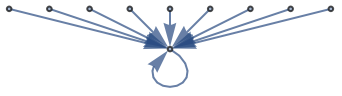
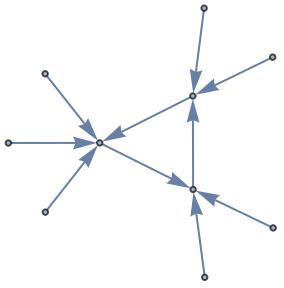
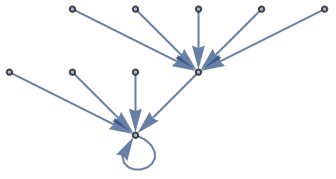
p1=Table[Graph[Table[xMod[10x+1,i],{x,0,9}]],{i,1,10}]
Out[]=
,
,
,
,
,
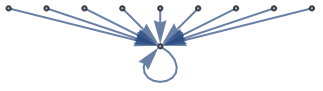
,
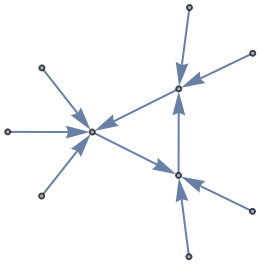
,
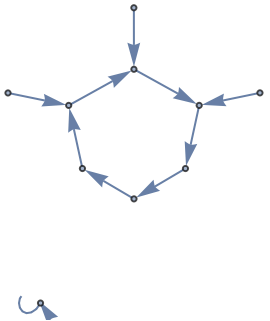
,
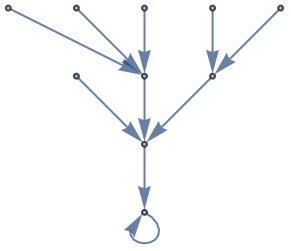
,
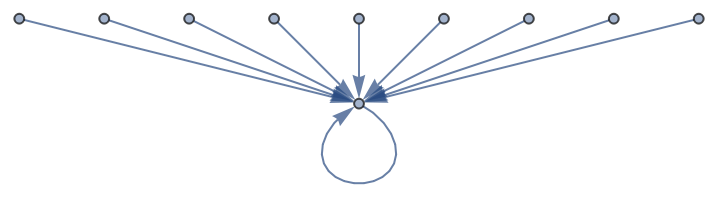
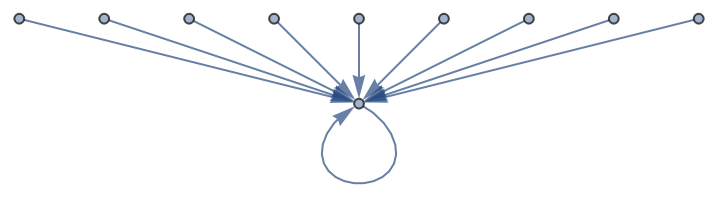
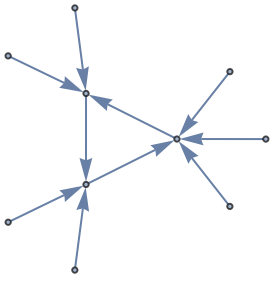
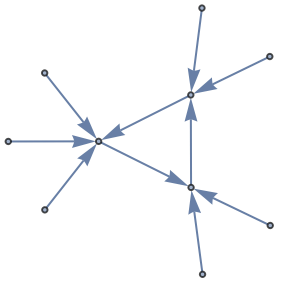
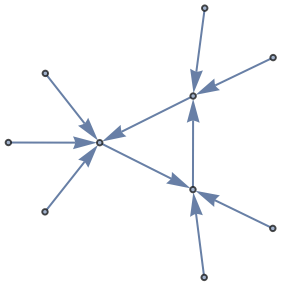
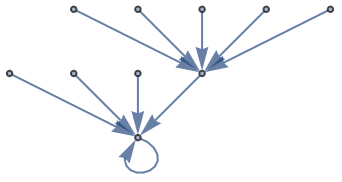
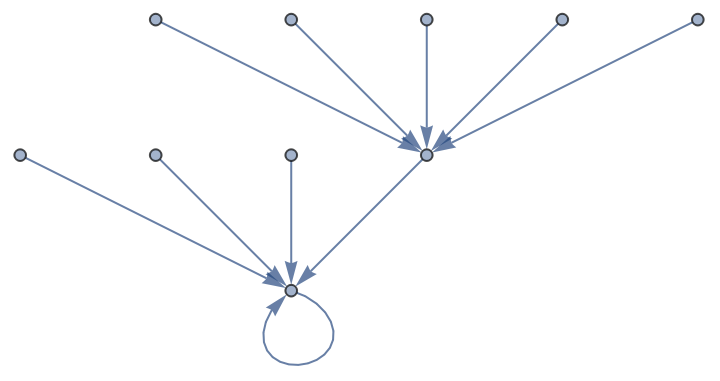
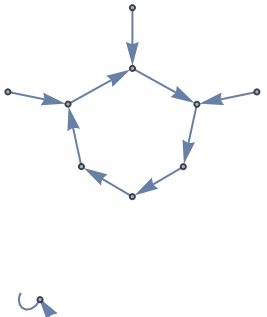
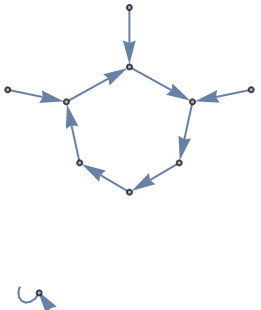
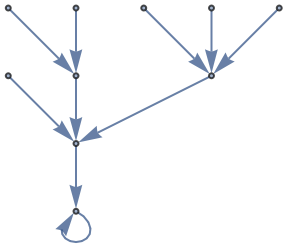
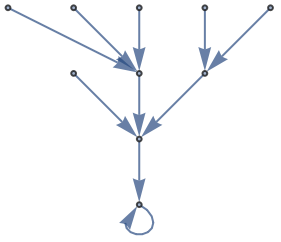
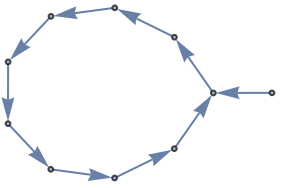
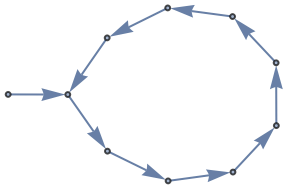
Then we group together the graphs by isomorphisms:
g1=GroupBy[p1,CanonicalGraph]
Out[]=
,
,
,
,
,
,
,
,
,
And we summarize our findings in a table
Show[GraphicsGrid[Prepend[Transpose[{Keys[g1],Length/@Values[g1],Table[Flatten[Position[IsomorphicGraphQ[#,Keys[g1][[i]]]&/@p1,True]],{i,1,Length[Keys[g1]]}]}],{"Graph","Number of Isomorphisms","Index"}]],PlotLabelHoldForm[IsomorphismsinxMod[10x+1,i]{i,1,10}Rule],LabelStyle{GrayLevel[0]}]
Out[]=
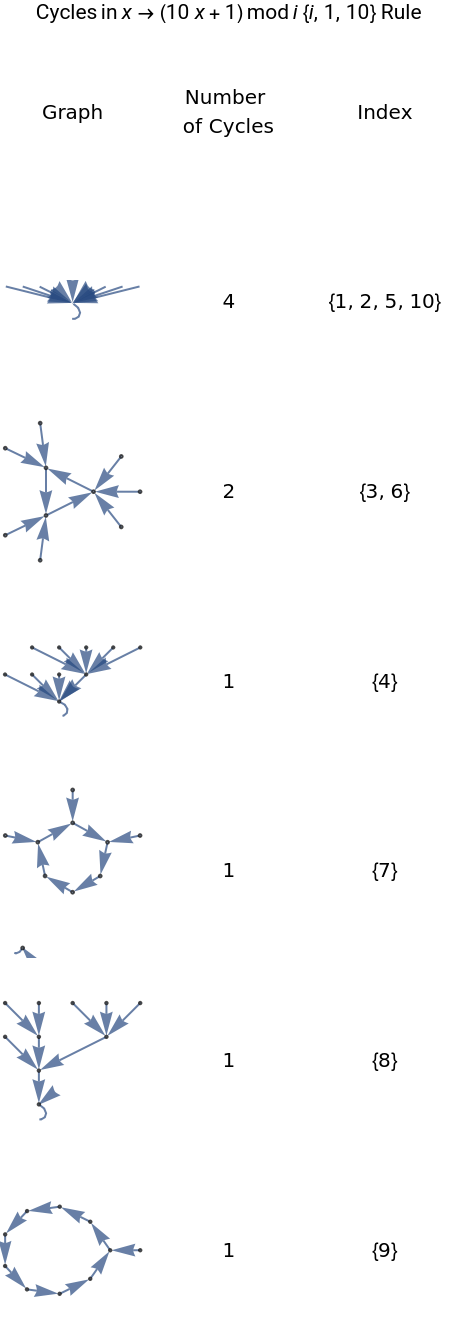
Finally, we explore the nature of the cycles formed
Show[GraphicsGrid[Prepend[Transpose[{Keys[g1],Length/@Values[g1],Table[Flatten[Position[IsomorphicGraphQ[#,Keys[g1][[i]]]&/@p1,True]],{i,1,Length[Keys[g1]]}]}],{"Graph","Number of Cycles","Index"}]],PlotLabelHoldForm[CyclesinxMod[10x+1,i]{i,1,10}Rule],LabelStyle{GrayLevel[0]}]
Out[]=
Quadratic Function
Quadratic Function
We then explore the quadratic function Mod[27 x^2 + 3, i], {x, 0, 28}, {i, 1, 29}
And obtain the following tables:
Cubic functions
Cubic functions
We finish our exploration with a cubic function of the form x -> Mod[2 x^3 + 1, i], {x, 0, 3}, {i, 1, 54}
Concluding remarks
Concluding remarks
We explored some properties, like isomorphisms and cycle size, of graphs obtained by a linear, a quadratic and a cubic function. There is a hint that the further application of these kind of rules on other functions may give rise to a structure in the distribution of isomorphisms and the size of the cycles formed by these graphs. Further investigation is needed.
Keywords
Keywords
◼
Ruliad
◼
Modular Algebra
◼
Graph Theory
Acknowledgment
Acknowledgment
We wish to thank Nikolay Murzin and Xerxes Arsiwalla for the help and guidance of this project, and Stephen Wolfram, who defined the project.
References
References
◼
A project to find the Fundamental Theory of Physics. Stephen Wolfram, 2022.
CITE THIS NOTEBOOK
CITE THIS NOTEBOOK
Explorations on the ruliad via modular Arithmetic
by Juan Arturo Silva-Ordaz
Wolfram Community, STAFF PICKS, July 12, 2023
https://community.wolfram.com/groups/-/m/t/2959627
by Juan Arturo Silva-Ordaz
Wolfram Community, STAFF PICKS, July 12, 2023
https://community.wolfram.com/groups/-/m/t/2959627