Roulette (Epitrochogon) of a Regular Polygon Rolling around Another Regular Polygon
Roulette (Epitrochogon) of a Regular Polygon Rolling around Another Regular Polygon


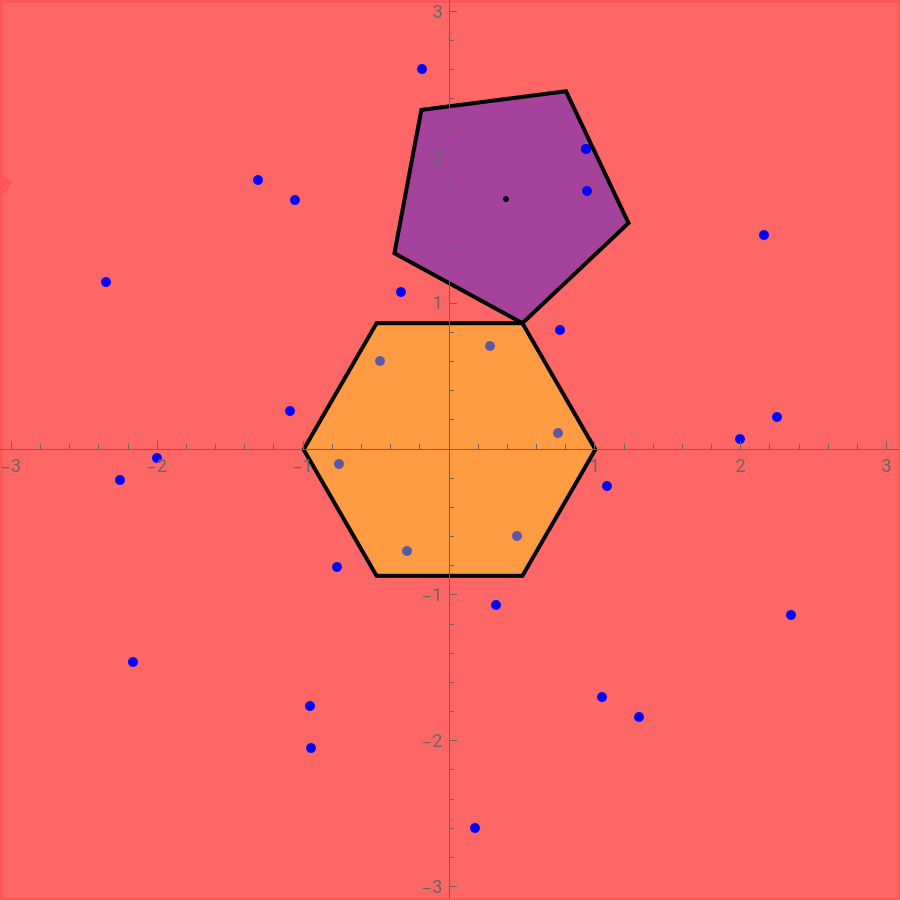
An epitrochogon is the trace (roulette) of a point attached to a polygon rolling without slipping around the outside of another polygon[1].
The epitrochogon can be curtate if the tracing point is inside the rolling polygon, or prolate if it is outside.
If the tracing point is at a vertex of the rolling polygon, the trace becomes an epicyclogon.
In this Demonstration, the base polygon and the rolling polygon have the same edge length. The resulting epitrochogon is a sequence of circle arcs with the same subtending angle and the vertices of the base polygon as centers.
The rolling polygon and the attached tracing point are subject to a sequence of three geometric transformations:
1. a stepwise rotation by a multiple of around its centroid
2π
m
2. a stepwise rotation by a multiple of around the center of the base polygon
-
2π
n
3. a continuous rotation by around the vertex of the base polygon it was moved to by the previous rotation
ϕmod-
2π(n+m)
nm
n
m
ϕ
References
References
[1] T. M. Apostol and M. A. Mnatsukanian, "Generalized Cyclogons," Math Horizons, 10(1), 2002, pp. 25–28. www.mamikon.com/USArticles/GenCycloGons.pdf.
External Links
External Links
Permanent Citation
Permanent Citation