Exploring the gauge symmetries in Wolfram Model
Chang Wu
Institut für Theoretische Physik, Georg-August-Universität Göttingen
Chang Wu
Institut für Theoretische Physik, Georg-August-Universität Göttingen
According to the previous project “Full Discretization of Local Gauge Invariance”, the discrete gauge invariance techniques were previously developed [1]. Therefore, continue exploring the symmetry and related to some known physics in QFT and QM is interesting.
In order to study the gauge symmetries with the wolfram model, we need to reproduce a function like “QuantumToMultiwaySystem”, but instead of each state vertex being a pure state, each state vertex would now be a configuration of a field over one-dimensional lattice, with the evolution rules being some discrete approximation to the equation of motion, such as Klein-Gordon equation for the scalar field.
As a first step, we use the “QuantumToMultiwaySystem” [2] to study a few well known operators, such as the Pauli and Gell-Mann matrices. And apply it to calculate the colour factor in QCD.
A First Example
A First Example
As a first example we study a simple operator which create a superposition of basis state. It has the matrix:
H
,
1 | 1 |
1 | -1 |
This operator is called as Hadamard gate in quantum computing [3], apply it to one of the basis gives
H0〉0〉+1〉.H1〉0〉-1〉.
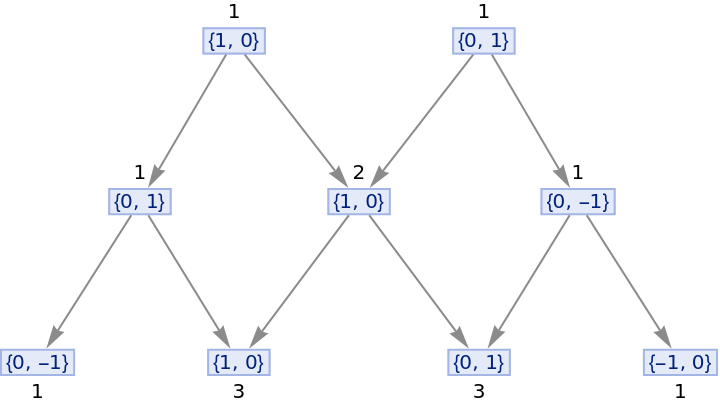
Therefore, we could apply the “QuantumToMultiwaySystem”, which gives the evolution graph as
In[]:=
ResourceFunction["QuantumToMultiwaySystem"][<|"Operator"{{1,1},{1,-1}},"Basis"{{1,0},{0,1}}|>,{1,1},2,"EvolutionGraphFull","IncludeStatePathWeights"True,VertexLabels"VertexWeight",AspectRatio0.5]
Out[]=
In[]:=
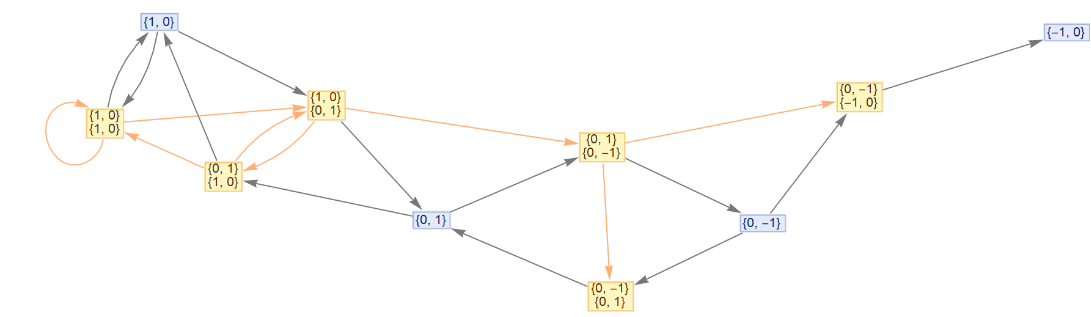
ResourceFunction["QuantumToMultiwaySystem"][<|"Operator"{{1,1},{1,-1}},"Basis"{{1,0},{0,1}}|>,{1,1},2,"EvolutionCausalGraph"]
Out[]=
This simple operator can be decomposed into a linear combination of Pauli matrices
H+
σ
1
σ
3,
where the Pauli matrices are usually taken in the form
σ
1
0 | 1 |
1 | 0 |
σ
2
0 | -i |
i | 0 |
σ
3
1 | 0 |
0 | -1 |
“ 4-dimensional” Pauli Matrices
“ 4-dimensional” Pauli Matrices
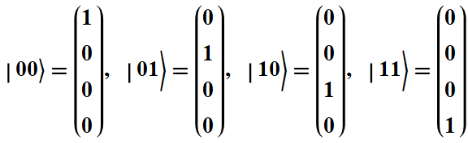
It is also possible to construct the Hilbert space for systems containing 2 spin systems, for example spinors in relativistic quantum mechanics. Using the tensor product of each vector, we have
{0〉,1〉}×{0〉,1〉}{00〉,01〉,10〉,11〉},
which the matrix representation are
Similarly, we could construct the “ 4-dimensional” Pauli Matrices
Σ
σ
1
σ
2,
for simplicity, we only collect the result below:
Σ
x
0 | 1 | 1 | 0 |
1 | 0 | 0 | 1 |
1 | 0 | 0 | 1 |
0 | 1 | 1 | 0 |
Σ
y
0 | - | - | 0 |
i | 0 | 0 | - |
i | 0 | 0 | - |
0 | i | i | 0 |
Σ
z
2 | 0 | 0 | 0 |
0 | 0 | 0 | 0 |
0 | 0 | 0 | 0 |
0 | 0 | 0 | -2 |
which is easy to varify the commutation relations, for example:
In[]:=
sigmax={{0,1,1,0},{1,0,0,1},{1,0,0,1},{0,1,1,0}};sigmay={{0,-I,-I,0},{I,0,0,-I},{I,0,0,-I},{0,I,I,0}};sigmax.sigmay-sigmay.sigmax//MatrixForm
Out[]//MatrixForm=
4 | 0 | 0 | 0 |
0 | 0 | 0 | 0 |
0 | 0 | 0 | 0 |
0 | 0 | 0 | -4 |
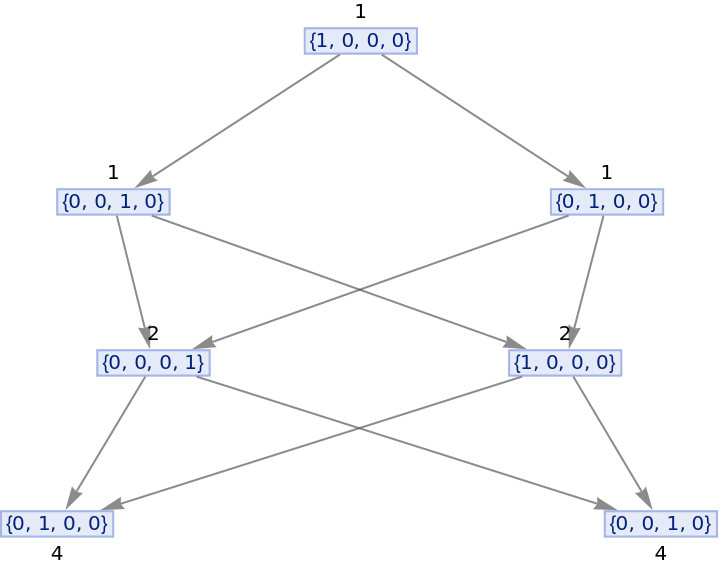
Thus, we can apply the “QuantumToMultiwaySystem” to study act on the basis states
Σ
x
In[]:=
ResourceFunction["QuantumToMultiwaySystem"][<|"Operator"sigmax,"Basis"{{1,0,0,0},{0,1,0,0},{0,0,1,0},{0,0,0,1}}|>,{1,0,0,0},3,"EvolutionGraphFull","IncludeStatePathWeights"True,VertexLabels"VertexWeight",AspectRatio0.8]
Out[]=
In[]:=
ResourceFunction["QuantumToMultiwaySystem"][<|"Operator"sigmax,"Basis"{{1,0,0,0},{0,1,0,0},{0,0,1,0},{0,0,0,1}}|>,{1,0,0,0},4,"EvolutionCausalGraph"]
Out[]=
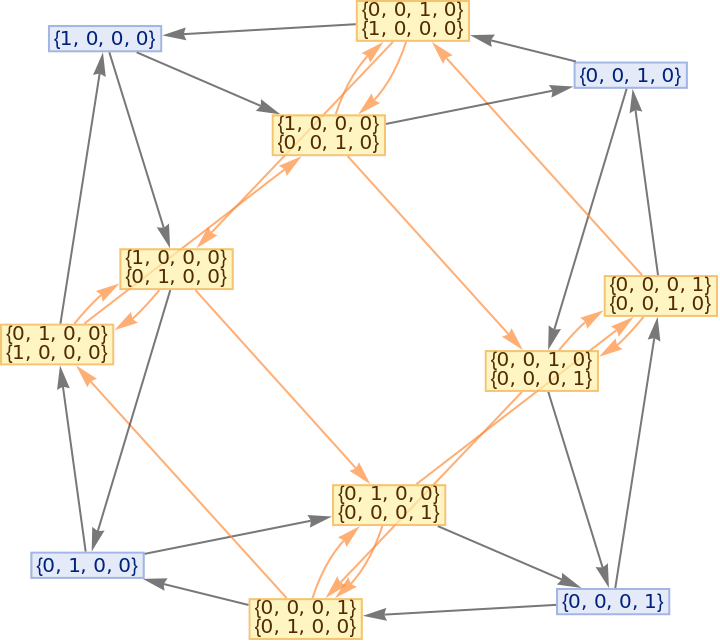
The “total spin” S can be identified from the eigenvalue of the operator, where in Multiway system, the eigenvalue can be obtained from the vertex weight
2
Σ
2
0 | 1 | 1 | 0 |
1 | 0 | 0 | 1 |
1 | 0 | 0 | 1 |
0 | 1 | 1 | 0 |
2
0 | - | - | 0 |
i | 0 | 0 | - |
i | 0 | 0 | - |
0 | i | i | 0 |
2
2 | 0 | 0 | 0 |
0 | 0 | 0 | 0 |
0 | 0 | 0 | 0 |
0 | 0 | 0 | -2 |
In[]:=
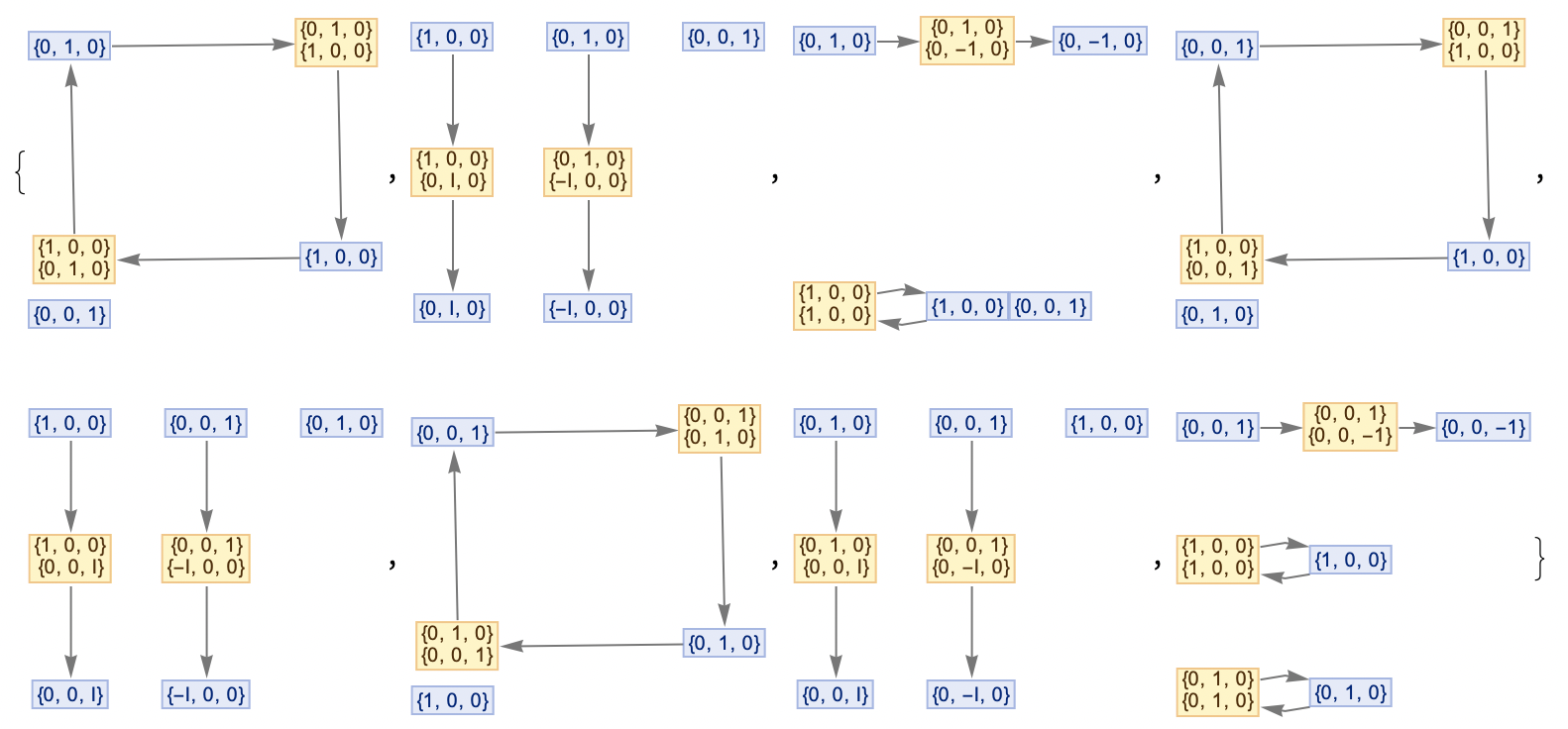
ResourceFunction["QuantumToMultiwaySystem"][<|"Operator"{{8,0,0,0},{0,4,4,0},{0,4,4,0},{0,0,0,8}},"Basis"{{1,0,0,0},{0,1,0,0},{0,0,1,0},{0,0,0,1}}|>,{1,0,0,0},1,"EvolutionGraphFull","IncludeStatePathWeights"True,VertexLabels"VertexWeight"]
Out[]=

Moreover, the Dirac–Pauli representation is useful to express the Dirac equation in covariant form
Gell-Mann Matrices
Gell-Mann Matrices
Start from the QCD Lagrangian, where the color is described by the local gauge transformations with respect to color SU(3) group
and similar to QED case, we could introduce the covariant derivative
And mathematically, quark colour transforms under the fundamental representation, while gluon responsible for exchanging momentum and colour between quarks, are transfer under the adjoint representation of SU(3), which are described by the Gell-Mann matrices
The Gell-Mann matrices are one possible representation of the infinitesimal generators of the special unitary group called SU(3), and we can use the Multiway system to study it’s eigenstate. For example
Colour Factor
Colour Factor
Next Step
Next Step
In this post, we have applied the Multiway system to study the QCD colour factor, where the higher-dimensional colour representation [5] is important to study the sub-leading colour effects. Therefore, we could continue developing this package and applying it to some processes with more complicated colour structure.
For a more interesting direction, we could develop a new function similar to the “QuantumToMultiwaySystem”, but each state vertex is replaced by a real scalar field over one-dimensional lattice structure, for example, the 1-dim Ising model. The Ising Model is a model of spins on a lattice with nearest-neighbor interactions. [6]
From the point of view in Wilsonian effective field theory, we can zoom out by ‘integrating out’ half of the spins on the lattice, which leaves a new effective theory for the remainder. Thus, at long distance the model is described by the QFT with action
In Multiway system, the Ising model have been studied with the string substitution systems [7]. For example:
Moreover, the ultimate goal would be looking an alternate way for spontaneous symmetry-breaking that arise from the discreteness of the lattice over which the scalar field is defined, where the EOM is the discretized Klein-Gordon equation with wavefunctions replaced by operators acting on states, analogous to the generation of Goldstone bosons.
Keywords
Keywords
◼
Multiway System
◼
Gauge Symmetries
◼
Pauli and Gell-Mann Matrices
◼
SU(3) quadratic Casimir
Acknowledgment
Acknowledgment
Mentor: Jon Lederman
The author would like to thank Jon Lederman, Jonathan Gorard, Xerxes D. Arsiwalla, and Stephan Wolfram for the useful discussions, and especially thank Xerxes D. Arsiwalla for pointed a possible new direction for this project.
References
References
◼
[4] M. L. Mangano, S. J. Parke, and Z. Xu, “Duality and Multi - Gluon Scattering,” Nucl. Phys. B, vol. 298, pp. 653–672, 1988.
◼
[5] Y. Bao and A. J. Larkoski, Calculating Pull for Non-Singlet Jets, arXiv:1910.02085.
◼
[6] Jared Kaplan - QFT Lectures Notes