A Wolfram-like model of language secessionism
A Wolfram-like model of language secessionism
Applications of the concepts from A New Kind of Science and Wolfram Physics Project to evolutionary linguistics
José Manuel Rodríguez Caballero
Institute of Computer Science
University of Tartu
Estonia
Institute of Computer Science
University of Tartu
Estonia
We present a toy model, named the homophilic-mimetic model, of language secessionism in a framework similar to the Wolfram model of fundamental physics. Unlike the (original) Wolfram model, where Newton-time emerges from Wolfram-time, in our model Newton-time triggers Wolfram-time. The mathematical ground of our model is a generalization of the diffusion equation in networks, where the network itself is also a time-dependent variable. We show some simulations of language secessionism according to our model.
July 25, 2020
Introduction
Introduction
In the Wolfram model of fundamental physics [2, 3, 10, 11] there is nothing but space. Time is given by the steps of computing and it is not linked to space as a continuum spacetime (this is a secondary notion). The peculiar space in this model is represented by a hypergraph, which evolves in time according to some set of rules. In this framework, there is no explanation why the vertices of the hypergraph should be connected the way they are or why the rule has a precise form and not another form since these are the primitive notions.
In our model, both the combinatorial structure of the spatial hypergraph and the precise form of the rule of evolution are derived from three assumptions (for this reason it is not, strictly speaking, a Wolfram model according to the original formulation). The first assumption is the existence of a one-dimensional fiber over each vertex such that the internal state of a vertex is a point in its fiber. The second assumption is a law, that in our case is homophily, determining whether or not there is a hyperedge according to the internal structure of the vertices involved. The third assumption is that the evolution of the sections in the bundle, that we call microstates of the population, is determined by a generalization of the diffusion equation in networks, involving the hypergraph itself, that we call macrostate of the population, as a variable. For simplicity, we will focus on the case where the hypergraph is a graph.
In the field of evolutionary linguistics, language secessionism is the natural partition of an old language into several new languages, e.g., the evolution from Vulgar Latin to Romance languages (Portuguese, Spanish, French, Italian, Romanian). In the present computational essay, we propose a toy model of language secessionism, that we call the homophilic-mimetic model [7]. We interpret any vertex of the spatial graph as a speaker and any edge between two vertex as the fact that the two speakers corresponding to the vertices understand each other.
The aim of the present computational essay is to show some simulations of language secessionism according to out model. In particular, we shall obtain a graph-theoretic analogous of what cosmologists [1] call the Black Hole Era, interpreted in our context as consolidation of the emerging languages. Finally, we will discuss the presence of computational irreducibility in our model.
Simulation Primitives
Simulation Primitives
Language Consolidation
Language Consolidation
In General Relativity, an event horizon is a boundary in spacetime beyond which events cannot affect an observer. S. Wolfram [11, 12] generalized this concept to branchial space and rulial space. From an information-theoretical point of view (making abstraction of the physics) we will consider an event horizon as a boundary in spacetime such that information cannot flow across [8, 12]. Such a definition is sufficiently general that it can be applied to other domains, e.g., mathematical sociology [7].
We interpret the flow of information as the paths in a spatial graph. We will call black hole a complete graph that is isolated in spacetime by an event horizon. In our model, an event horizon is interpreted as the impossibility of speakers from each side of the boundary to understand the speakers on the other side. We interpret a black hole as the consolidation of a language in a community, where every speaker in the black hole understands all in-group speakers and does not understand any out-group speakers.
The output in the following function is the Boolean value True if the spatial graph G is not in the Black Hole Era and the Boolean value False otherwise.
In[]:=
NotBlackHoleEra[G_(*macrostateofthepopulation*)]:=MemberQ[CompleteGraphQ/@ConnectedGraphComponents[G],False]
Homophilic Networks
Homophilic Networks
The tendency of people to interact more frequently with other people sharing similar characteristics is known in sociology as homophily [section 7.13, 5]. In our model, the spatial graph (macrostate of the population) is given by a homophilic network determined by the microstate of the population ψ and a positive parameter ϵ (tolerance). In the homophilic network, there is an edge between the vertices i and j if and only if the inequality Abs[ψ[[i]] - ψ[[j]]] ≤ ϵ holds. In our model, the homophilic graph is the graph of speakers (vertices) who can understand each other (edges).
The following function determines the homophilic network determined by the microstate ψ and tolerance threshold ϵ.
In[]:=
HomophilicNetwork[ψ_,ϵ_]:=Graph[Range[Length[ψ]],Flatten[Table[If[Abs[ψ[[i]]-ψ[[j]]]≤ϵ,ij],{i,Length[ψ]-1},{j,i+1,Length[ψ]}]]/.NullSequence[]]
Evolution of the population
Evolution of the population
In the homophilic-mimetic model there are two kinds of time. The first kind, that we call Newton-time, is the real variable t in the differential and integral equations which determine the evolution of the microstate ψ(t). The second kind, that we call Wolfram-time, is given by the sequence of macrostates HomophilicNetwork[ψ(t), ϵ] associated to the evolution of the microstates ψ(t), where any change in the graph is interpreted as a step in Wolfram-time.
In the (original) Wolfram model, Newton-time emerges from the application of a set of rules. In contrast, in the homophilic-mimetic model, the application of a rule (one step in Wolfram-time) is triggered by the evolution of the microstate in Newton-time. Furthermore, in the homophilic-mimetic model, when the macrostate HomophilicNetwork[ψ(t), ϵ] reaches the Black Hole Era, the Wolfram-time stop, whereas the Newton-time continues forever.
The following function determines the evolution of the population in Wolfram-time, triggered by the microstate transformation f, while condition b holds. If f is the diffusion in the homophilic network, the convergence of the spatial graph to a Black Hole Era is guaranteed, for all dt small enough, by a theorem due to the author [7].
In[]:=
EvolutionWhile[f_,ϵ_,dt_,init_,b_]:=Block[{ψ=init,(*initializationofthemicrostateofthepopulation*)G=HomophilicNetwork[init,ϵ](*constructionthehomophilicnetwork*),W={G}(*initizalizationoftheWolfram-time*)},While[b[G],ψ=f[G,ψ,dt];(*applicationoftheruleofevolution*)G=HomophilicNetwork[ψ,ϵ];(*updateofthespatialgraph*)W=If[Last[W]≠G,Join[W,{G}],W]];(*updateoftheWolfram-time*)W]
Diffusion in a Network
Diffusion in a Network
The (classical) diffusion equation, also known as heat conduction equation, is the parabolic partial differential equation Δu.
′
u
The diffusion equation [section 6.13.1, 5] in the graph G is similar to the (classical) diffusion equation, but substituting the Laplacian operator Δ by minus the Laplacian matrix -KirchhoffMatrix[G].
J. Gorard [page 55, 3] used the diffusion equation in networks -in a different way as we will do below- in order to obtain the (discrete) Schrödinger equation in the Wolfram model. The imaginary unit as a coefficient in Schrödinger equation is produced by the imaginary branchlike distances in the discrete multiway metric.
In the homophilic-mimetic model, the diffusion equation in networks is used in order to express the postulate: the fiber of each vertex has a tendency to imitate the fiber of the vertices connected to it. In other words, we postulate that space is a sort of machine learning device, in which each vertex learns by imitation from other vertices connected to it. The idea behind this postulate is that speakers have a tendency to imitate other speakers in the way they use the language.
The following function gives the update of the microstate of the population according to the diffusion equation in networks. The parameter dt is the unit step in Newton-time. In theory, dt should be infinitesimal, but in practice, dt should be small with respect to ϵ.
In[]:=
DiffusionUpdate[G_,ψ_,dt_]:=ψ-dt*KirchhoffMatrix[G].ψ
Evolution of a Small Population
Evolution of a Small Population
Choose one of the following options and then go to the cell "animation" below.
Small Spatial Graph (Option 1)
Small Spatial Graph (Option 1)
From a uniform microstate to the state of language consolidation in a small population (with respect to the number of vertices).
In[]:=
W=EvolutionWhile[DiffusionUpdate(*ruleofevolution*),0.2(*tolerancethreshold*),0.001(*unit-stepinNewton-time*),Table[0.1*t,{t,0,29}](*initialcondition*),NotBlackHoleEra(*conditiontocontinuethewhile-loop*)];
Small Spatial Graph (Option 2)
Small Spatial Graph (Option 2)
From a random microstate to the state of language consolidation in a small population (with respect to the number of vertices).
In[]:=
W=EvolutionWhile[DiffusionUpdate(*ruleofevolution*),0.2(*tolerancethreshold*),0.001(*unit-stepinNewton-time*),Table[RandomReal[{-1,1}],{30}](*initialcondition*),NotBlackHoleEra(*conditiontocontinuethewhile-loop*)];
Animation
Animation
Animation of the evolution of the population until the state of language consolidation.
In[]:=
ListAnimate[GraphPlot[#,PlotTheme"Monochrome",GraphLayout"SpringEmbedding"]&/@W,AnimationRunningFalse,DefaultDuration3*Length[W],SaveDefinitionsTrue]
Out[]=
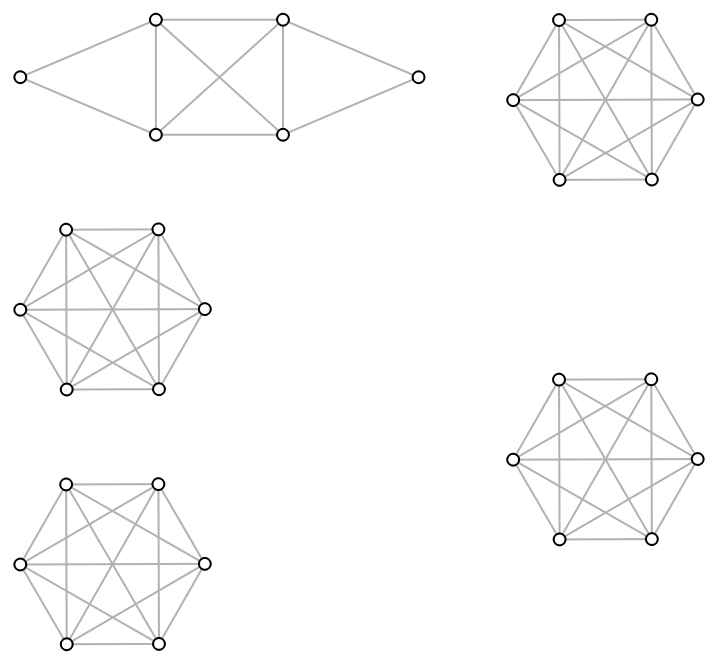
In[]:=
Clear[W](*clearmemory*)
Evolution of a Large Population
Evolution of a Large Population
Generation of a Large Spatial Graph
Generation of a Large Spatial Graph
From a random microstate to the state of language consolidation in a large population (with respect to the number of vertices).
In[]:=
W=EvolutionWhile[DiffusionUpdate(*ruleofevolution*),0.2(*tolerancethreshold*),0.001(*unit-stepinNewton-time*),Table[RandomReal[{-2,2}],{300}](*initialcondition*),NotBlackHoleEra(*conditiontocontinuethewhile-loop*)];
Graph
Graph
Event horizon formation shown as the number of connected components with respect to Wolfram-time.
In[]:=
ListPlot[Table[Length[ConnectedComponents[W[[i]]]],{i,Length[W]}],PlotStyleBlack](*dotheexperimentseveraltimesinordertoseehowitchangesbecauseofrandomness*)
Out[]=
In[]:=
Clear[W](*clearmemory*)
Time of Consolidation
Time of Consolidation
Sampling Populations
Sampling Populations
Generation of a sample of populations. Progress bar below.
Histogram
Histogram
Histogram of the Wolfram-time needed for language consolidation (in the random sampling).
The spatial graph corresponding to the longest Wolfram-time of language consolidation (in the random sampling).
Longest Wolfram-time of language consolidation (in the random sampling).
Computational Irreducibility
Computational Irreducibility
The following definition is our version of S. Wolfram's computationally irreducible questions [9].
Definition. Given a fixed Turing machine and two abstract functions f and g such that the domain of f contains the codomain of g and the domain of g is infinite. We say that f is a computationally irreducible question about g if there are implementations F and G of f and g, respectively, such that for any implementation (allowing shortcuts) H of the composition (f o g), and any input x of g, with a finite number of exceptions, the number of steps in the computation of the composition F[G[x]] is smaller or equal to the number of steps of the computation of H[x].
Conjecture. In the homophilic-mimetic model, the time of language consolidation is a computationally irreducible question with respect to the evolution of the population. More precisely, assume that ϵ, dt and the components of ψ are rational numbers, the function Length is a computationally irreducible question about EvolutionWhile[DiffusionUpdate, ϵ, dt, ψ, NotBlackHoleEra].
Conclusions
Conclusions
Linguistic vs Physics
Linguistic vs Physics
□
The main difference between language consolidation (according to our model) and the evolution of our Universe is that the homophilic-mimetic evolution violates the conservation of information. According to L. Susskind [8], this is the most important law of physics.
□
Unlike black hole evaporation via Hawking radiation, producing the transition from the Black Hole Era to the Dark Era, in our model there is nothing after language consolidation.
Future Work
Future Work
□
To empirically check whether or not the homophilic-mimetic model provides a description of language secessionism.
□
To explore the applications of the homophilic-mimetic model outside evolutionary linguistics.
□
To study the causal graph, the branchial space, and other concepts imported from the Wolfram model, associated to the homophilic-mimetic model.
Acknowledgments
Acknowledgments
Many thanks to Matthew Szudzik for the edition and corrections.
References
References
[1] Adams, Fred C., and Greg Laughlin. "The five ages of the universe: inside the physics of eternity." Simon and Schuster, 2016.
[2] Gorard, Jonathan. "Some Relativistic and Gravitational Properties of the Wolfram Model." arXiv preprint arXiv:2004.14810 (2020).
[3] Gorard, Jonathan. "Some Quantum Mechanical Properties of the Wolfram Model." (2020).
[4] Israeli, Navot, and Nigel Goldenfeld. "Computational irreducibility and the predictability of complex physical systems." Physical review letters 92.7 (2004): 074105.
[5] Newman, Mark. "Networks: An Introduction." Oxford University Press.
[6] Rodriguez Caballero, Jose Manuel . "Brainstorming about the geometric structures in the Wolfram model of fundamental physics." arXiv preprint arXiv:2006.01135 (2020).
[7] Rodriguez Caballero, Jose Manuel. "Homophilic networks evolving by mimesis." arXiv preprint arXiv:2008.05894 .
[8] Susskind, Leonard. "The black hole war: My battle with Stephen Hawking to make the world safe for quantum mechanics." Hachette UK, 2008.
[9] Wolfram, Stephen. "A New Kind of Science." Champaign, IL: Wolfram media, 2002.
[10] Wolfram, Stephen. "Cellular automata and complexity: collected papers." CRC Press, 2018.
[11] Wolfram, Stephen. "A Class of Models with the Potential to Represent Fundamental Physics." arXiv (2020): arXiv-2004.
[12] Wolfram, Stephen, "Event Horizons, Singularities and Other Exotic Spacetime Phenomena." Wolfram Physics Bulletin, May 20, 2020.