The reciprocal Fibonacci constant
Mathematical doodling: reciprocal Fibonacci numbers
by Jonathan Kinlay
Mathematical doodling: reciprocal Fibonacci numbers
by Jonathan Kinlay
Successive values in the infinite series of reciprocal Fibonacci numbers rapidly diminish, becoming arbitrarily small in the limit:
In[]:=
Table,{N,1,20}
1
Fibonacci[N]
Out[]=
1,1,,,,,,,,,,,,,,,,,,
1
2
1
3
1
5
1
8
1
13
1
21
1
34
1
55
1
89
1
144
1
233
1
377
1
610
1
987
1
1597
1
2584
1
4181
1
6765
In[]:=
N[%]
Out[]=
{1.,1.,0.5,0.333333,0.2,0.125,0.0769231,0.047619,0.0294118,0.0181818,0.011236,0.00694444,0.00429185,0.00265252,0.00163934,0.00101317,0.000626174,0.000386997,0.000239177,0.00014782}
So the sum of the series appears likely to converge:
In[]:=
Table,{N,1,20}//N
N
∑
n=1
1
Fibonacci[n]
Out[]=
{1.,2.,2.5,2.83333,3.03333,3.15833,3.23526,3.28288,3.31229,3.33047,3.3417,3.34865,3.35294,3.35559,3.35723,3.35825,3.35887,3.35926,3.3595,3.35965}
In[]:=
ListPlotTable,{N,1,20},Filling-> Axis
N
∑
n=1
1
Fibonacci[n]
Out[]=
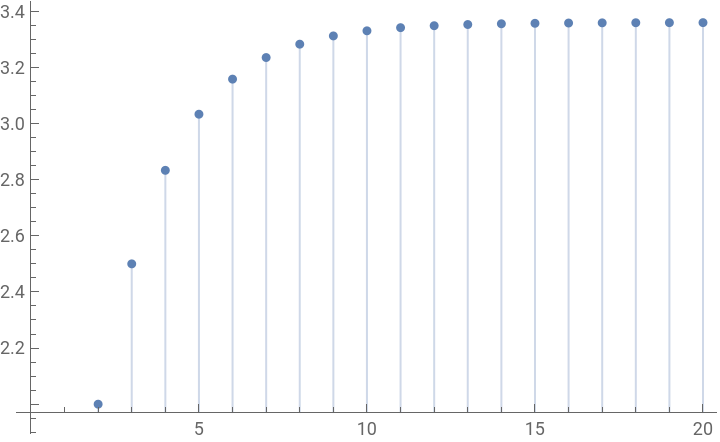
Sum of the Reciprocal Fibonacci Series
Sum of the Reciprocal Fibonacci Series
The direct attempt to find the limit of sum of series doesn’t succeed, so we break the problem down into two parts; first, the series of even-indexed Fibonacci numbers:
In[]:=
N
∑
n=1
1
Fibonacci[2n]
Out[]=
-++,-,
5
QPolyGamma0,1,1
4
2
(1+
5
)2Log(3+
1
2
5
)5
QPolyGamma0,1+N,1
4
2
(1+
5
)2Log(3+
1
2
5
)5
QPolyGamma0,1-π
Log
1
4
2
(1+
5
)1
4
2
(1+
5
)2Log(3+
1
2
5
)5
QPolyGamma0,1+N-π
Log
1
4
2
(1+
5
)1
4
2
(1+
5
)2Log(3+
1
2
5
)In[]:=
FullSimplify[%56]
Out[]=
1
Log[4]-2Log[3+
5
]5
QPolyGamma0,1,1
2
5
)-QPolyGamma0,1+N,1
2
5
)-QPolyGamma0,1+π
Log
2
3+
5
1
2
5
)+QPolyGamma0,1+N+π
Log
2
3+
5
1
2
5
)Limit of the Even-Indexed Series
Limit of the Even-Indexed Series
In[]:=
Limit,N-> ∞
N
∑
n=1
1
Fibonacci[2n]
Out[]=
5
πLog1
2
5
)+Log1
2
5
)QPolyGamma0,1,1
2
5
)-QPolyGamma0,1+π
Log(3-
1
2
5
)1
2
5
)Log1
2
5
)Log[4]-2Log[3+5
]In[]:=
FibSumEven=N[Re[%],10]
Out[]=
1.535370509
Limit of the Odd-Indexed Series
Limit of the Odd-Indexed Series
And now the sum of the odd-indexed series:
In[]:=
Limit,N-> ∞
N
∑
n=0
1
Fibonacci[2n+1]
Out[]=
(5+,(3+,(3+
5
)π-ImQPolyGamma0,-π+Log
2
3+
5
Log[4]-2Log[3+
5
]1
2
5
)+ImQPolyGamma0,π+Log
2
3+
5
Log[4]-2Log[3+
5
]1
2
5
)22(3+
Log5
)2
3+
5
In[]:=
FibSumOdd=N[Re[%],10]
Out[]=
1.824515157
Sum of the Infinite Series of Reciprocal Fibonacci Numbers
Sum of the Infinite Series of Reciprocal Fibonacci Numbers
So the sum of the infinite series of Fibonacci reciprocals is just the sum of the even-indexed and odd-indexed series:
In[]:=
N[FibSumEven+FibSumOdd,10]
Out[]=
3.359885666
The Reciprocal Fibonacci Constant
The Reciprocal Fibonacci Constant
It turns out that I am not the first to look into this question, which was addressed over 30 years ago by Horadam and others. The limit of the even-indexed series was given by Horadam 1988, Knopp 1990, Paszkowski 1997and Finch 2003. Likewise the limit of the odd-indexed series was given in Horadam 1988, Griffin 1992, Zhao 1999, and Finch 2003.
The series sum even has a name: the Reciprocal Fibonacci Constant.
A related question raised by Paul Erdos is whether the constant is irrational; and it was proved to be so in 1989 by André-Jeannin
The series sum even has a name: the Reciprocal Fibonacci Constant.
A related question raised by Paul Erdos is whether the constant is irrational; and it was proved to be so in 1989 by André-Jeannin
Looking at the above formulae, we find in several places the term (3+.This is equivalent to 1 + ϕ, where:
1
2
5
)In[]:=
ϕ = Limit[Fibonacci[N]/Fibonacci[N-1],N-> ∞]
Out[]=
1
2
5
)is the
Out[]=
References
References
See : Weisstein, Eric W . "Reciprocal Fibonacci Constant." From MathWorld-- A Wolfram Web Resource . https://mathworld.wolfram.com/ReciprocalFibonacciConstant.html
André - Jeannin, R . "Irrationalité de la somme des inverses de certaines suites récurrentes." C . R . Acad . Sci . Paris Sér . I Math . 308, 539 - 541, 1989.
Apéry, F . "Roger Apéry, 1916-1994: A Radical Mathematician." Math . Intell . 18, No . 2, 54 - 61, 1996.
Arndt, J . "On Computing the Generalized Lambert Series." 24 Jun 2012. http://arxiv.org/abs/1202.6525. Borwein, J . M . and Borwein, P . B . "Evaluation of Sums of Reciprocals of Fibonacci Sequences." §3 .7 in Pi & the AGM : A Study in Analytic Number Theory and Computational Complexity . New York : Wiley, pp . 91 - 101, 1987.
Bundschuh, P . and Väänänen, K . "Arithmetical Investigations of a Certain Infinite Product." Compos . Math . 91, 175 - 199, 1994.
Duverney, D . "Irrationalité de la somme des inverses de la suite de Fibonacci." Elem . Math . 52, 31 - 36, 1997.
Finch, S . R . Mathematical Constants . Cambridge, England : Cambridge University Press, p . 358, 2003.
Griffin, P . "Acceleration of the Sum of Fibonacci Reciprocals." Fib . Quart . 30, 179 - 181, 1992.
Horadam, A . F . "Elliptic Functions and Lambert Series in the Summation of Reciprocals in Certain Recurrence-Generated Sequences." Fib . Quart . 26, 98 - 114, 1988.
Knopp, K . Theory and Application of Infinite Series . New York : Dover, 1990.
Landau, E . "Sur la série des inverse de nombres de Fibonacci." Bull . Soc . Math . France 27, 298 - 300, 1899.
Paszkowski, S . "Fast Convergent Quasipower Series for Some Elementary and Special Functions." Comput . Math . Appl . 33, 181 - 191, 1997.
Michon, G . P . "Final Answers: Numerical Constants." http://home.att.net/~numericana/answer/constants.htm#prevost. Sloane, N . J . A . Sequences A079586, A153386, and A153387 in "The On-Line Encyclopedia of Integer Sequences."
Zhao, F . -Z . "Notes of Reciprocal Series Related to the Fibonacci and Lucas Numbers." Fib . Quart . 37, 254 - 257, 1999.