ORIGINAL ARTICLE: Cashion, M. D., Johnson, B. C., Gibson, H., Turtle, E. P., Sori, M. M., & Melosh, H. J. (2024). Europa’s double ridges produced by ice wedging. Journal of Geophysical Research: Planets, 129, e2023JE008007. https://doi.org/10.1029/2023JE008007
Article Abstract: Double ridges are sprawling features observed globally across the icy surface of Europa. They consist of two topographic highs flanking a trough. The topographic relief of the ridges is approximately 100 m, and the ridges extend up to hundreds of kilometers in length. The interior structure and dynamics of Europa’s ice shell are currently poorly constrained. Therefore, accurate models for the formation of these prominent surface features can be useful for determining how the ice shell operates. We hypothesize that double ridges form as a result of incremental ice wedging. We use both analytical and numerical finite element models to quantify the deformation that occurs as an ice wedge grows incrementally within the ice shell. We show that incremental growth of the ice wedge results in surface deformation that matches the size and shape of typical Europan double ridges, including their topographic relief and surrounding troughs. We find that as the depth of the ice wedge increases, double ridges become broader and shorter. We explore the possibility of local and non-local sources for the liquid water that freezes to produce the wedge and ultimately argue in favor of local sources of liquid water within the ice shell.
This program evaluates the analytical expressions describing the surface uplift above a vertical edge dislocation located a specified distance below the surface. Two of these dislocations are then superposed to model double ridges on Europa. We assume that Europa’s shell is composed of pure water ice.
Variables can be easily changed to consider more cases.
This program is adapted from the solutions presented by Savage (1998), please see their work for details.
Displacement by upward facing dislocation
Displacement by upward facing dislocation
First, evaluate the surface displacement caused by an upward facing dislocation.
The ice wedge is:
500 m wide (bv = 5e5 mm)
500 m below surface (c = 500 m = 5e5 mm)
in a 1 km thick layer of ice (h = 1e6 mm)
Running the cell below will output two plots that show the displacement caused by the dislocation in the horizontal and vertical directions, respectively.
The ice wedge is:
500 m wide (bv = 5e5 mm)
500 m below surface (c = 500 m = 5e5 mm)
in a 1 km thick layer of ice (h = 1e6 mm)
Running the cell below will output two plots that show the displacement caused by the dislocation in the horizontal and vertical directions, respectively.
In[]:=
Out[]=
{{0,0},{200000.,9399.82},{400000,27076.5},{600000,41851.8},{1000000,59351.6},{1500000,70539.6},{2000000,77529.9},{3000000,86677.6},{5000000,97257.9},{7000000,103768.},{10000000,110422.}}
Out[]=
{{0,0},{200000,-12389.2+0.},{400000,-29761.1+0.},{600000,-47725.3+0.},{1000000,-75098.+0.},{1500000,-95802.6+0.},{2000000,-108719.+0.},{3000000,-124151.+0.},{5000000,-138842.+0.},{7000000,-145795.+0.},{10000000,-151225.+0.}}
Out[]=
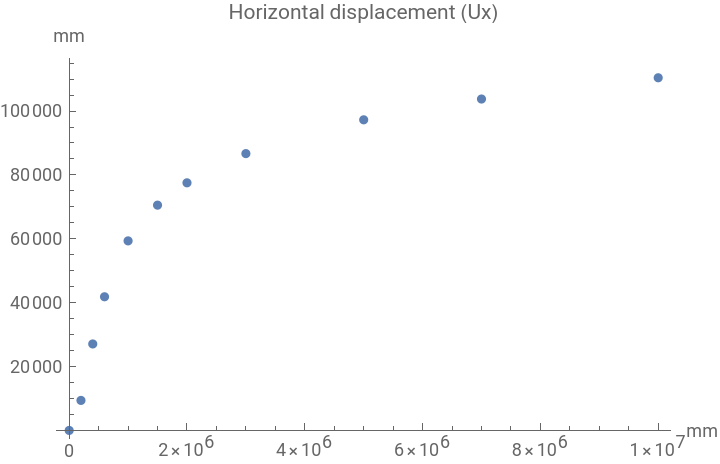
Out[]=
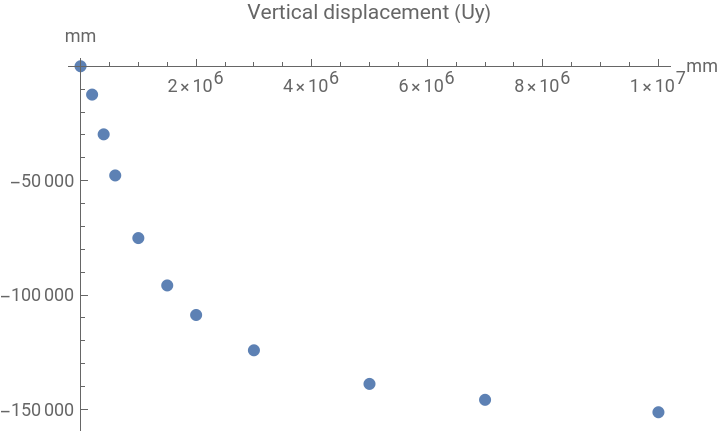
Displacement by downward facing dislocation
Displacement by downward facing dislocation
Now evaluate the displacement caused by a downward facing dislocation.
The ice wedge is:
500 m wide but facing the opposite direction as before (bv = -5e5 mm)
100 m below surface (c = 900 m = 9e5 mm)
in a 1 km thick layer of ice (h = 1e6 mm)
Running the cell below will output two plots that show the displacement caused by the dislocation in the horizontal and vertical directions, respectively.
In[]:=
bv=-5*^5;gam=0.5;kap1=5/3;kap2=5/3;c=9.0*^5;h=1*^6;y1=h/5;y2=2*h/5;y3=3*h/5;y4=h;y5=3*h/2;y6=2*h;y7=3*h;y8=5*h;y9=7*h;y10=10*h;sig=1;del=(gam*kap1+1)/(kap2+1);eta=(gam+kap2)/(kap2+1);yref=30*h;k=c/h;p=Cosh[xi*h];q=Sinh[xi*h];t=xi*h;m=Exp[2*k*t];g2=gam*g1;coef=2*(del+eta-1)*g1*bv/(del*eta*(kap1+1));phi1=coef*(I*Exp[-(h+c+x)*xi]/xi)*ca;psi1=coef*(I*Exp[-(h+c+x)*xi]/xi^2)*cb;phi2=coef*(I*Exp[-(h+c)*xi]/xi)*(cc*Cosh[xi*x]+ cd*Sinh[xi*x]);psi2=coef*(I*Exp[-(h+c)*xi]/xi^2)*(ce*Cosh[xi*x]+ cf*Sinh[xi*x]);ux1=Simplify[phi1*(kap1+1)-D[x*phi1+psi1,x]]/(2*g1);uy1=-Simplify[(x*phi1+psi1)*I*xi]/(2*g1);ux2=Simplify[phi2*(kap2+1)-D[x*phi2+psi2,x]]/(2*g2);uy2=-Simplify[(x*phi2+psi2)*I*xi]/(2*g2);equ1=gam*kap1*ca+gam*cb-kap2*cc+cf==0;equ2=gam*sig*cb-ce==0;equ3=(kap1+1)*sig*ca+2*sig*cb+(kap2+1)*cd-2*ce==0;equ4=(kap1-1)*ca+2*cb-(kap2-1)*cc+2*cf==0;equ5=((kap2+1)*q-2*t*p)*cc-((kap2+1)*p-2*t*q)*cd+2*p*ce-2*q*cf==I*(2*del*eta*t*(1-k)*m+del-eta+2*del*(1-eta)*(1-k)*t*(1-2*k*t));equ6=((kap2-1)*p-2*t*q)*cc-((kap2-1)*q-2*t*p)*cd+2*q*ce-2*p*cf==-I*(2*del*eta*(-1+(1-k)*t)*m+2*del*eta-del-eta+2*del*(1-eta)*(1+k)*t-4*del*(1-eta)*k*t^2);Solve[{equ1,equ2,equ3,equ4,equ5,equ6},{ca,cb,cc,cd,ce,cf}];ux2e=ux2/.%;uy2e=uy2/.%%;ux2h=First[Simplify[ux2e/.x-h]];uy2h=First[Simplify[uy2e/.x-h]];daty={{0,0},{y1,NIntegrate[I/Pi*uy2h*Sin[xi*y1],{xi,0,1,Infinity}]},{y2,NIntegrate[I/Pi*uy2h*Sin[xi*y2],{xi,0,1,Infinity}]},{y3,NIntegrate[I/Pi*uy2h*Sin[xi*y3],{xi,0,1,Infinity}]},{y4,NIntegrate[I/Pi*uy2h*Sin[xi*y4],{xi,0,1,Infinity}]},{y5,NIntegrate[I/Pi*uy2h*Sin[xi*y5],{xi,0,1,Infinity}]},{y6,NIntegrate[I/Pi*uy2h*Sin[xi*y6],{xi,0,1,Infinity}]},{y7,NIntegrate[I/Pi*uy2h*Sin[xi*y7],{xi,0,1,Infinity}]},{y8,NIntegrate[I/Pi*uy2h*Sin[xi*y8],{xi,0,1,Infinity}]},{y9,NIntegrate[I/Pi*uy2h*Sin[xi*y9],{xi,0,1,Infinity}]},{y10,NIntegrate[I/Pi*uy2h*Sin[xi*y10],{xi,0,1,Infinity}]}};datx={{0,0},{y1,NIntegrate[ux2h/Pi*(Cos[xi*y1]-1),{xi,0,1,Infinity}]},{y2,NIntegrate[ux2h/Pi*(Cos[xi*y2]-1),{xi,0,1,Infinity}]},{y3,NIntegrate[ux2h/Pi*(Cos[xi*y3]-1),{xi,0,1,Infinity}]},{y4,NIntegrate[ux2h/Pi*(Cos[xi*y4]-1),{xi,0,1,Infinity}]},{y5,NIntegrate[ux2h/Pi*(Cos[xi*y5]-1),{xi,0,1,Infinity}]},{y6,NIntegrate[ux2h/Pi*(Cos[xi*y6]-1),{xi,0,1,Infinity}]},{y7,NIntegrate[ux2h/Pi*(Cos[xi*y7]-1),{xi,0,1,Infinity}]},{y8,NIntegrate[ux2h/Pi*(Cos[xi*y8]-1),{xi,0,1,Infinity}]},{y9,NIntegrate[ux2h/Pi*(Cos[xi*y9]-1),{xi,0,1,Infinity}]},{y10,NIntegrate[ux2h/Pi*(Cos[xi*y10]-1),{xi,0,1,Infinity}]}};r1=Sqrt[(h-c)^2+y^2];r2=Sqrt[(h+c)^2+y^2];theta1=ArcTan[h-c,-y];theta2=ArcTan[h+c,-y];a=(1-1/gam)/(1+kap2/gam);b=(kap1-kap2/gam)/(kap1+1/gam);uxyhalf=(bv/(2*Pi(kap2+1)))*(2*(0.5*(kap2-1)* Log[r1]-(h-c)^2/r1^2)-(b+a)*(0.5*(kap2-1)* Log[r2]-(h+c)^2/r2^2)+(b-a)*(0.5*(kap2+1)* Log[r2]-(h+c)^2/r2^2)+2*c*a*(-2*(h+c)/ r2^2+(3-kap2)*(h+c)/r2^2-4*(h+c)^3/ r2^4+2*c(-1/r2^2+2*(h+c)^2/r2^4)));uyyhalf=(bv/(2*Pi(kap2+1)))*(2*(0.5*(kap2+1)* theta1+(h-c)*y/r1^2)-(b+a)*(0.5*(kap2+1)* theta2+(h+c)*y/r2^2)+(b-a)*(0.5*(kap2- 1)*theta2+(h+c)*y/r2^2)+2*a*c*(2*y/ r2^2-(1+kap2)*y/r2^2+4*(h+c)^2*y/r2^4 -4*c*(h+c)*y/r2^4));fidxy=N[uxyhalf/.y0];fidyy=N[uyyhalf/.y0];datxyhalf={{0,0},{0.0,N[uxyhalf/.yy1]-fidxy},{0,N[uxyhalf/.yy2]-fidxy},{0,N[uxyhalf/.yy3]-fidxy},{0,N[uxyhalf/.yy4]-fidxy},{0,N[uxyhalf/.yy5]-fidxy},{0,N[uxyhalf/.yy6]-fidxy},{0,N[uxyhalf/.yy7]-fidxy},{0,N[uxyhalf/.yy8]-fidxy},{0,N[uxyhalf/.yy9]-fidxy},{0,N[uxyhalf/.yy10]-fidxy}};datyyhalf={{0,0},{0,N[uyyhalf/.yy1]-fidyy},{0,N[uyyhalf/.yy2]-fidyy},{0,N[uyyhalf/.yy3]-fidyy},{0,N[uyyhalf/.yy4]-fidyy},{0,N[uyyhalf/.yy5]-fidyy},{0,N[uyyhalf/.yy6]-fidyy},{0,N[uyyhalf/.yy7]-fidyy},{0,N[uyyhalf/.yy8]-fidyy},{0,N[uyyhalf/.yy9]-fidyy},{0,N[uyyhalf/.yy10]-fidyy}};datxldh=datx+datxyhalfdatyldh=daty+datyyhalfuxfin=ListPlot[datx+datxyhalf,PlotStyle{PointSize[0.015]},PlotRangeAll,PlotLabel"Horizontal displacement (Ux)",AxesLabel{mm,mm}]uyfin=ListPlot[daty+datyyhalf,PlotStyle{PointSize[0.02]},PlotRangeAll,PlotLabel"Vertical displacement (Uy)",AxesLabel{mm,mm}]
Ridges modeling
Ridges modeling
Ridges are modeled as the superposition of the vertical displacements from both dislocations.
These opposing dislocations are at depths of 100 m and 500 m and have bv= |500 m|
These opposing dislocations are at depths of 100 m and 500 m and have bv= |500 m|
CITE THIS NOTEBOOK
CITE THIS NOTEBOOK
Europa's Double Ridges Produced by Ice Wedging
by M. D. Cashion, B. C. Johnson, H. Gibson, E. P. Turtle, M. M. Sori, H. J. Melosh
Wolfram Community, STAFF PICKS, February 9, 2024
https://community.wolfram.com/groups/-/m/t/3118955
by M. D. Cashion, B. C. Johnson, H. Gibson, E. P. Turtle, M. M. Sori, H. J. Melosh
Wolfram Community, STAFF PICKS, February 9, 2024
https://community.wolfram.com/groups/-/m/t/3118955