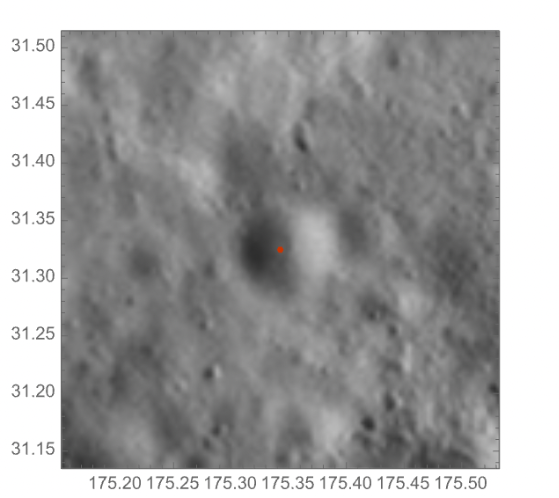
This project will survey the surface of the Moon and select craters that best approximate paraboloids as candidate locations for the construction of radio telescopes. The project will make use of Moon crater entity positions as well as geo elevation data. By fitting paraboloids to the topography of Moon craters and selecting the best fitting and most appropriate sites to minimize excavation, materials, and work required in construction, as well as solar radiation interference, we will narrow down the list to one candidate for location of a radio telescope on the Moon.
Introduction:
Introduction:
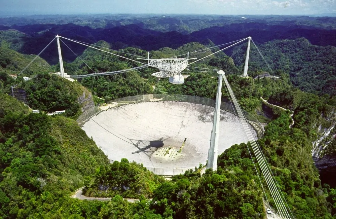
Just as optical telescopes are the primary observing instrument for traditional astronomy in the visible light spectrum, radio telescopes play an instrumental role in observing features of the cosmos that emit frequencies in the radio wave spectrum. Currently, the best radio telescope in use on Earth is under a massive handicap that it inherently can never escape. Being on Earth, the atmosphere’s outermost layer (called the Ionosphere) acts as an insulator to a wide range of radio waves, keeping Earth-sourced radio waves in, and Space-sourced radio waves out. Apart from this, in a case that a small sliver of Space-sourced radio waves were observable by our instruments, the egregious amount of interference from our Radio towers, power lines, and even natural phenomena like rain would make the data skewed and inaccurate for scientific advancement. We would need to construct a radio telescope free from these Earthly inhibitors. Fortunately, the Moon has had over 300 years of scientific observations, and in the latest 50 years of technological advancement, we are privy to the coordinates and properties of over 2 million craters that exist on the moon today. Many sources such as the IAU(International Astronomical Union) and the United States Geological Survey have openly available databases of the Moon’s craters, some named, most nameless. What if we used one of these craters and their natural curved structure to build a Radio Telescope on top of? The idea is not as far-out as it may seem, considering that it has already been done for the Arecibo telescope in Puerto Rico (photo above). Fortunately, NASA has already asked this question, and provided some parameters in which such an undertaking may be able to realize its potential.
Selection Criteria:
Selection Criteria:
In order to decide one winner from the millions of craters that can be observed on the Moon today, We need some method of systematically filtering for ideal conditions for the home of a lunar radio telescope. The following criteria were generated by NASA in the united search for a location on the Moon that would be free from radio interference and ideal for scientific research to be conducted. These criteria include:
◼
Far - side of the moon, near 20°±10°N and 180°±45°E to avoid Earth - based radio interference .
◼
Diameter between 3-5km
◼
Minimum Depth of 600m (0.6km)
◼
Complete unbroken Rim
◼
Level surface and gentle slope outside the crater
◼
Inside of Crater is free of obstructions and most fitting to a perfect Paraboloid for minimal construction or excavation work on site
Data Preparation: Dataset of Lunar Craters:
Data Preparation: Dataset of Lunar Craters:
Import a lunar crater dataset:
In[]:=
lunarCraterDataset=Import,"Dataset","HeaderLines"->1[All,KeyDrop[{"Lat_new","Lon_new"}]];
Visualise a histogram of the Lat and Lon coordinates represented in the dataset:
Out[]=
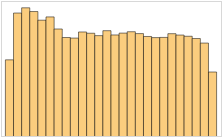
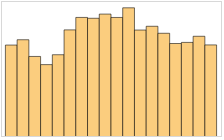
As we can see, there are a huge variety of craters spread out in all directions of the surface of the Moon. With over 100,000 candidates to choose from, choosing one champion will prove quite the task.
Filtering Craters by Location:
Filtering Craters by Location:

As shown above, we immediately start searching for ideal candidates on the far side of the moon. Fortunately the Moon has a Latitude and Longitude system exactly like Earth, and the “Prime Meridian” at 0° directly faces Earth at all times. The “Dark side of the moon” starts at 90°E and ends at 270°E.
Filter out craters that are not on the far side of the moon:
In[]:=
lunarCraterDatasetTrimmed=Dataset[lunarCraterDataset[Select[-80<#Lat<80&&!(-90<=#Lon<=90)&&3<=#"Diam_km"<=5&]][(*Correct moon crater longitudes for better plotting:*) All,<|#,"Lon"->If[#Lon<-90,#Lon+360,#Lon]|>&],MaxItems->5]
Out[]=


Plot the selection of possible candidate crater sites:
Out[]=
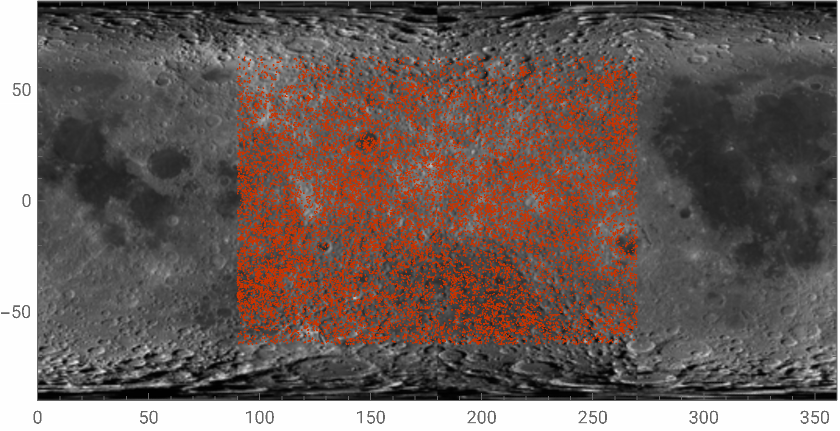
Show the density of possible candidates in the area of interest:
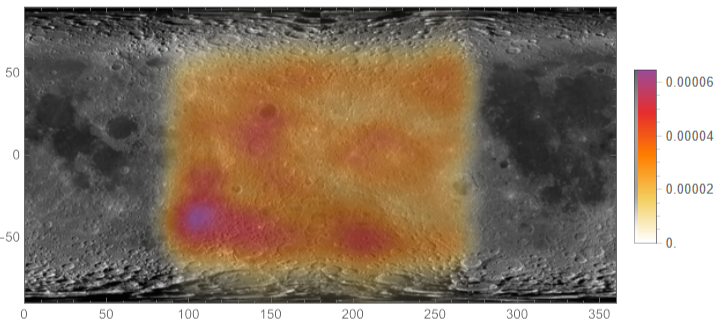
As it turns out, NASA recommends a more constrained geographical range to best avoid radio interference. This range is 20°±10°N, and 180°±45°E
Filter the data further to conform to the NASA location selection criteria:
In[]:=
lunarCraterDatasetTrimmed=With[{threshLat=10,threshLon=45}, Dataset[lunarCraterDatasetTrimmed[Select[20-threshLat<#"Lat"<20+threshLat&&180-threshLon<#"Lon"<180+threshLon&]],MaxItems->5] ]
Out[]=
We can now plot the updated selection of potential crater candidates:
Plot the selection of possible candidate crater sites:
Out[]=
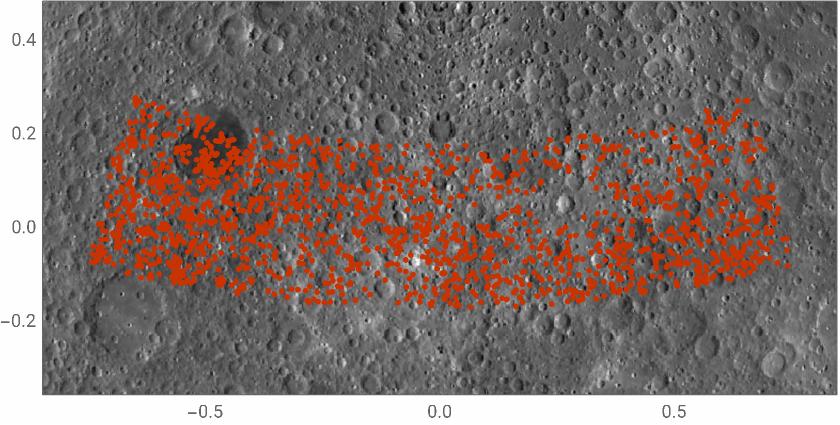
Show the density of possible candidates in the area of interest:
Filtering Craters by Topography:
Filtering Craters by Topography:
Estimating the Depth of Lunar Craters:
Estimating the Depth of Lunar Craters:
Discard topographical data outside the estimated area of a crater:
Estimate a crater’s depth based on it’s topography given its position and radius:
Estimate the crater depth for every observation in the dataset, and save the results to a .csv table:
Import the processed data:
Filtering By Crater Depth:
Filtering By Crater Depth:
Filter the dataset to only include craters deeper than .6km:
Visualise the histogram of crater depths for remaining candidate craters:
Visualise a map of the remaining candidate crater locations:
Visualise a heat map of the remaining candidate craters:
The Depth/Diameter ratios are in important measurement to weed out the obscure looking craters on the lunar surface. We need a crater that is in the “Goldilocks zone” of not too flat, but not too steep. This would be to ensure that we have plenty of space to build the radio telescope entirely submerged inside the crater, and allowing for traversal and construction within the boundaries of the rim.
What is does the histogram of depth/diameter ratios look like?
Visualise a map of the remaining candidate crater locations:
Filtering by Crater Surrounding Area Flatness:
Filtering by Crater Surrounding Area Flatness:
Get crater topography given a crater’s location and diameter:
Discard topographical data inside the estimated area of a crater, keeping only the immediate surroundings within a radius around the crater equal to the crater diameter:
To estimate the evenness and range of the elevations in the area immediately surrounding the crater, we select elevation data only around the crater. With an annulus of inner radius equal to the radius of the crater, and outer radius equal to the diameter of the crater, we may compute the standard deviation and minimum elevation to maximum elevation ranges of these data. To penalise craters with highly uneven topography in their immediate surroundings, we multiply the standard deviation with the range - giving what we call an “OuterTerrainScore”. Higher Outer Terrain Scores equate to more uneven surroundings for the crater.
The lower the score the better. Narrow down the selection to the top 10 craters with the best outer terrain score:
Again, we can visualize what we’re left with:
Visualise a map of the remaining candidate crater locations:
Filtering Craters By Paraboloid Fit:
Filtering Craters By Paraboloid Fit:
Fitting Paraboloids To Best Candidate Crater Sites:
Fitting Paraboloids To Best Candidate Crater Sites:
Create a column storing crater topography in for the current selection of craters:
Define a function to extract topographical data from within the crater, and fit a paraboloid to the data:
In the composite plots in the table below, the data have been centered around zero, and their range is defined for each crater by the resolution of its topography data array. Therefore, in the composite plots, the x and y axes are not particularly informative, but this does not matter in our case.
Fit paraboloids to the data, produce a composite plot of the crater data and fitted paraboloid, compute the parameter table for the fit, as well as its R-Squared:
Select The Best Crater Candidate For Construction of a Moon Radio Telescope:
Select The Best Crater Candidate For Construction of a Moon Radio Telescope:
So after all this work, which crater would we recommend as the next lunar radio telescope site?
Pick the crater with the highest R-Squared:
Crater #38928 from our dataset is the winner! In celebration, I will graciously name it “Herrera”.
Show the row corresponding to the winning crater in the final filtered craters dataset:
So where is it and what does it look like? Together, let’s admire our champion.
Plot the topography of “Herrera”:
Plot the Position of “Herrera”:
Reflection and Concluding Remarks:
Reflection and Concluding Remarks:
Keywords:
Keywords:
◼
NASA
◼
Radio Telescope
◼
Dark Side of The Moon
◼
Interference
◼
Paraboloid
◼
Coordinates
◼
Cartography
References:
References:
◼
Hall, L. (2020, April 7). Lunar crater radio telescope (LCRT) on the far-side of the Moon. NASA
https://www.nasa.gov/general/lunar-crater-radio-telescope-lcrt-on-the-far-side-of-the-moon/
https://www.nasa.gov/general/lunar-crater-radio-telescope-lcrt-on-the-far-side-of-the-moon/
◼
Yang, C., & Guan, R. (2020, August 6). CE_DeepCraters. figshare.
https://figshare.com/articles/dataset/CE_DeepCraters/12768539
https://figshare.com/articles/dataset/CE_DeepCraters/12768539
Acknowledgements:
Acknowledgements:
First and foremost I would like to thank my mentor Phileas Dazeley-Gaist for his support and counseling throughout the duration of this project. Without his help, much of the technical work and troubleshooting would not have been possible to overcome. Also I would like to give thanks to my uncle Eric for putting me on this path of academic enrichment and expanding the horizons for what I thought was feasible to achieve. Last but not least, I give thanks to Stephen Wolfram for entrusting me with such a fascinating project and giving encouragement as well as direction for where to focus my astronomical enthusiasm.
First and foremost I would like to thank my mentor Phileas Dazeley-Gaist for his support and counseling throughout the duration of this project. Without his help, much of the technical work and troubleshooting would not have been possible to overcome. Also I would like to give thanks to my uncle Eric for putting me on this path of academic enrichment and expanding the horizons for what I thought was feasible to achieve. Last but not least, I give thanks to Stephen Wolfram for entrusting me with such a fascinating project and giving encouragement as well as direction for where to focus my astronomical enthusiasm.
Citation for this Notebook:
Citation for this Notebook:
Identifying candidate moon craters for radio telescope placement
by Andrew Herrera
Wolfram Community, July 10 2024
https://community.wolfram.com/groups/-/m/t/3211829
by Andrew Herrera
Wolfram Community, July 10 2024
https://community.wolfram.com/groups/-/m/t/3211829