Analytic Solutions of the Helmholtz Equation for Some Polygons with 45 Degree Angles
Analytic Solutions of the Helmholtz Equation for Some Polygons with 45 Degree Angles


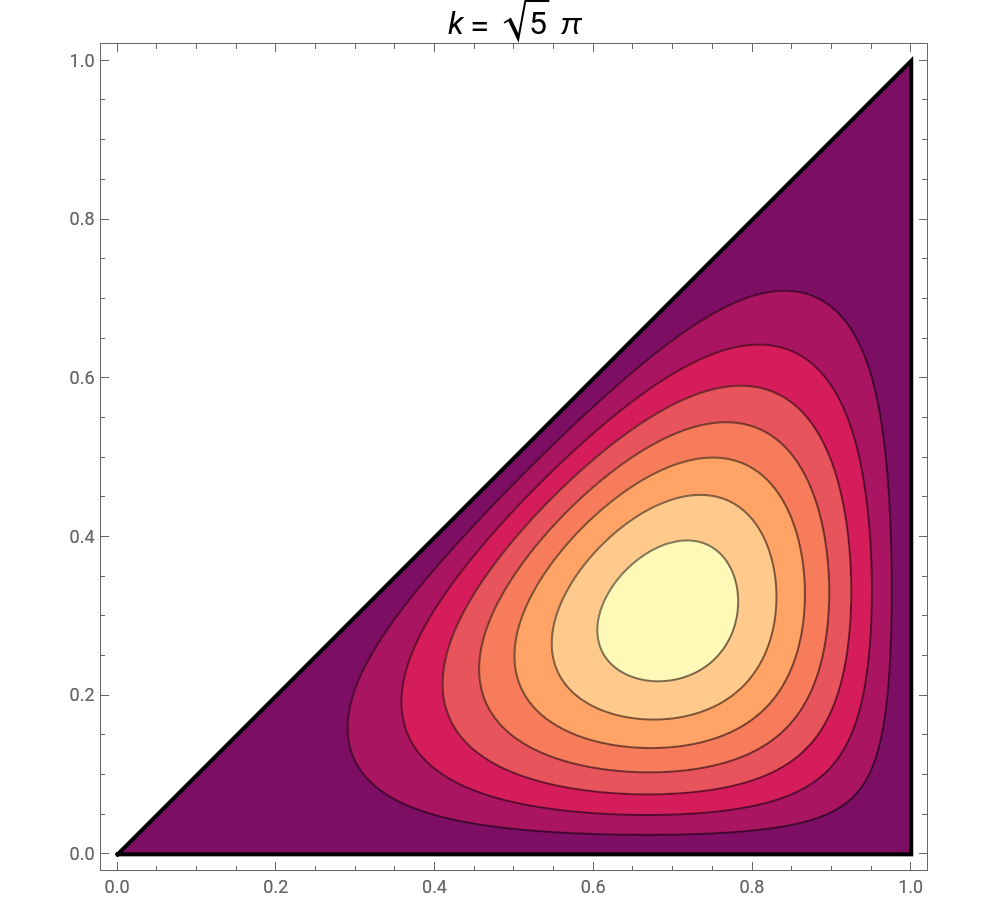
This Demonstration considers the Helmholtz equation in two dimensions:
(+)ϕ(x,y)=0
2
∇
2
k
within the interior of a polygonal region , subject to Dirichlet boundary conditions . This equation can be applied to the mechanical vibration of plates with clamped boundaries, in which case =/. Here, is an allowed eigenfrequency of vibration, with representing the speed of waves in the vibrating medium. In quantum mechanics, the Helmholtz equation in the form
Ω
∂Ω=0
2
k
2
ω
2
c
ω
c
-ψ(x,y)=Eψ(x,y)
2
ℏ
2m
2
∇
represents a particle in an infinite two-dimensional potential well.
The Helmholtz equation in a unit square has the simple solutions
ϕ
nm
with .
n,m=1,2,3,…
A linear combination of degenerate solutions
ϕ
nm
m≠n
has the additional property of vanishing along the diagonal . This suggests an additional solution of the Helmholtz equation for isosceles right triangles, and by stacking a set of such triangles, one can build some irregular polygons with the same solutions. We consider here the cases of a parallelogram, a trapezoid and a (nonregular) hexagon. These all contain 45° or 135° vertex angles.
x=y
For each of the four irregular polygons, you can choose the quantum numbers and to produce a contour plot of (x,y). The corresponding vibration eigenvalue is also shown.
n
m
ϕ
nm
k=+π
2
n
2
m
References
References
[1] H. P. W. Gottlieb, "Exact Vibration Solutions for Some Irregularly Shaped Membranes and Simply Supported Plates," Journal of Sound and Vibration, 103(3), 1985 pp. 333–339. doi:10.1016/0022-460X(85)90426-2.
[2] W.-K. Li, "A Particle in an Isosceles Right Triangle," Journal of Chemical Education, 61(12), 1984 p. 1034. doi:10.1021/ed061p1034.
External Links
External Links
Permanent Citation
Permanent Citation