McCabe-Thiele Method for Methanol/Water Separation
McCabe-Thiele Method for Methanol/Water Separation


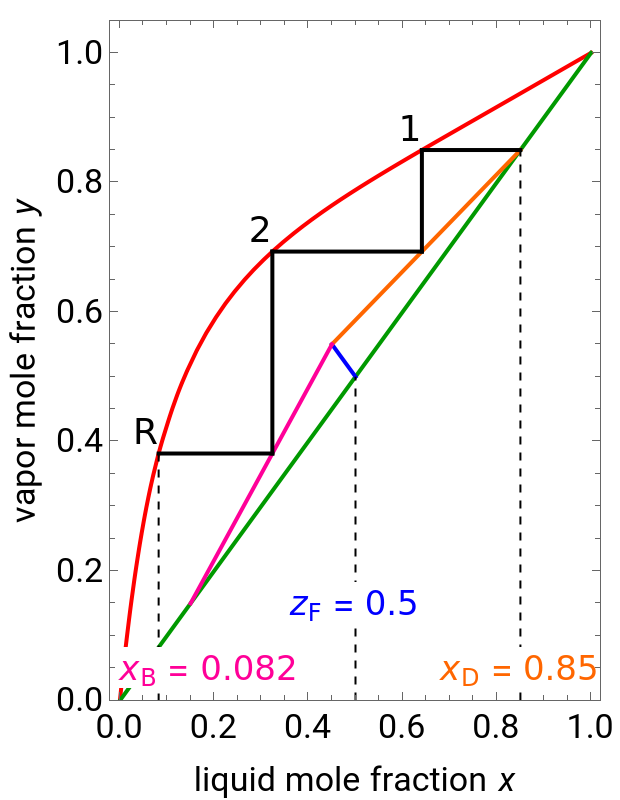
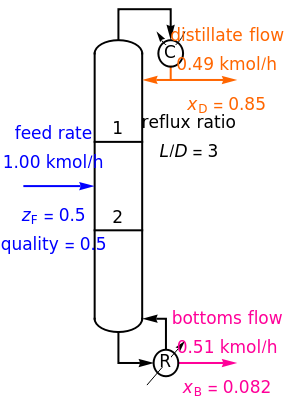
This Demonstration shows how to determine the number of equilibrium stages needed for a two-component (methanol/water) separation in a counter-current distillation column. It also shows the optimal location to feed the binary mixture into the column. Check "view process flow diagram" to show the - diagram on the left and the process flow diagram on the right. When that box is not checked, a larger - diagram is shown and you can move the cursor over the curves to see labels. The column feed has a methanol mole fraction of =0.5 and a quality of 0.5. The condenser is a total condenser, so it is not considered an equilibrium stage. Set the external reflux ratio , as well as the methanol mole fractions in the distillate and bottoms streams, with sliders. The number of stages is determined by stepping off stages starting at ; the partial reboiler is an equilibrium stage. The number of equilibrium stages depends on the compositions of the exiting streams and the reflux ratio. The stages can be numbered with the first stage above the reboiler (bottom to top) or with the first stage at the condenser, use buttons to switch between these numbering options. Note that the determined by stepping off stages is often lower than the desired because reaching the exact value of the desired would require a partial stage, which is not possible.
x
y
x
y
z
F
L/D
x
D
x
B
x
D
x
B
x
B
x
B
Details
Details
The McCabe–Thiele graphical solution method for binary distillation is used to determine the number of equilibrium stages needed to achieve a specified separation in a distillation column. This method assumes:
1. The distillation column is adiabatic.
2. Constant molar overflow (CMO), which means that for every mole of vapor condensed, one mole of liquid is vaporized. This results in constant liquid and vapor flow rates between stages (the exception being the flow rates of the stages above and below the feed stream, which are not equal). This assumption requires that:
2a. Specific heat changes are small compared to latent heat changes between stages and .
-≪
H
i+1
H
i
λ
vap
-≪
h
i+1
h
i
λ
vap
2b. Heat of vaporization is the same for both components and thus independent of concentration.
λ
vap
3. Heat of mixing is negligible.
The equilibrium curve was calculated using the modified Raoult's law:
P=+
x
1
γ
1
sat
P
1
x
2
γ
2
sat
P
2
y
i
x
i
γ
i
sat
P
i
where and are the liquid and vapor mole fractions ( for methanol, for water), +=1, +=1, is total pressure and is the saturation pressure, which is calculated using the Antoine equation:
x
i
y
i
i=1
i=2
x
1
x
2
y
1
y
2
P
sat
P
i
sat
P
i
A
i
B
i
T+
C
i
10
where is temperature, and , and are Antoine constants.
T
A
i
B
i
C
i
The activity coefficients are calculated using the two-parameter Margules model:
γ
i
ln=(+2(-))
γ
1
2
x
2
A
12
A
21
A
12
x
1
ln=(+2(-))
γ
2
2
x
1
A
21
A
12
A
21
x
2
where =0.7923 and =0.5434 are the Margules parameters for a methanol/water mixture.
A
12
A
21
The operating lines for the rectifying and stripping sections are used to determine the number of stages. First the feed and rectifying operating lines are calculated:
y
F
q
q-1
z
F
q-1
y
R
R
R+1
x
D
R+1
where is the vapor quality of the feed, is the mole fraction of methanol in the feed, is the liquid mole fraction of methanol in the distillate and is the reflux ratio.
q
z
F
x
D
R=L/D
The operating line for the stripping section is found by drawing a line through the bottoms composition on the – line and the intersection of the feed line (also called the line) and rectifying line . The feed line intersects the rectifying line at :
y
S
x
B
x
y
q
y
F
y
R
(,)
x
int
y
int
x
int
x
D
z
F
q+R
y
int
y
F
x
int
y
R
x
int
the slope of the stripping line is calculated from and and the intercept is found:
(,)
x
int
y
int
(,)
x
B
x
B
y
y
S
y
int
x
B
x
int
x
B
x
B
x
B
View the screencast videos at[1] and[2] for a step-by-step explanation of the McCabe–Thiele method.
References
References
[1] McCabe–Thiele Graphical Method Example Part 1[Video]. (Mar 6, 2014) www.youtube.com/watch?v=Cv4KjY2BJTA.
[2] McCabe-Thiele Graphical Method Example Part 2[Video]. (Mar 6, 2014) www.youtube.com/watch?v=eIJk5uXmBRc.
External Links
External Links
Permanent Citation
Permanent Citation
Neil Hendren, Rachael L. Baumann, John L. Falconer, Thomas Belval
"McCabe-Thiele Method for Methanol/Water Separation"
http://demonstrations.wolfram.com/McCabeThieleMethodForMethanolWaterSeparation/
Wolfram Demonstrations Project
Published: October 4, 2016