In a set of points, a line containing only two points is an ordinary line. For a set of points, the edges of an Ordinary Graph are the ordinary lines.
Ordinary Octagram = ShrikhandeGraph
Ordinary Octagram = ShrikhandeGraph
The ordinary graph of the octagram is the Shrikhande graph:
In[]:=
pp=RootReduceJoinCirclePoints[8],1+
2
CirclePoints[8];extra=ResourceFunction["FindExtraordinaryLines"][pp];ee=Complement[Subsets[Range[16],{2}],Flatten[Subsets[#,{2}]&/@extra,1]];In[]:=
Row[{Graphics[{LightGray,Line[pp[[#]]]&/@extra,Thick,Cyan,Line[pp[[#]]]&/@ee,Black,Disk[#,.07]&/@pp},ImageSize->Small],Graph[GraphData["ShrikhandeGraph"],ImageSize->Small]}]
Out[]=
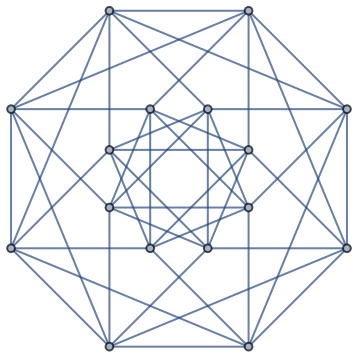
In[]:=
IsomorphicGraphQ[GraphData["ShrikhandeGraph"],Graph[UndirectedEdge@@@ee]]
Out[]=
True
Ordinary Pentagram = Petersen Graph
Ordinary Pentagram = Petersen Graph
The ordinary graph of the pentagram is the Petersen graph:
In[]:=
pp=RootReduce[Join[CirclePoints[5],-GoldenRatio^2CirclePoints[5]]];extra=ResourceFunction["FindExtraordinaryLines"][pp];ee=Complement[Subsets[Range[10],{2}],Flatten[Subsets[#,{2}]&/@extra,1]];
In[]:=
Row[{Graphics[{LightGray,Line[pp[[#]]]&/@extra,Thick,Cyan,Line[pp[[#]]]&/@ee,Black,Disk[#,.1]&/@pp},ImageSize->Small],Graph[GraphData["PetersenGraph"],ImageSize->Small]}]
Out[]=
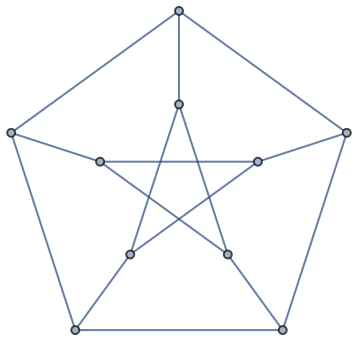
In[]:=
IsomorphicGraphQ[GraphData["PetersenGraph"],Graph[UndirectedEdge@@@ee]]
Out[]=
True
Ordinary Desargues = Petersen Graph
Ordinary Desargues = Petersen Graph
The ordinary graph of the Desargues configuration is the Petersen graph:
In[]:=
des={{0,0},{0,1},{0,3},{2,1},{2,2},{2,4},{3,3},{4,2},{4,3},{8,1}};pp=des;extra=ResourceFunction["FindExtraordinaryLines"][pp];ee=Complement[Subsets[Range[10],{2}],Flatten[Subsets[#,{2}]&/@extra,1]];
In[]:=
Row[{Graphics[{LightGray,Line[pp[[#]]]&/@extra,Thick,Cyan,Line[pp[[#]]]&/@ee,Black,Disk[#,.1]&/@pp},ImageSize->Small],Graph[GraphData["PetersenGraph"],ImageSize->Small]}]
Out[]=
In[]:=
IsomorphicGraphQ[GraphData["PetersenGraph"],Graph[UndirectedEdge@@@ee]]
Out[]=
True
Ordinary Hexagram+Point = CuboctahedralGraph
Ordinary Hexagram+Point = CuboctahedralGraph
The ordinary graph of the 13-point hexagram is the cuboctahedral graph:
In[]:=
pp=RootReduce[Join[CirclePoints[6],Sqrt[3]Reverse/@CirclePoints[6],{{0,0}}]];extra=ResourceFunction["FindExtraordinaryLines"][pp];ee=Complement[Subsets[Range[13],{2}],Flatten[Subsets[#,{2}]&/@extra,1]];
In[]:=
Row[{Graphics[{LightGray,Line[pp[[#]]]&/@extra,Thick,Cyan,Line[pp[[#]]]&/@ee,Black,Disk[#,.1]&/@pp},ImageSize->Small],Graph[GraphData["CuboctahedralGraph"],ImageSize->Small]}]
Out[]=
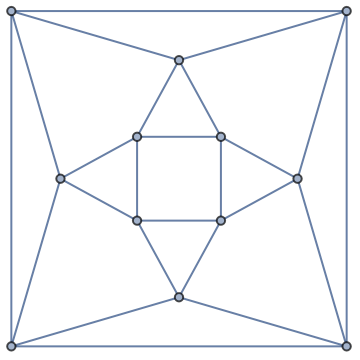
In[]:=
IsomorphicGraphQ[GraphData["CuboctahedralGraph"],Graph[UndirectedEdge@@@ee]]
Out[]=
True
Ordinary Orchard 16 = {QuarticTransitive,23}
Ordinary Orchard 16 = {QuarticTransitive,23}
In[]:=
o16=,-7+3,1,,5-3,1,,-7+3,5-3,-5+3,-,,7-3,-5+3,7-3,-,{0,0};

1
2
5
,1
2
5
,1
2
5
,1
2
5
,1
4
5
,1
2
1
4
5
,1
4
5
,1
4
5
,1
2
In[]:=
pp=o16;extra=ResourceFunction["FindExtraordinaryLines"][pp];ee=Complement[Subsets[Range[13],{2}],Flatten[Subsets[#,{2}]&/@extra,1]];
In[]:=
Row[{Graphics[{LightGray,Line[pp[[#]]]&/@extra,Thick,Cyan,Line[pp[[#]]]&/@ee,Black,Disk[#,.04]&/@pp},ImageSize->Small],Graph[GraphData[{"QuarticTransitive",23}],ImageSize->Small]}]
Out[]=
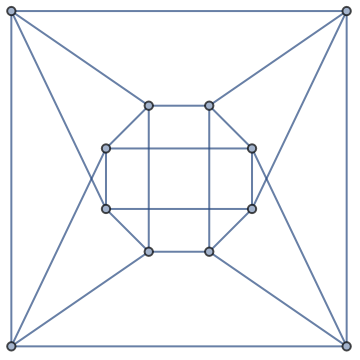
In[]:=
IsomorphicGraphQ[GraphData[{"QuarticTransitive",23}],Graph[UndirectedEdge@@@ee]]
Out[]=
True
Ordinary Grünbaum-Rigby Configuration
Ordinary Grünbaum-Rigby Configuration
In[]:=
pp=RootReduceJoinCirclePoints[7],CirclePoints[7],CirclePoints[7];extra=ResourceFunction["FindExtraordinaryLines"][pp];ee=Complement[Subsets[Range[21],{2}],Flatten[Subsets[#,{2}]&/@extra,1]];
In[]:=
Graphics[{LightGray,Line[pp[[#]]]&/@extra,Thick,Cyan,Line[pp[[#]]]&/@ee,Black,Disk[#,.1]&/@pp}]
Out[]=
Not in GraphData
In[]:=
SortBy[{#,IsomorphicGraphQ[GraphData[#],Graph[UndirectedEdge@@@ee]]}&/@GraphData["Sextic",21],Last]
Out[]=
{{{Circulant,{21,{1,4,5}}},False},{{Circulant,{21,{1,6,8}}},False}}
In[]:=
Factor[CharacteristicPolynomial[AdjacencyMatrix[Graph[UndirectedEdge@@@ee]],x]]
Out[]=
-((-6+x))
2
x
6
(1+x)
6
(-7+)
2
x
Ordinary Orchard 17 == Not regular
Ordinary Orchard 17 == Not regular
In the below, each of these 32 tuples summing to zero is on a line:
Sadly, doesn’t lead to a regular graph:
Anything else?
Anything else?
Do any other point sets have interesting ordinary graphs?
CITE THIS NOTEBOOK
CITE THIS NOTEBOOK
Different ordinary graphs: creation and visualization
by Ed Pegg
Wolfram Community, STAFF PICKS, September 13, 2024
https://community.wolfram.com/groups/-/m/t/3273063
by Ed Pegg
Wolfram Community, STAFF PICKS, September 13, 2024
https://community.wolfram.com/groups/-/m/t/3273063