Started learning Group Theory, and learned about the integers modulo n. Decided to code up a visualization of the additive operation generators on the set of elements in the group of integers modulo n. This generator must have no prime factors in common with n otherwise it would not reach every number in the set.
This code creates a manipulate for modn and gives each possible generator that reaches the whole set. The elements are shown on the points of a n-sided polygon.
In[]:=
intmodn[modulo_Integer]:=Manipulate[Show[Graphics[{LightBlue,RegularPolygon[modulo]},PlotLabel->StringForm["<``,+``>",modulo,op]],Table[Graphics[Text[Style[n,20,Red],CirclePoints[modulo][[n+1]]]],{n,0,modulo-1}],Graphics[Circle[CirclePoints[modulo][[Mod[op*i,modulo]+1]],.1]]],{i,1,modulo,1},{op,Select[Range[0,modulo-1],GCD[#,modulo]==1&]}]
Integers Modulo 12
Integers Modulo 12
In[]:=
intmodn[12]
Out[]=


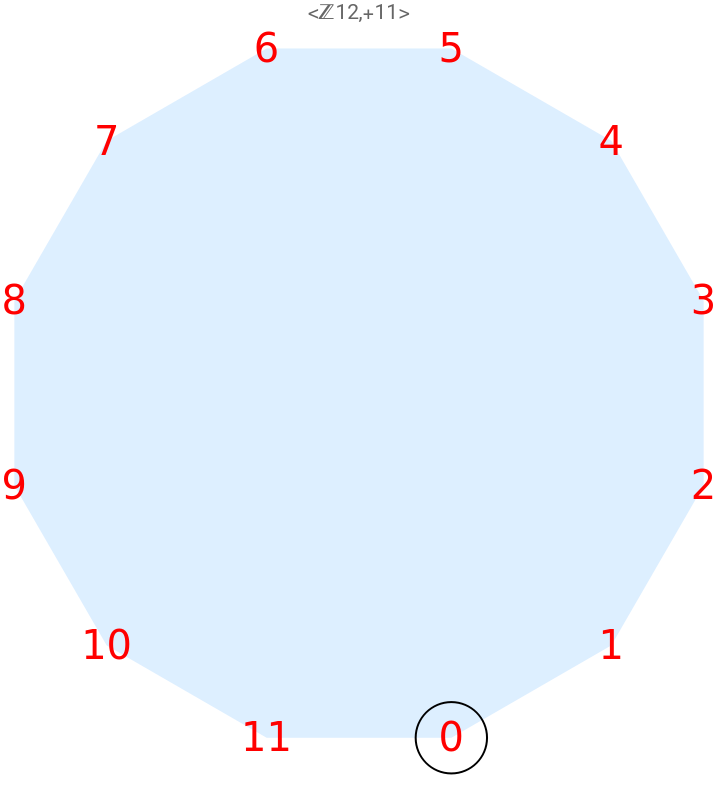
We see the possible generators are 1, 5, 7, 11. This is because these are the only numbers in the set of mod12 that have no prime factors in common with 12.
We see that 1 and 11 have an interesting property of mirroring their behavior. 1 goes counterclockwise from one to zero, 11 goes clockwise from 11 to one.
Integers Modulo 17
Integers Modulo 17
In[]:=
intmodn[17]
Out[]=
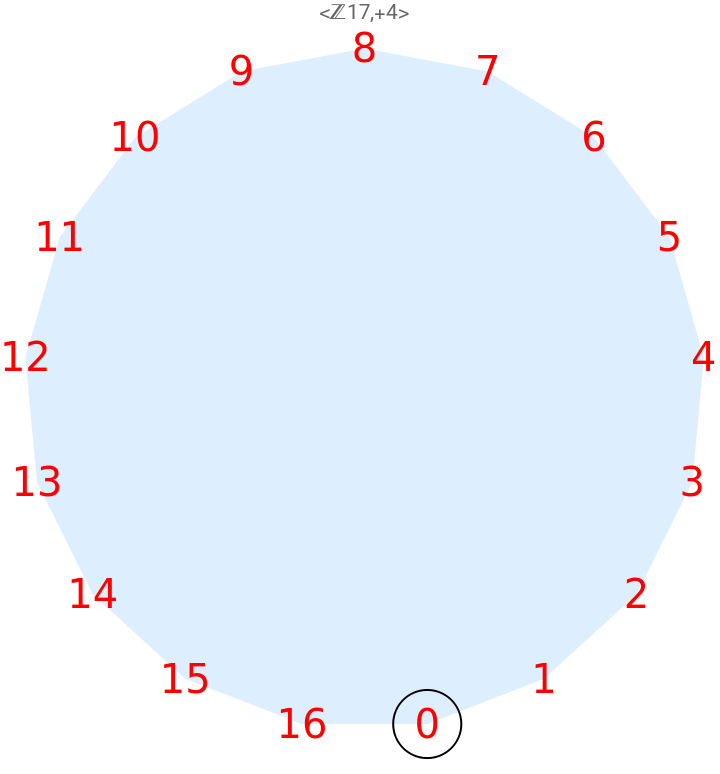
Since 17 is a prime number each of the elements in mod12 can be an add operation for traversing the elements.
Integers Modulo 4
Integers Modulo 4
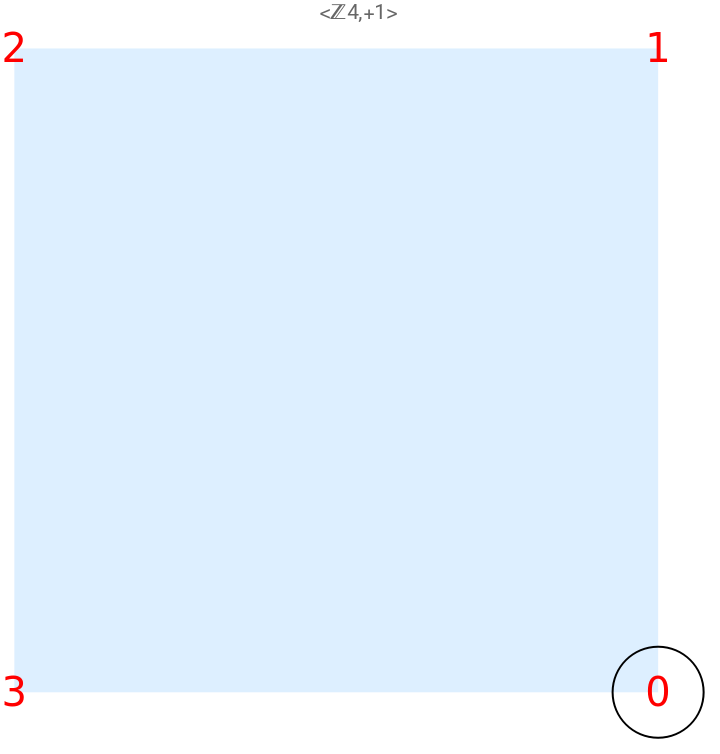
We see the integers module 4 with the addition operation has an isomorphism to the group of rotations of a square.
In[]:=
intmodn[4]
Out[]=
In[]:=
Table[Rotate[Show[Graphics[{LightBlue,RegularPolygon[4]}],Table[Graphics[Text[Style[n,20,Red],CirclePoints[4][[n+1]]]],{n,0,3}]],rot],{rot,{0,Pi/2,Pi,3*Pi/2}}]
Out[]=
,,,
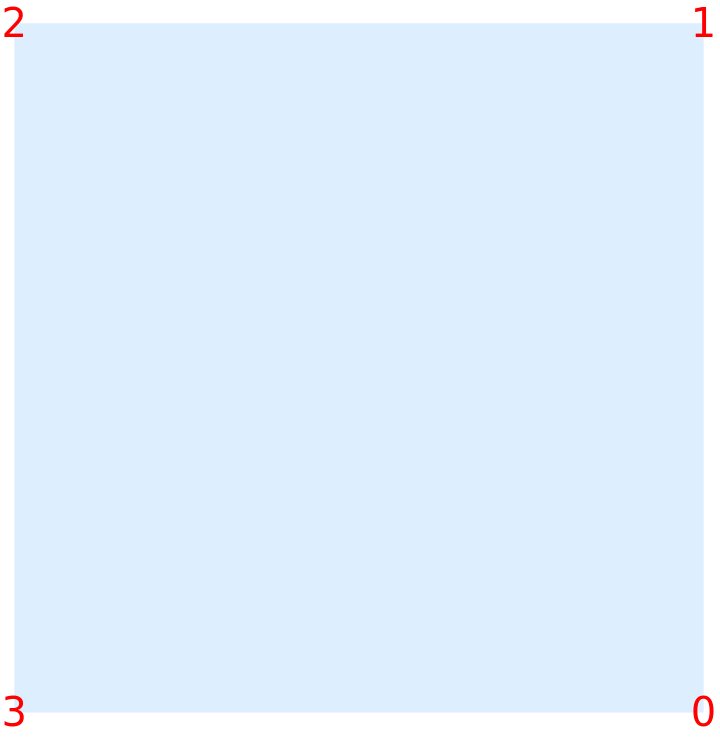
This is also generalizable to all the other n-sided polygons.
CITE THIS NOTEBOOK
CITE THIS NOTEBOOK
Visualization for the generators of the additive group of integers modulo n
by Arihant Gadgade
Wolfram Community, STAFF PICKS, October 13, 2024
https://community.wolfram.com/groups/-/m/t/3297140
by Arihant Gadgade
Wolfram Community, STAFF PICKS, October 13, 2024
https://community.wolfram.com/groups/-/m/t/3297140