Introduction
Introduction
In this notebook we apply different LLM prompts in order to comprehensively (and effectively) summarize large texts.
Remark: This notebook is intended to serve as a template for the initial versions of comprehensive text analyses.
Remark: I found an actual notebook template to be not that convenient.
Remark: All remarks in italics are supposed to be removed.
Ingestion
Ingestion
Remark: Chose whether to analyze a text from file or to analyze the transcript of a YouTube video.
Ingest text from a file:
In[]:=
(*url="https://raw.githubusercontent.com/antononcube/RakuForPrediction-blog/refs/heads/main/Data/Live-CEOing-Ep-886-Design-Review-of-LLMGraph.txt";txtFocus=Import[url];TextStats[txtFocus]*)
Ingest transcript of YouTube video:
In[]:=
txtFocus=ResourceFunction["YouTubeTranscript"]["ewU83vHwN8Y"];TextStats[txtFocus]
Out[]=
Characters35820,Words7082,Lines1043
Remark: The text ingested above is the transcript of the video "Live CEOing Ep 886: Design Review of LLMGraph".
Remark: The transcript of a YouTube video can be obtained in several ways:
- Use the Wolfram Function Repository function "YouTubeTranscript"
- Download the video or audio track and use the built-in function SpeechRecognize
- On macOS, download the audio track and use the program hear
- Use the Python package “pytube” (or “pytubefix”)
- Use the Wolfram Function Repository function "YouTubeTranscript"
- Download the video or audio track and use the built-in function SpeechRecognize
- On macOS, download the audio track and use the program hear
- Use the Python package “pytube” (or “pytubefix”)
Summary
Summary
Summarize the text:
In[]:=
LLMSynthesize[{LLMPrompt["Summarize"],txtFocus},LLMEvaluator->conf]//ResourceFunction["ImportMarkdownString"]
Out[]=
The text discusses the design review for version 14.3 of a language, focusing on an LLM (Large Language Model) graph feature that orchestrates LLM function calls to support complex workflows with asynchronous execution. The discussion covers the structure and functionality of LLM graphs, including inputs, conditions, and outputs, and explores the potential for integrating these concepts into graph evaluation frameworks. The conversation also touches on naming conventions, the possibility of listable functions, and the relationship between LLM functions and node functions within the graph system.
Tabulate topics
Tabulate topics
Extract and tabulate text topics:
In[]:=
tblThemes=LLMSynthesize[LLMPrompt["ThemeTableJSON"][txtFocus,"article",30],LLMEvaluator->conf];
In[]:=
GridTableFormFromJSON[tblThemes]
Out[]=
# | theme | content |
1 | Introduction | Introduction to the language design review for version 14.3, focusing on LLM graph for knitting together LLM calls to support complex workflows and asynchronous calls. |
2 | LLM Graph Overview | Discussion on LLM graph as an orchestrator of LLM calls, with examples and syntax for chaining and asynchronous application. |
3 | Graph Evaluation Consistency | Ensuring consistency with directed acyclic graph evaluation concepts, avoiding complex port concepts, and focusing on node dependencies. |
4 | Node Communication and Output | Nodes communicate via prompts, with outputs determined by terminal nodes. Discussion on handling multiple terminal nodes and output associations. |
5 | Complex Workflows and Evaluation | Examples of chaining and free-of-thought workflows, using different evaluators, and the importance of asynchronous code organization. |
6 | Graph Visualization and Design | Visualization of LLM graphs, ensuring compatibility with net graph and proof graph designs, and the importance of a consistent design language. |
7 | Advanced Features: Listability and Conditionals | Discussion on implementing listable templates and conditional nodes, enhancing functionality and performance of LLM graphs. |
8 | Function and Template Naming | Naming conventions for node functions, test functions, and LLM functions to avoid confusion and ensure clarity in graph design. |
9 | Asynchronous vs. Synchronous Execution | Exploration of LLM graph submit functionality for asynchronous execution and property extraction, contrasting static and dynamic information retrieval. |
10 | Conclusion and Next Steps | Final thoughts on LLM graph design, future work on semantic ranking, and ensuring alignment with existing graph evaluation and ranking functions. |
Mind-map
Mind-map
In[]:=
mmdBigPicture=LLMSynthesize[{LLMPrompt["CodeWriter"],"Create a concise Wolfram Language graph-based mind-map for the text:",txtFocus},LLMEvaluator->conf];TextStats[mmdBigPicture]
Out[]=
Characters1139,Words102,Lines37
Take graph edges and apply custom styling:
In[]:=
Graph[EdgeList[ToExpression[mmdBigPicture]],VertexLabels->"Name",VertexLabelStyle->Directive[Black,Italic,12],GraphLayout->{"LayeredEmbedding","Orientation"->Left},PlotTheme->"Web",ImageSize->600,ImagePadding->{{50,100},{10,10}}]
Out[]=
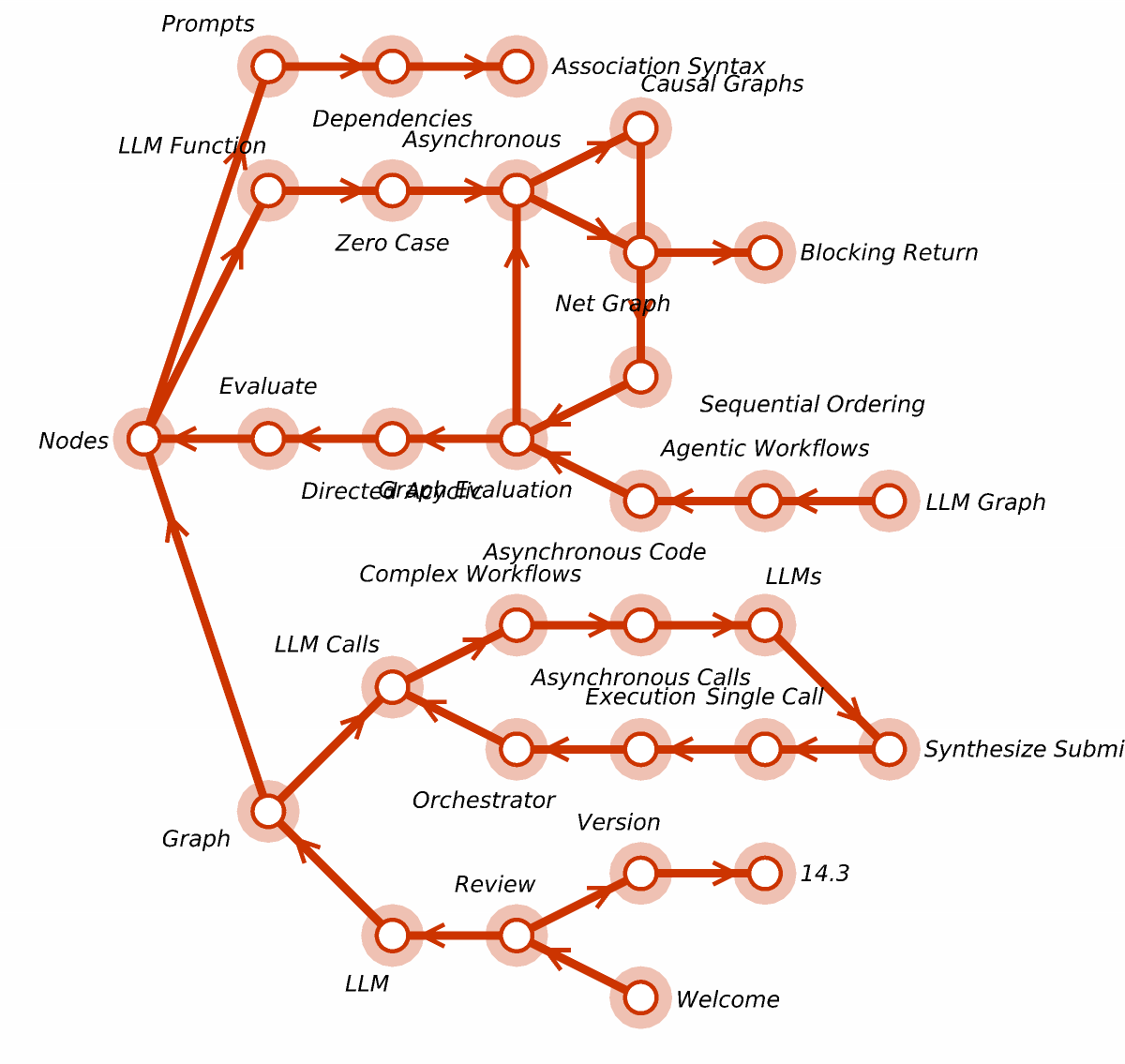
Mermaid-JS
Mermaid-JS
Sophisticated feedback
Sophisticated feedback
Give sophisticated feedback using different “idea hats”:
In[]:=
sophFeed=LLMSynthesize[LLMPrompt["SophisticatedFeedback"][txtFocus,"JSON"],LLMEvaluator->conf];TextStats[sophFeed]
Out[]=
Characters4898,Words621,Lines56
In[]:=
ResourceFunction["ImportMarkdownString"][DropFencedCode[sophFeed]]
Out[]=
Summary of the Idea:The discussion revolves around the design and implementation of a new feature called LLM Graph in version 14.3 of a language processing system. This feature is intended to orchestrate large language model (LLM) calls, allowing for more complex workflows and asynchronous execution. The LLM Graph acts as an orchestrator, knitting together various LLM function calls, enabling users to build complex workflows by chaining and branching LLM operations. The conversation covers various aspects of the design, including syntax, functionality, and potential improvements to the system's asynchronous framework.
In[]:=
GridTableFormFromJSON[FencedCode[sophFeed]]
Out[]=
# | hat | perspective | feedback | new_ideas |
1 | White Hat | Information and Facts | LLM Graph is a feature that organizes and orchestrates LLM calls into a directed acyclic graph (DAG) for complex workflows. It supports asynchronous execution, allowing nodes to communicate and depend on each other. The system uses templates and functions to define node operations. | Provide detailed documentation on LLM Graph's capabilities and limitations, create a visual guide for understanding DAGs in LLM Graph, develop tutorials for common use cases of LLM Graph. |
2 | Black Hat | Judgement and Caution | The complexity of managing asynchronous execution and ensuring consistency across various nodes could introduce bugs. The lack of clear error handling in the case of cyclic dependencies or failed nodes is a concern. | Implement robust error handling for cyclic dependencies, develop a testing framework to simulate and catch potential execution issues, create a logging system to track and debug node execution. |
3 | Gray Hat | Cynicism and Skepticism | This sounds like a fancy way to complicate LLM calls with added jargon. The promise of 'more complex workflows' might just be a way to mask inefficiencies in simpler systems. | Simplify the language used in explaining LLM Graph, provide a comparison with existing simpler alternatives, offer a 'quick start' mode for users who do not need complex workflows. |
4 | Red Hat | Feelings and Emotion | The idea of orchestrating LLM calls feels exciting and powerful. However, there's a lingering concern about usability for non-expert users. Will it be intuitive enough? | Design an intuitive user interface for LLM Graph, gather user feedback to improve the design and usability, create engaging learning materials to ease the onboarding process. |
5 | Yellow Hat | Benefits and Creativity | This could revolutionize how complex LLM workflows are managed, potentially leading to more efficient and innovative applications. The asynchronous nature could significantly enhance performance. | Explore integration with other systems for expanded functionality, develop use cases that demonstrate the creative potential of LLM Graph, investigate how LLM Graph can be used to optimize resource allocation. |
6 | Green Hat | Profitability and Potential | LLM Graph could open new revenue streams by offering premium features for complex workflow management. Its potential for improving efficiency could attract enterprise clients. | Offer LLM Graph as a premium feature in a subscription model, partner with businesses to develop custom solutions using LLM Graph, create a marketplace for pre-built LLM Graph templates. |
7 | Blue Hat | Usefulness and Opportunities | LLM Graph presents a useful tool for those needing complex workflow orchestration. It opens opportunities for more advanced LLM applications and could become an industry standard if executed well. | Identify industries that would benefit most from LLM Graph, develop partnerships with educational institutions to teach LLM Graph skills, create a certification program for LLM Graph proficiency. |
8 | Purple Hat | Assessment and Direction | The LLM Graph concept is promising, combining the strengths of asynchronous processing with complex workflow management. However, it requires careful implementation to ensure usability and reliability. | Prioritize user-friendly design and error handling in development, conduct pilot programs to refine the system based on real-world feedback, focus on scalability to accommodate future growth and complexity. |
Specific questions
Specific questions
Get answers to specific questions (if any.)
Structured
Structured
Remark: Instead of using the simple workflow above, more structured question-answer response can be obtained using the function LLMTextualAnswer of the paclet "NLPTemplateEngine".
Extracted wisdom or cynical insights
Extracted wisdom or cynical insights
Remark: Choose one of the prompts. “FindPropagandaMessage” tends to be more fun.
CITE THIS NOTEBOOK
CITE THIS NOTEBOOK
LLM comprehensive summary template for large texts
by Anton Antonov
Wolfram Community, STAFF PICKS, April 23, 2025
https://community.wolfram.com/groups/-/m/t/3448842
by Anton Antonov
Wolfram Community, STAFF PICKS, April 23, 2025
https://community.wolfram.com/groups/-/m/t/3448842