Analysis of the underlying polyhedron in the Conext21/Tsubasa football
by Philip Kuchel
School of Life and Environmental Sciences,
University of Sydney,
NSW 2006, Australia
by Philip Kuchel
School of Life and Environmental Sciences,
University of Sydney,
NSW 2006, Australia
Inspection of the seam-and-node structure of the football led me to the Small Rhombicuboctahedron, which was already in the PolyhedronData collection of Mathematica; but then it was clear that there was much more to this analysis...Here is the story and how it led to PolyhedronData["Conext21Polyhedron"] and Eric Weisstein's entry in Wolfram's MathWorld.
Geometrical dissection of the Conext 21 football
Geometrical dissection of the Conext 21 football
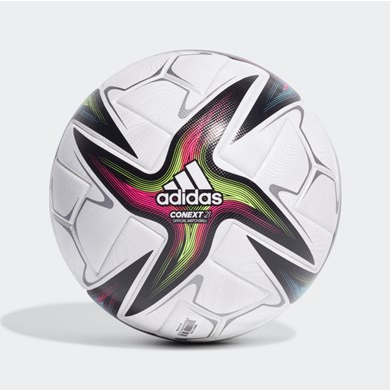
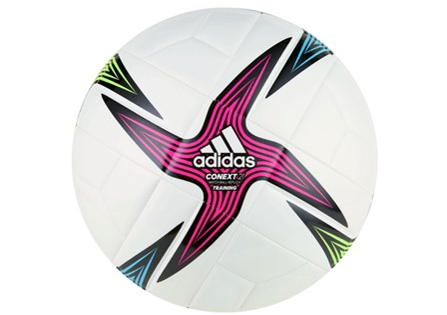
Match BallThe official Match Football of the 2020 Tokyo Olympic Games was the Adidas Conext 21 (also called Tsubasa). As with my previous “Football articles”[1 - 3], the aim was to identify and name the polyhedron that is formed by the intersections of its panels (faces), edges (seams or grooves), and intersection points of three or more panels (vertices) . The advertising description of its panel configuration states[4] : “Its interlinking panels represent the unity of football’s six continental federations.”To the footballing geometer “jumping to conclusions” (a sport in itself!) the claim of six panels might imply a cube as its underlying polyhedron, which is then inflated to form a sphere, as with Brazuca[2] . However, the situation with this particular football is much more complicated . It turns out to be a’ small rhombicuboctahedron’ that is embellished by subdivision of some of its panels, and reduced in panel-number by selective, symmetrical, elimination of edges, to become what is topologically a cube (another cube![3]) . FIGURE 1. Adidas Conext 21 Official Matchball; originally to be named Tsubasa for the 2020 Olympic Games held in Tokyo in 2021, but this was changed. In the centre of the image is a square bearing the maker's name and type designation. The peculiarly shaped moulded panels are evident. Practice or Replica BallFigure 1 shows Conext 21 with decals that emphasize one of its four 'propellers' with their 4-fold symmetry, and with 'triskelions' nestled between the blades of these interlocking structures. The whole ball is moulded with no stitched seams. However, "Replica" versions, as is shown in Figure 2, are also sold by Adidas [5]. This variant-design turns out to be useful for our geometrical analysis. FIGURE 2. Replica Adidas Conext 21 Training ball. Note the extra sewn seams that explicitly delineate the panels.
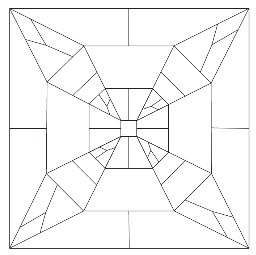
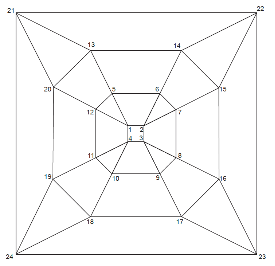
Schlegel DiagramsThe Replica version has more explicitly defined panels than the Matchball; it has 54 simpler panels compared with only 6 in the Matchball, albeit polygonal-edged, ones. How does this transformation come about? Well, the connectivities of sides (edges) of the polyhedral ‘net’ (or ‘graph’) of the Replica can be formally represented as a Schlegel diagram [1-7] as shown in Figure 3. Counting the features reveals 54 faces (F), 80 vertices (V), and 132 edges (E), that are consistent with Euler’s formula: V - E + F = 2. This configuration did not conform to any of the (then) 214 polyhedra listed in Mathematica’s PolyhedronData [8]. However, the Schlegel diagram reveals obvious subdomains in 12 of the 18 squares, and in each of the 8 triangles shown in Figure 4. This Schlegel diagram turns out to correspond to that of a small rhombicuboctahedron, which was readily summoned from Mathematica’s PolyhedronDatan which produced Figure 5. It has 24 vertices, 48 edges, and 26 faces, also consistent with Euler’s formula. FIGURE 3. Schlegel diagram of Replica Adidas Conext 21, Training ball (as shown in Figure 2). FIGURE 4. Schlegel diagram of Replica Adidas Conext 21 Training ball shown in Figure 2, but with the systematic removal of the subdivisions made by the seams in 12 squares and 8 triangles. The vertex numbers were assigned using a clockwise (left handed) convention, extending outwards in 4 layers from the centre.
Small Rhombicuboctahedron
Figure 5 shows the small rhombicuboctahedron. Topologically it is derived from a cube, not by slicing off its corners which generates a truncated cube, with alternating triangular and square faces, but by chamfering off each of the 8 edges. This produces three bands of 8 squares with 8 triangles filling in the spaces. In other words, we can focus on one band of 8 squares, that intersects with another band at right angles to it, which shares two squares with it, and so the band contributes 6 more squares; and then the third band at right angles to the other two contributes 4 new ones. Thus, by avoiding double counting of squares, we obtain the sum of 18 squares and 8 triangles.
Figure 5 shows the small rhombicuboctahedron. Topologically it is derived from a cube, not by slicing off its corners which generates a truncated cube, with alternating triangular and square faces, but by chamfering off each of the 8 edges. This produces three bands of 8 squares with 8 triangles filling in the spaces. In other words, we can focus on one band of 8 squares, that intersects with another band at right angles to it, which shares two squares with it, and so the band contributes 6 more squares; and then the third band at right angles to the other two contributes 4 new ones. Thus, by avoiding double counting of squares, we obtain the sum of 18 squares and 8 triangles.
In[]:=
Graphics3D[{Opacity[0.8],Glow[Green],EdgeForm[{Black,Thick}],PolyhedronData["SmallRhombicuboctahedron","Polygons"]},LightingNone,BoxStyleDirective[White,Dashed]]
Out[]=

FIGURE 5. Reconstruction of the 3D body shown in Figure 4; a small rhombicuboctahedron drawn with the Mathematica script above.
Aside: The appellation of ‘small’ rhombicuboctahedron implies that there is a ‘large one’ as well. In fact its correct name is ‘great’ rhombicuboctahedron; it is derived from a cube by taking smaller chamfers than for the ‘small’ version, thus generating octahedra on each of the original faces (6), while the faces generated at the corners are hexagons (8), with intervening squares on the edges (12). This is also available in Mathematica by evaluating PolyhedronData[“GreatRhombicuboctahedron”].
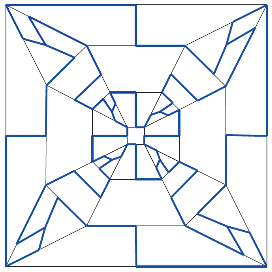
Seam Path or ConnectivityWe now return to the quest for assigning the name to the shape of the polyhedron underlying the Matchball. For this we modify Figure 3 by highlighting, in blue, only those seams that are actually moulded in the Matchball. This construction is shown in Figure 6. FIGURE 6. Blue lines pick out the Conext 21 Matchball (Figure 1) seams from the Schlegel diagram of the Replica ball shown in Figure 3.The numbering of the original small rhombicuboctahedron (Figure 4) was transferred to the Conext 21 system of grooves (edges) for use in the 'Graph' analysis in Mathematica, that is given below. But, first consider the original question. To identify the underlying polyhedron we need to locate the points at which three or more lines, representing edges, meet to form vertices. Hence, the red dotted lines in Figure 8, in effect, result from straightening out the polygonal edges. They join 8 points in a regular array, which is now readily seen to be the classical "picture frame" Schlegel diagram of a cube [3]. So the original aim has been realised: Conext 21 is topologically a cube.
Conclusion
In conclusion, the Schlegel diagram is a key object to be used when setting out to identify the underlying polyhedral symmetry in sports balls. In the present case of Conext 21 the Adidas designers would have begun with a computer graphic of a small rhombicuboctahedron, then subdivided the triangles into 3 quadrilaterals (as can be done for any triangle) and bisected those squares that share an edge with a triangle; there are 12 of these, in which the bisection is parallel to the edge with the triangle. On the other hand, 6 of the squares only contact a triangle at a vertex, and these were left unaltered. Then, seams were selectively and symmetrically removed to create tortuous polygonal edges leading to what became a cube. Such transformations are readily implemented to inflate to make a sphere, when the polyhedron is only moulded. However, if the inflated polyhedron is to be made from stitching panels together, then the edges are more easily handled as simple shapes; thus, the Replica football persists as a face-subdivided small rhombicuboctahedron. I wonder how many millions of spectators of football games all around the World know this underlying secret?!
A more general final point is that topological and differential-geometrical analysis of shapes like those discussed here, and in biology [e.g., 10], have been rendered much more accessible in recent years, thanks to Mathematica [8,9].
Finally, and satisfyingly, "closing this analysis", the specific elaboration of the SmallRhombicuboctahedron that gives rise to the Conext21 polyhedron is now described in Wolfram MathWorld [11].
References
1. P. W. Kuchel, Can you 'bend' a truncated octahedron? Math. Gaz. 91 (November 2007) pp. 533-536.
2. P. W. Kuchel, Can you 'bend' a truncated truncated tetrahedron? Math. Gaz. 96 (July 2012) pp. 317-323.
3. P. W. Kuchel, Kicking a cube. Math. Gaz. 99 (July 2015) pp. 346-347.
4. Conext 21 Authentic: https://www.adidas.com.au/conext-21-pro-ball/GK3488.html
5. Conext 21 Replica: https://www.adidas.com.au/conext-21-league-ball/GK3489.html
6. H. S. M. Coxeter, Introduction to Geometry (2nd edn.), John Wiley & Sons (1969).
7. H. M. Cundy and A. P. Rollett, Mathematical Models, Oxford University press (1972), Chap III.
8. S. Wolfram, Mathematica (Version 12.0), Wolfram Research, Inc., (2019).
9. S. Wolfram, An Elementary Introduction to the Wolfram Language (2nd edn.), Wolfram Media, Inc. (2017).
10. P. W. Kuchel, C. D. Cox, D. Daners, D. Shishmarev and P. Galvosas, Surface model of the human red blood cell simulating changes in membrane curvature under strain, Sci. Rep. 1 13112, (2021) 1-18.
11. Weisstein, E. (2022) https://mathworld.wolfram.com/Conext21Polyhedron.html
APPENDICES
APPENDICES
Notebook#1 Football Graphs
Notebook#1 Football Graphs
Exploration of Mathematica's graphing functionality in the context of understanding and demonstrating the subgraphs of Conext21
Exploration of Mathematica's graphing functionality in the context of understanding and demonstrating the subgraphs of Conext21
Inspection of Conext21 showed it to be based on a Small Rhombicoctahedron ... but there were "elaborations" to consider . The Net in Mathematica was a good starting point for constructing the Graph and interpolating new nodes to make the polyhedron have the nodes and edges of the football.
First, check the features of "SmallRhombicuboctahedron" in PolyhedronData
Use a hard copy of the Net to apply a numbering system and then Graph this using the node connectivity syntax
In[]:=
Scramble the ordering of the nodes to obtain different orientations of the Net in apparent 3 -space
Explore the capability for finding the shortest path between two specified nodes in the Graph...use the first depiction above, rhoCubOct1
Swap edges and observe the result
Conclusion: The geometrical behaviour of the Net is consistent throughout various mathematical manipulations, thus implying that the Graph can now be extended to include the sub-division of selected ‘faces’ to make the overall structure congruent with Conext21
Notebook #2 "It is a cube!"
Notebook #2 "It is a cube!"
Small rhombicuboctahedron: The numbering scheme for the vertices was carried over to the complete geometrical dissection of the ‘Replica Connext21/Tsubasa’ and the ‘Authentic’ version as well...see the manuscript for what I mean by these terms
Small rhombicuboctahedron. The numbering sequence has been retained but the position in the Graph List is changed to give a different perspective on the graph/net for the Replica Connext21/Replica Tsubasa dissection
Small rhombicuboctahedron. Selected subsets of the graph of Replica Connext21/Replica Tsubasa
Small rhombicuboctahedron but with subdivision of the faces according to the Replica Connext21/Replica Tsubasa sheme. The numbering scheme for the vertices is carried over from the small rhombicocuboctahedron
Graph of the authentic Connext21/Tsubasa polyhedron. Note that it has the symmetry of a cube with 6 faces 12 edges and 8 vertices
Notebook #3 Eric Weisstein’s MathWorld entry
Notebook #3 Eric Weisstein’s MathWorld entry