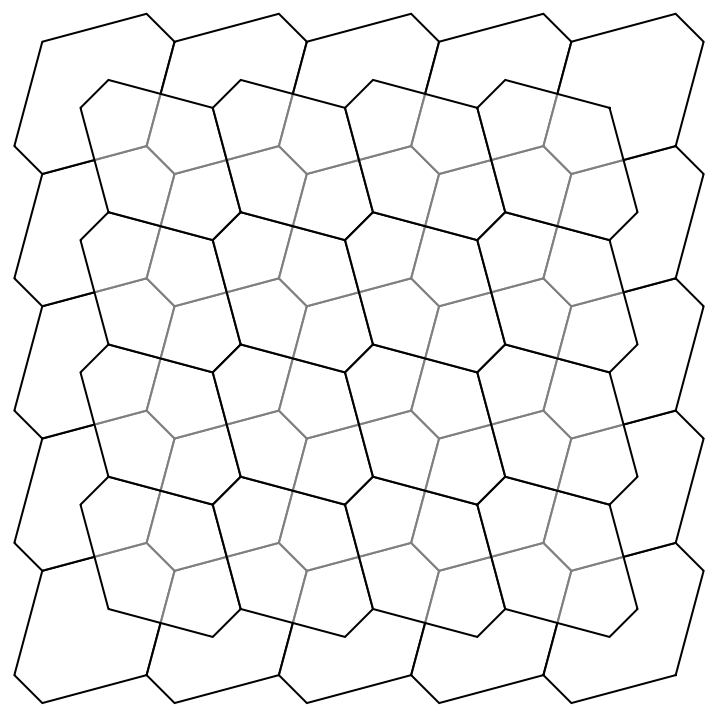
At Quanta Magazine, a recent article talked about “spherical cubes”, which are objects that fill a square lattice with minimal perimeter or surface area. In 2D, Jaigyoung Choe apparently found the minimal solution. Unfortunately, the paper they discuss doesn’t give a picture of the 3D case, and doesn’t offer an exact solution of the 2D case.
A bit of tinkering and I determined the vertices of the hexagon had these coordinates:
In[]:=
vv={{1-x,-1+x},{x,1-x},{1-x,x},{-1+x,1-x},{-x,-1+x},{-1+x,-x}};
So we can get the perimeter:
In[]:=
perimeter=Total[ResourceFunction["RealEuclideanDistance"]@@#&/@Partition[vv,2,1,1]]
Out[]=
2++2++2+
2
(1-2x)
2
(-2+2x)
2
(1-2x)
2
(-1+2x)
2
(2-2x)
2
(-1+2x)
And then plot the perimeter:
In[]:=
Plot[perimeter,{x,.5,.7}]
Out[]=
And the solution immediately follows. Was so complicated that they had to approximate it?
2
+6
In[]:=
Simplify[Minimize[perimeter,x]]
Out[]=
(9-
2
+6
,x1
12
3
)In[]:=
N[%]
Out[]=
{3.8637,{x0.605662}}
So now we can use exact tiles for Choe’s irregular hexagon:
In[]:=
choe=vv/.x9-
1
12
3
;In[]:=
Graphics[{EdgeForm[Black],White,Table[Polygon[{a,b}+#&/@choe],{a,0,4},{b,0,4}]}]
Out[]=
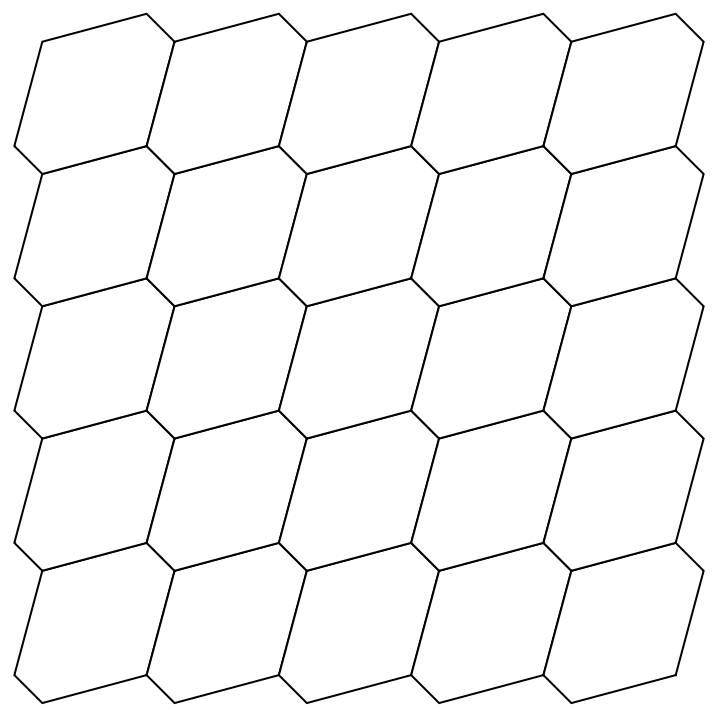
These hexagons can be seen in the Cairo tessellation. Thus, it turns out that Choe’s irregular hexagon has been known for awhile as a solution for a different problem.
In[]:=
Graphics[{EdgeForm[Black],Opacity[.5],White,Table[Polygon[{a,b}+#&/@choe],{a,0,4},{b,0,4}],Table[Polygon[{a,b}+{#[[1]],-#[[2]]}&/@choe],{a,1/2,4,1},{b,1/2,4,1}]}]
Out[]=